Pallet size affects container utilization by changing floor positions, cases per pallet, stack height, and gross weight. It affects landed cost because these choices change how many saleable units share the fixed or semi-fixed cost of each shipment.
A smaller footprint is not automatically cheaper. The best size is the one that moves the most undamaged, receiver-approved product—not simply the most pallets. This guide shows how to compare 20ft, 40ft, and 40HQ capacity, calculate the cost effect, and evaluate a nestable export pallet.
Quick Answer: Pallet footprint controls the first layer of container capacity; the product pattern and loaded height control how much cargo each position carries; payload and handling rules set the final limit. For identical loads, moving from 20 to 21 usable pallet positions cuts the fixed container cost allocated to each position by 4.8%. If the smaller pallet holds fewer products, however, that saving can disappear.
What Does Container Utilization Actually Measure?
Container utilization is not one percentage. A reliable loading plan checks floor space, cubic space, payload, and saleable units separately because any one of them can become the limiting factor.
| Utilization Measure | Calculation | What It Reveals |
|---|---|---|
| Floor-space utilization | Total loaded-unit footprint ÷ usable container floor area × 100 | Whether pallet dimensions and loading orientation use the floor efficiently |
| Cube utilization | Total external loaded-unit volume ÷ usable container volume × 100 | Whether pallet height, partial layers, and non-stackable cargo waste vertical space |
| Payload utilization | Total cargo gross weight ÷ permitted container payload × 100 | Whether the shipment weighs out before it cubes out |
| Saleable-unit utilization | Saleable products loaded or received per container | Whether a higher pallet count actually moves more revenue-producing product |
The fourth measure is usually the best commercial KPI. A loading plan can show a high floor percentage while carrying fewer cases because the carton-to-pallet pattern wastes deck space or the cargo cannot use the available height.
Use the lowest valid result from the three physical limits:
Final Planned Quantity = Minimum Of Floor-Fit Capacity, Height-Approved Capacity, Payload Capacity, And Operational Capacity
“Operational capacity” accounts for door passage, forklift access, dunnage, load securing, loading sequence, and safe unloading. It is the reason a mathematical maximum is not automatically a bookable quantity.
How Many Pallets Fit In A 20ft, 40ft, Or 40HQ Container?
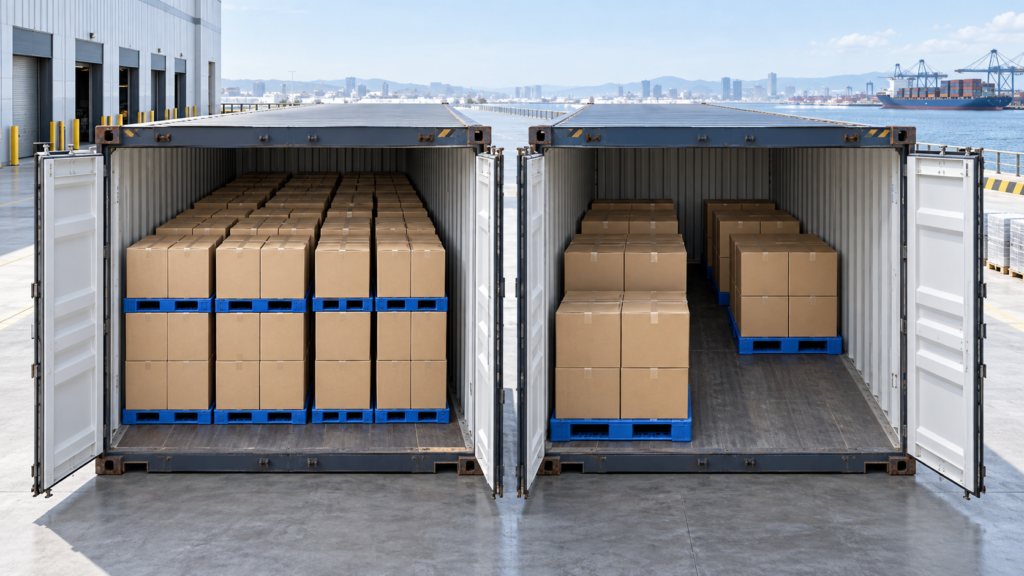
A practical starting range is 11 Euro pallets or 9–10 industrial pallets in a 20ft container, and 24–25 Euro pallets or 20–21 industrial pallets in a 40ft container. A 40HQ normally has the same floor positions as a 40GP because its main advantage is extra height, not extra floor length or width.
Reference Container Dimensions
Hapag-Lloyd’s example equipment specifications show why the assigned container must be checked. The carrier notes that dimensions vary by manufacturer.
| Container Type | Example Usable Internal Dimensions (L × W × H) | Example Door Opening (W × H) | Example Maximum Payload |
|---|---|---|---|
| 20ft General Purpose | 5,900 × 2,352 × 2,395 mm | 2,340 × 2,292 mm | 28,130 kg |
| 40ft General Purpose | 12,032 × 2,352 × 2,395 mm | 2,340 × 2,292 mm | 28,750 kg |
| 40ft High Cube | 12,032 × 2,350 × 2,700 mm | 2,340 × 2,597 mm | 28,600 kg |
Typical Pallet Capacity By Footprint
The table below gives single-floor planning references with no cargo overhang. MSC publishes 11 and 24–25 positions for 1200 × 800 mm pallets and 9–10 and 20–21 for 1200 × 1000 mm pallets in 20ft and 40ft equipment.
The Transport Information Service stowage guide also shows that the pattern and four-way entry affect the maximum.
| Pallet Footprint | Common Description | 20GP Planning Count | 40GP Planning Count | 40HQ Floor Count | Main Qualification |
|---|---|---|---|---|---|
| 1200 × 800 mm | Euro footprint | 10–11 | 24–25 | 24–25 | The 25-position 40ft pattern can be extremely tight |
| 1200 × 1000 mm | Industrial / UK footprint | 9–10 | 20–21 | 20–21 | Some geometric layouts show 22, but working clearance may remove a position |
| 1219.2 × 1016 mm | 48 × 40 in GMA footprint | About 9–10 | About 20 | About 20 | It is not dimensionally identical to 1200 × 1000 mm |
| 1100 × 1100 mm | Asian square footprint | 10 | 20 | 20 | Two nominal pallets use 2,200 mm of container width |
| 1140 × 1140 mm | ISO square footprint | 10 | 20 | 20 | Two nominal pallets use 2,280 mm; door and load tolerances are critical |
These are planning figures, not loading guarantees. The recognized footprints in ISO 6780 provide principal pallet dimensions and tolerances, but they do not certify a particular container layout.
A detailed standard pallet size chart can help shortlist the regional footprint before the loaded-unit study begins.
For teams asking how many 48 × 40 pallets fit in a 40ft shipping container, about 20 is a sensible first estimate. Keep the calculation in exact millimetres: silently replacing 1219.2 × 1016 mm with 1200 × 1000 mm can create clearance that does not exist.
Which Limit Stops A Container From Taking More Pallets?
The first limit depends on the product. Lightweight consumer goods often cube out, dense bags or liquids may weigh out, and awkward unit loads can fail at the door or handling stage before either published capacity is reached.
Floor Space And Loading Pattern
A rows-times-columns calculation works only for one uniform orientation. Mixed and pinwheel pallet loading can use residual strips, but the pallet must be accessible from the required direction and the loading equipment must be able to place the last positions.
The difference between theory and practice can be only a few millimetres. Twelve 1,000 mm increments use 12,000 mm of a 12,032 mm example interior, leaving 32 mm before container variation, pallet tolerance, load bulge, and working clearance are considered.
Height And Door Clearance
Use the smaller of internal height and clear door height, then reserve the space needed to lift and move the load. A 40HQ can carry more product only when the extra height unlocks another case layer, another safe unit-load tier, or a taller empty-pallet stack.
Geometric height does not prove stackability. The lower packaging, pallet, load distribution, temperature, dwell time, and restraint method must all support the upper tier without unacceptable compression or deflection.
Payload And Weight Distribution
Payload can erase the benefit of extra floor positions. With the 28,750 kg example payload above, 25 positions allow an average gross load of 1,150 kg per position, while 20 positions allow 1,437.5 kg before other route limits are applied.
If each loaded pallet weighs 1,400 kg, payload permits only floor(28,750 ÷ 1,400) = 20 pallets. The container can still have empty floor space. Container, chassis, road, axle, and route restrictions may impose a lower limit than the plate value.
Securing And Unloading
A tight layout still needs a safe restraint plan. The IMO/ILO/UNECE CTU Code covers cargo distribution, support, and securing throughout the intermodal route. Space for dunnage, blocking, lashings, or unloading access is working space, not automatically wasted space.
Base design matters here. A four-way forklift pallet may enable a rotated pattern, while runner or foot geometry can still block a hand pallet truck from the same direction. Validate both loading and receiving equipment before approving the higher count.
How Does Pallet Size Change Landed Cost Per Unit?
Pallet size mainly changes landed cost by altering the number of saleable units that share shipment-level costs. It can also change pallet purchase cost, packaging labor, cargo damage, destination handling, storage, and repalletizing.
Landed Cost Formula
The U.S. International Trade Administration defines landed cost as the product price plus freight, insurance, tariffs, taxes, and other fees. Its guidance also warns that landed cost should be treated as an estimate because tariff rules and additional charges can change.
Estimated Landed Cost Per Saleable Unit = (Goods + Pallets And Packing + Origin Charges + Freight + Insurance + Duties And Taxes + Destination Charges + Inland Delivery + Expected Damage Or Rework) ÷ Saleable Units Received
Use the Incoterm and the destination’s customs rules to decide which party pays each line and how duties or taxes are assessed. Pallet size does not change the tariff rate by itself, but freight and packing may form part of the customs value in some markets.
FCL Vs LCL Cost Allocation
For FCL shipping, much of the transport cost is charged per container, so utilization changes the allocation per unit.
For LCL shipping, the external palletized volume can affect the bill directly. DHL explains that LCL ocean chargeable weight compares volume and gross weight, while FCL uses a per-container charge.
What Is One Extra Pallet Position Worth?
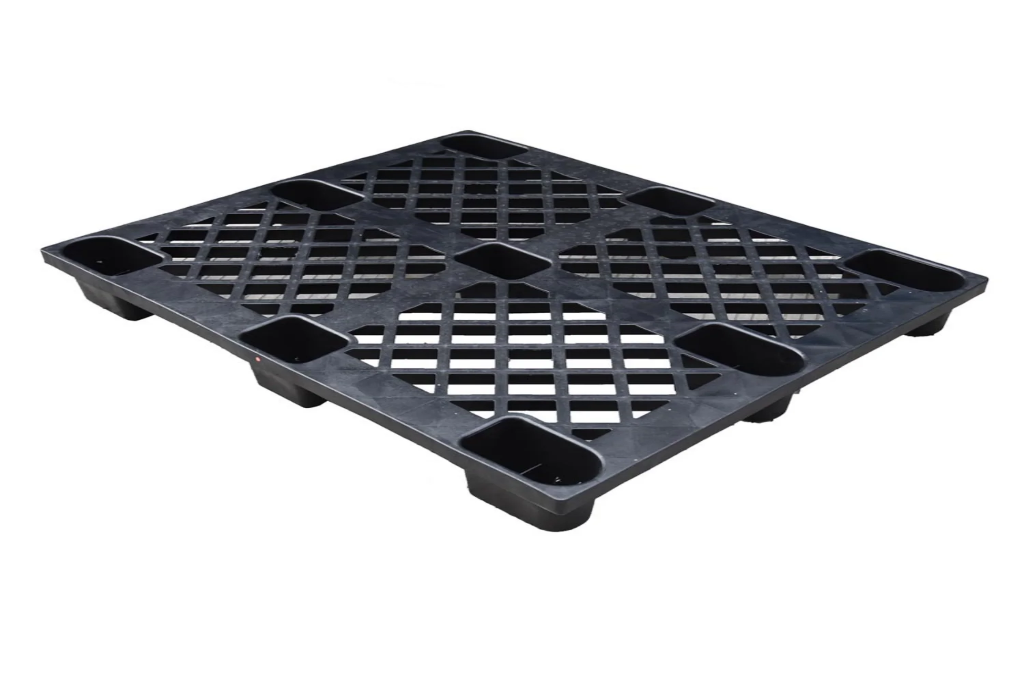
If every pallet carries the same quantity and the container-level cost stays fixed, the saving can be calculated without assuming a freight rate.
| Change In Usable Positions | Increase In Load Quantity | Reduction In Fixed Cost Per Position |
|---|---|---|
| 9 → 10 | 11.1% | 10.0% |
| 10 → 11 | 10.0% | 9.1% |
| 20 → 21 | 5.0% | 4.8% |
| 24 → 25 | 4.2% | 4.0% |
The calculation is valid only when products per pallet, rejection rate, and shipment-level cost remain equal. When pallet capacities differ, compare total saleable units instead.
Worked Export Case: 1200 × 800 Vs 1200 × 1000 Pallets
Case Assumptions
In this illustrative calculation, a production trial has already confirmed 25 Euro-footprint loads or 20 industrial-footprint loads in the assigned 40GP. The same SKU and loaded height are used, but the approved carton patterns differ.
Assume a product cost of $20 per saleable case, $18 of pallet-and-securing cost per load, and $6,000 of container-level logistics. Duty and tax are excluded so the example isolates the pallet-driven difference; they must be added under the actual import rules.
| Calculation | 1200 × 800 mm | 1200 × 1000 mm |
|---|---|---|
| Validated floor positions | 25 | 20 |
| Approved cases per pallet | 40 | 45 |
| Saleable cases per container | 1,000 | 900 |
| Goods value | $20,000 | $18,000 |
| Pallets and securing | $450 | $360 |
| Container-level logistics | $6,000 | $6,000 |
| Delivered total before duty/tax | $26,450 | $24,360 |
| Fixed logistics per case | $6.00 | $6.67 |
| Delivered cost before duty/tax per case | $26.45 | $27.07 |
Case Result And Sensitivity
In this case, the Euro pallet moves 11.1% more cases and lowers the pre-duty delivered cost by about $0.62 per case, or 2.3%. The $6,000 freight pool did not change; the denominator did.
Now change one assumption. If the 1200 × 1000 mm pallet carries 50 cases instead of 45, both options move 1,000 cases. At the assumed $18 per load, the 20-pallet option then uses $90 less pallet and securing cost. This is why a pallet-count comparison must never replace a carton-pattern study.
Nestable Export Pallet Case: How Empty-Pallet Density Cuts Freight Cost
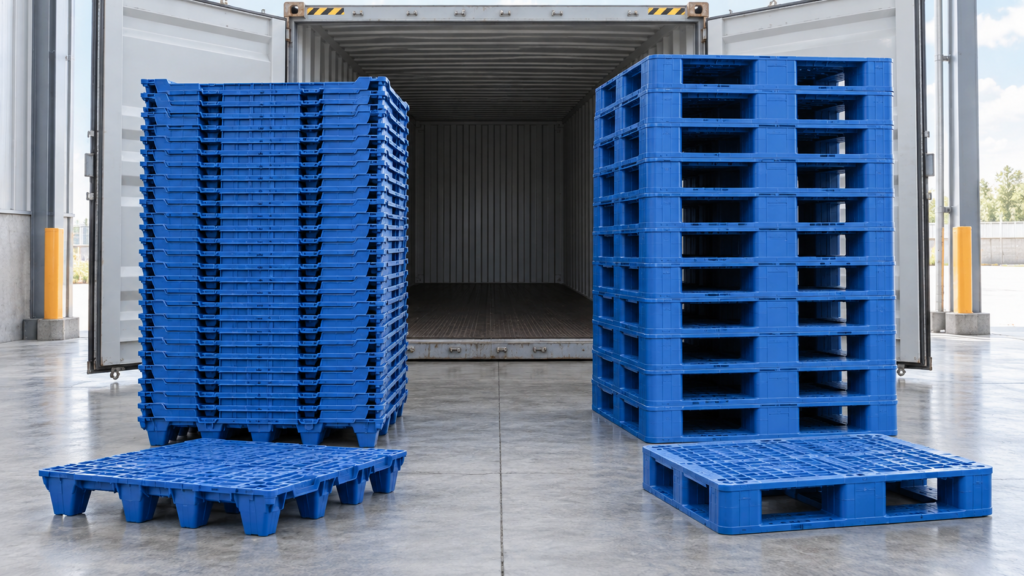
Why Nesting Changes Empty-Pallet Economics
Nestability reduces the cost of moving empty pallets, not the floor footprint of a pallet carrying cargo. A nine-leg pallet and a runner pallet of the same length and width normally occupy the same loaded floor position.
The useful nesting specification is the nesting increment: the height added by each pallet after the first. A percentage such as “75% space saving” is difficult to audit unless the first-pallet height, increment, quantity, and total stack height are also stated.
Nested Stack Height = First-Pallet Height + (Quantity − 1) × Nesting Increment
Reproducible Nesting Calculation
Consider an illustrative 1200 × 1000 mm empty export pallet with a 140 mm first height and a verified 45 mm nesting increment. Assume 20 floor stacks, 100 mm working clearance below the door, and $4,500 of container-level inbound logistics.
| Calculation | 40GP | 40HQ |
|---|---|---|
| Example clear door height | 2,292 mm | 2,597 mm |
| Available stack height after 100 mm allowance | 2,192 mm | 2,497 mm |
| Nestable pallets per stack | 46 | 53 |
| Non-nestable 140 mm pallets per stack | 15 | 17 |
| Total at 20 validated floor stacks: nestable | 920 | 1,060 |
| Total at 20 validated floor stacks: non-nestable | 300 | 340 |
| Logistics allocation per nestable pallet | $4.89 | $4.25 |
| Logistics allocation per non-nestable pallet | $15.00 | $13.24 |
What The Result Means
Under these assumptions, nesting lowers the 40GP transport allocation per empty pallet by about 67.4%. This is not a universal loading claim: stack count, stack weight, stability, restraint, packaging, pallet tolerance, and actual equipment can lower the result.
For a real comparison, request a model drawing and measured stack data from the nestable plastic pallet range.
The fuller guide to choosing a nestable export pallet explains where nine-leg designs fit and where runner support is safer.
What Should You Verify Before Approving The Pallet And Loading Plan?
Approve the pallet, packaging, container, and destination interfaces as one system. The following RFQ inputs allow standard one-way export plastic pallets and a custom option to be compared on landed cost rather than unit price alone.
| RFQ Area | Information To Provide Or Request |
|---|---|
| Product and packaging | Maximum carton, bag, drum, or component dimensions; unit weight; quantity; rigidity; load distribution; allowable overhang |
| Unit load | Maximum wrapped L × W × H; gross weight; products per layer; number of layers; approved pallet tiers |
| Pallet | Footprint, height, tolerance, tare, deck and base design, entry directions, material, static and dynamic conditions |
| Container and route | 20GP, 40GP, or 40HQ; minimum internal and door dimensions; payload; origin, destination, and Incoterm |
| Handling and storage | Forklift and pallet-jack details; floor, conveyor, rack, or block-stack support; loading and unloading sequence |
| Empty-pallet logistics | First-pallet height, nesting increment, units per safe stack, stack weight, restraint, and return ratio |
| Cost model | Pallet and packing cost, FCL or LCL charges, duties and taxes, destination handling, repalletizing, damage, and annual volume |
| Approval evidence | Dimensioned drawing, model-specific load basis, loading diagram, production-intent sample, and trial record |
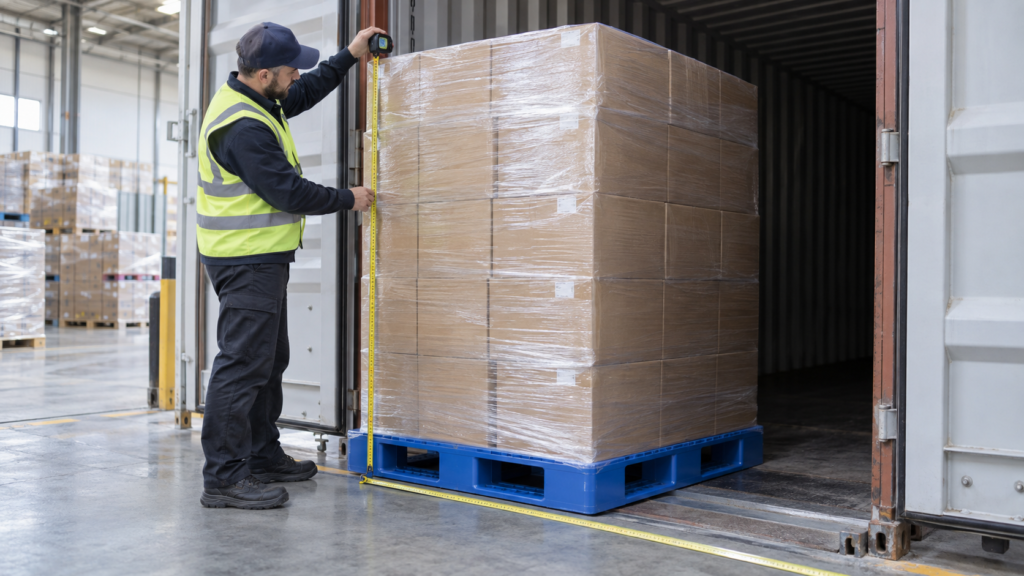
Before volume approval, measure the widest wrapped load and run a physical trial with the assigned equipment. If the container transfers to a domestic trailer, compare the onward route with the separate truck pallet capacity guide rather than assuming the ocean pattern will transfer unchanged.
A strong loading proposal should show a repeatable working count and a clearly labeled geometric maximum. It should also state the assumptions that would reduce capacity, so the quotation, packing list, and warehouse plan use the same number.
Frequently Asked Questions
Do Plastic Export Pallets Need ISPM 15 Treatment?
ISPM 15 regulates specified wood packaging rather than plastic pallets; for the United States, USDA APHIS lists plastic pallets among products not subject to its wood-packaging regulation. Confirm the destination’s cleanliness, material, cargo, and industry rules separately.
Can A Nestable Plastic Pallet Be Used In Beam Racking?
Only when the exact model has a verified rating for the beam span, support direction, payload, temperature, and dwell time. A typical nine-leg export pallet should not be assumed rackable from its static or dynamic rating.
Does Pallet Tare Weight Change Ocean Freight Cost?
An FCL rate may not change while the shipment remains within its limits, but pallet tare consumes payload and can reduce saleable cargo in a weight-limited load. It can also affect LCL, airfreight, handling, and inland weight charges.
Should Pallet And Packing Cost Be Included In Customs Value?
The answer depends on the importing jurisdiction and transaction; for example, U.S. CBP states that certain packing costs form part of transaction value while international freight and insurance are generally excluded. Use the actual Incoterm and obtain a customs broker’s ruling for the shipment.
Can Mixed Pallet Sizes Improve Container Utilization?
Sometimes. A mixed-size plan can fill residual space, but it needs a dimensioned loading sequence, weight-distribution check, securement plan, and receiving method rather than a simple area calculation.
Is A Pallet-Wide Container Always More Economical?
No. Pallet-wide equipment can add floor positions on supported lanes, but the freight rate, equipment availability, port coverage, inland compatibility, and repositioning cost must be compared with the extra saleable units.
Can A 1200 × 800 Pallet Replace A 48 × 40 Pallet At Destination?
Only when the receiver approves the footprint, load pattern, rack or conveyor interface, and handling equipment. Better ocean utilization does not compensate for repalletizing, rejection, or automation stoppages after arrival.
Final Thoughts
The right pallet size is the footprint and structure that delivers the lowest landed cost per saleable unit while remaining compatible with the product, container, payload, handling equipment, and receiving site. Optimize the carton pattern and loaded envelope first; then compare pallet positions, empty-pallet density, and price.
Preface Plast manufactures standard and custom plastic pallets for international shipping, warehousing, and automated logistics. The team can compare 1200 × 800, 1200 × 1000, 1100 × 1100, 48 × 40 in, and OEM/ODM options around the actual route.
Send your product pattern, maximum loaded dimensions, gross weight, container type, destination, handling method, nesting requirement, annual volume, and cost target. Preface Plast can develop a model-level loading proposal that reduces trial-and-error cost and supports stable long-term supply.