
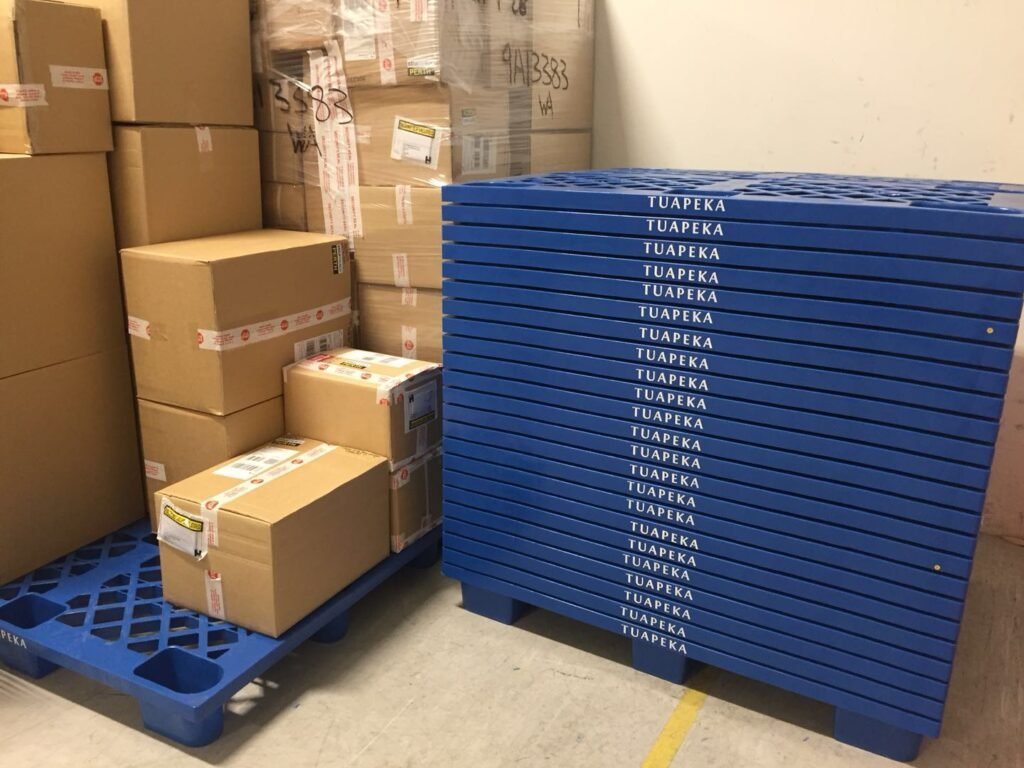
The right export pallets are not simply the lightest or least expensive models. For many one-way shipments, nestable plastic pallets for export reduce empty volume and avoid the treatment rules applied to solid wood packaging. The final choice still has to match your load, destination, equipment, storage method, and landed-cost target.
This guide helps you turn those route details into a specification you can quote, test, and approve.
When Should You Choose Nestable Export Plastic Pallets?
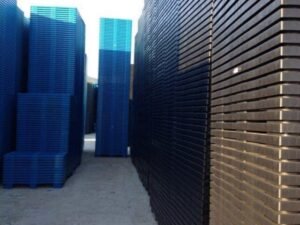
Choose a nestable design when the pallet travels one way, waits empty at destination, or returns without a load. Its feet fit into the unit below, reducing empty-stack height. Use the nestable plastic pallet range to compare footprints for staging, container loading, storage, and reverse logistics.
This structure fits best when empty pallets accumulate at a warehouse or distribution point, tare weight affects freight cost, and handling stays on floors, vehicle decks, forklifts, or approved conveyors. It is less suitable when the loaded pallet must span unsupported rack beams.
The same design is not automatically suitable for every stage. A nine-leg pallet that performs well on a flat floor can deflect when only two rack beams support it. If the receiving site uses open racking, ask for a rackable model, approved support decking, or tested runners instead of relying on a static load figure.
How Do One-Way, Nestable, Stackable, And Rackable Pallets Differ?
The route—not the product label—should decide the structure. One way plastic pallets are not expected to return, but the term does not describe one universal design or strength level.
The term disposable plastic pallets is also common. Disposal should not be the default when a unit can be inspected, reused, or recycled safely at destination.
| Pallet Design | Best Fit | Main Advantage | Main Check Before Approval |
|---|---|---|---|
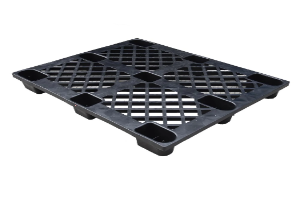
| Nestable export pallet | One-way export, retail delivery, empty return | Reduces empty stack volume | Pallet-jack access, nesting increment, and rack limitations |
| Stackable pallet | Loaded floor stacking and repeated transport | Stable base under loaded pallets | Empty-stack height and runner compatibility |
| Rackable pallet | Beam racks, high-bay storage, heavier repeat use | Controls deflection across a defined span | Rated load, span, direction, temperature, and dwell time |
| Reusable distribution pallet | Closed loops between known sites | Longer service life and consistent interfaces | Tracking, loss rate, cleaning, and return cost |
A low-cost nestable pallet is often the correct choice for a one-way carton load. It is usually the wrong choice when the loaded unit must sit in unsupported racking for weeks. Adding clip-on or molded runners may improve stability and conveyor contact, but it also changes pallet weight, nesting, price, and recyclability.
What Information Should You Define Before Requesting A Quote?
A useful quotation starts with the complete unit load. Before comparing pallets for shipping, provide the product and packaging, total loaded weight, load pattern, point loads, center of gravity, and any overhang. Sending only a footprint and target price encourages assumptions, and those assumptions become expensive after production.
Next, map the entire route: origin, destination, transport modes, transfers, floor storage, forklifts, pallet jacks, conveyors, rack beams, and loaded stacking. Temperature, outdoor exposure, chemicals, cleaning, storage duration, fork clearance, and the receiving site’s dimensional rules can all change the correct structure or resin.
Finish with quantity, delivery schedule, packing, Incoterm, inspection, and end-of-life plan. These inputs let weight, ribs, feet, material, and price be selected together; removing resin may lower tare weight but can also reduce stiffness or impact margin when the structure is not redesigned.
Which Export Pallet Size Fits Your Route?
Use the footprint already accepted by the destination and handling network unless a container study proves that another size creates a worthwhile saving. ISO 6780 covers principal dimensions and tolerances for intercontinental flat pallets, but a recognized footprint still needs to fit your packages, equipment, and receiver.
| Common Footprint | Practical Starting Market Or Use | Questions To Resolve |
|---|---|---|
| 1200 × 800 mm | European retail and distribution networks | Does the receiver require this exact footprint and entry geometry? |
| 1200 × 1000 mm | General industrial and international distribution | Does the package pattern use the full deck without overhang? |
| 1219 × 1016 mm (48 × 40 in) | North American distribution | Will the pallet work with local pallet jacks, racks, and dock equipment? |
| 1100 × 1100 mm | Selected Asian routes, bags, drums, and FIBCs | Are deck support and container orientation suitable for the load? |
| 800 × 600 mm | Half-pallet, display, parcel, and selected postal flows | Will the smaller footprint reduce unused space without creating instability? |
Nominal size is only the first check. Height, fork openings, foot position, deck, and tolerance determine equipment fit. For a European route, a 1200 × 800 mm Euro plastic pallet can frame the compatibility discussion; automation still requires a production trial.
A 1200 × 1000 mm plastic shipping pallet provides a comparison when the route needs runners rather than the lightest nestable base. Use the full product catalog to narrow alternatives by footprint and structure.
How Should You Verify Load Capacity?
Treat every load rating as conditional. Static, dynamic, and racking capacities describe different support conditions, so the largest number on a data sheet is rarely the number that controls an export route.
| Rating | Support Condition | Why It Matters To Your Shipment |
|---|---|---|
| Static load | Pallet rests on a flat, solid floor | Relevant to stationary floor storage and loaded stacking |
| Dynamic load | Pallet is lifted and moved | Relevant to forklifts, pallet jacks, impacts, and transfers |
| Racking load | Pallet spans defined beams or rails | Relevant only when tested for the actual span and support direction |
Ask for the test method and conditions behind the rating: payload distribution, support points, temperature, test duration, deflection limit, and safety criteria. Cartons spread weight differently from drums, coils, machinery feet, or flexible bulk bags. Cold resin behavior and long storage time can also change the result.
Before a bulk order, test a production-intent sample with the real load, restraint method, forks, pallet jack, rack, and conveyor. A sample that only carries sandbags on a floor does not validate the complete handling route.
Which Material Is Right For Plastic Pallets For Export?

Material selection is a balance between impact behavior, stiffness, temperature, consistency, hygiene, recycled content, and cost. HDPE is often selected where impact and lower-temperature handling matter, while PP can provide useful stiffness in suitable temperature ranges. The finished pallet design and verified test result matter more than the resin name alone.
Recycled plastic pallets can be an effective option for cost-sensitive export and non-food-contact applications when the feedstock is controlled. Ask for the resin type, recycled-content statement, batch controls, odor/color expectations, relevant declarations, and performance data. “Recycled HDPE” without a material specification does not show how consistent the next production batch will be.
Virgin or documented food-contact material may be required for hygiene-sensitive routes, but virgin resin alone does not make a pallet food-safe. Deck design, additives, contamination controls, cleaning, drainage, and the exact contact scenario still need review.
How Much Space Will Nesting Actually Save?
Compare nested stack dimensions, not a percentage in a brochure. The useful number is the nesting increment—the additional height created by each extra pallet after the first one is placed in the stack.
Use this calculation:
Nested Stack Height = First Pallet Height + (Number Of Additional Pallets × Nesting Increment)
For example, a 140 mm pallet with a 45 mm increment would create a 545 mm stack of ten: 140 + (9 × 45). This is only an illustration; use the approved model’s drawing and physical stack measurement for your loading plan.
Nesting ratios such as 3:1 or 4:1 can be useful for a quick comparison, but they may be calculated against different reference heights. Request the number of pallets per stack, total stack height, stack weight, maximum safe stack, and whether strapping or a loading frame changes the result.
How Many Nestable Pallets Fit In A Container?
There is no reliable universal figure for a 20GP or 40HQ. Actual quantity depends on footprint, nested height, container internal dimensions and door opening, stack orientation, packaging, safe stack weight, loading method, and any bracing or clearance required.
A practical estimate first calculates floor positions from the footprint and loading orientation, then calculates pallets per stack from usable internal height and the verified nesting increment.
Estimated Empty Pallets Per Container = Floor Positions × Pallets Per Nested Stack
The quotation should show the assumptions beside the quantity. Before booking freight, approve a loading drawing or loading trial with the same pallet and packing method. This prevents a theoretical “maximum” from becoming a short shipment at the factory door.
Do Plastic Export Pallets Need ISPM 15 Treatment?
Molded plastic pallets are not solid wood packaging, so they are outside the heat-treatment, fumigation, and marking regime that ISPM 15 applies to wood packaging material. For the United States, USDA APHIS specifically lists plastic pallets as an alternative not subject to its wood-packaging regulation.
That does not make every plastic pallet automatically acceptable everywhere. Check the destination’s import rules, the carrier’s policy, receiving-site specifications, material or food-contact documents, cleanliness, and any fire or insurance restrictions. A mixed pallet with solid wood components may also be treated differently from an all-plastic design.
Use precise wording in purchase documents: “plastic pallet; ISPM 15 wood treatment not applicable” is clearer than asking for an ISPM 15 stamp on plastic.
When Are Lightweight Nestable Pallets The Wrong Choice?
Nestable plastic shipping pallets are designed around freight and empty-space efficiency, not maximum performance in every system. Choose another structure—or validate additional support—when the route includes unsupported racking, repeated severe impacts, concentrated loads, long dwell times, aggressive temperatures, or automation with strict underside geometry.
If the pallet moves into beam racks, compare a purpose-built option such as a 48 × 40 rackable plastic pallet. Confirm the actual span, support direction, payload, temperature, and permitted deflection before approval.
For a repeated plant-to-warehouse loop, a durable distribution pallet may cost less per completed trip than a lightweight export model.
Loads with concentrated contact need a different discussion. A 1100 × 1100 mm bulk bag pallet is a more relevant starting point for FIBCs than a general carton pallet, but the filled bag and deck still require a practical trial.
Parcels and postal pallets need the correct footprint, hand access, restraint, and destination approval. Hygiene-sensitive routes instead need documented material and a cleanable design.
Air Cargo Pallet Plastic: Shipper Pallet Or Aircraft ULD?
For air freight, low pallet weight can reduce chargeable weight, but the term air cargo pallet plastic can refer to two different items. A lightweight plastic shipper pallet supports cargo before or during tender; an aircraft pallet with its net is a Unit Load Device (ULD), which is an aircraft component governed by aviation and carrier requirements.
IATA defines an aircraft ULD as an aircraft pallet-and-net combination or an aircraft container. Never present a standard molded export pallet as an aircraft ULD. Give the freight forwarder the pallet material, dimensions, tare weight, load, and restraint plan for approval.
How Should You Compare Economy And Cheap Plastic Pallets?
An economical pallet meets the route with the least unnecessary material and functionality. Economy plastic pallets can therefore be the correct option for one-way, floor-handled export loads. By contrast, cheap plastic pallets become expensive when low stiffness, inconsistent resin, poor nesting, dimensional variation, or breakage reduces container utilization or damages cargo.
Compare quotations on landed cost per usable pallet:
Landed Cost Per Usable Pallet = (Product + Packing + Freight + Duty + Clearance + Inland Delivery + Inspection + Expected Loss) ÷ Accepted Quantity
For a returnable route, add return freight, cleaning, tracking, repair or replacement, loss, and completed trips. A heavier reusable pallet may have a lower cost per trip; a lighter one-way pallet may have a lower cost per delivered shipment. There is no honest comparison until both quotations describe the same route and acceptance standard.
What Should You Check Before Approving Bulk Production?
The approved sample, drawing, and purchase specification should say the same thing. This is how you reduce the risk that the sample performs well but the production batch arrives with different weight, color, dimensions, nesting, or material.
Use the following approval list:
- Model number and dated dimensional drawing
- Resin type, recycled content, color, and additive requirements
- Pallet weight and agreed tolerance
- Static, dynamic, and racking ratings with their test conditions
- Real nesting increment, stack quantity, and stack height
- Forklift, pallet-jack, conveyor, rack, and load-restraint compatibility
- Surface, edge, foot, flatness, and workmanship acceptance criteria
- Production-intent sample or first-article approval
- In-process and pre-shipment inspection records
- Packing method and 20GP/40HQ loading assumptions
- Quantity tolerance, MOQ, production lead time, Incoterm, and change control
When comparing factories, ask for evidence tied to your model: material records, measurement reports, load-test conditions, batch photos, and a container-loading plan. A general certificate or factory video may establish capability, but it does not prove that a specific pallet suits your load.
How Can You Plan Reuse And End Of Life?
One-way does not have to mean waste. If the receiving site can inspect and reuse the pallet within its approved load and handling conditions, the same unit may complete additional trips. Ownership, collection, contamination, and local recycling access should be decided before shipment rather than after empty pallets accumulate.
If you plan to repurpose plastic pallets, keep structurally damaged units away from load-bearing, elevated, or safety-critical use. Identify the resin and remove incompatible metal, rubber, labels, or electronics when required by the recycler. A recyclable material only creates value when a practical collection and processing route exists.
Frequently Asked Questions
Are Black Export Pallets Always Made From Recycled Plastic?
No. Color does not prove resin origin or recycled percentage; request a material declaration and batch controls if composition matters to your route.
Can A Nestable Pallet Use Clip-On Runners?
Some models accept runners to improve base stability or equipment contact, but the modified pallet needs its own load, nesting, conveyor, and recycling review.
Why Do Empty Nestable Pallets Sometimes Jam?
Dimensional variation, deformation, dirt, excessive stack pressure, or an unsuitable taper can cause jamming. Include nesting performance in sample and pre-shipment inspection instead of checking only length and width.
Can Postal Pallets Be Used For International Parcels?
Yes, when their footprint, restraint points, entry clearance, and loaded height match the postal or parcel operator’s process. Approval from the receiving network matters more than the product name.
Can A Damaged One-Way Pallet Be Used Again?
Only after inspection against defined removal criteria. Cracked decks, damaged feet, severe warping, or unknown prior loading should remove the pallet from structural service.
Final Thoughts
The best nestable export pallet is the lightest design that still protects your load, fits every handling point, nests at the verified height, and arrives at the right total cost. A low unit quote cannot compensate for an unsuitable footprint, unverified capacity, poor container planning, or inconsistent bulk production.
Share your cargo dimensions, loaded weight, destination, handling method, required footprint, container plan, annual quantity, and material preference with Preface Plast.
We can compare relevant nestable, one-way, and catalog models with an OEM/ODM option, align the specification with your budget, and prepare a sample and production plan that reduces selection risk while supporting stable long-term supply.