
A standard 53-foot dry van fits 26 standard 48 × 40 in pallets in one layer, or up to 52 pallets when the unit loads can be safely double-stacked. A tightly controlled turned layout may fit 30 pallets on the floor, but 26 remains the more reliable planning number.
How many pallets fit in a truck depends on the truck’s usable interior dimensions, loaded pallet measurements, payload, axle distribution, handling access and cargo stability. This guide shows how to calculate each limit before booking a truck or approving a pallet specification.
Quick Answer: For a full truckload of 48 × 40 in pallets, plan around 26 positions in a 53-foot trailer, 24 in a 48-foot trailer and 12 in a 26-foot box truck. Treat higher counts as optimized layouts that require exact dimensional and operational validation.
Quick Answer: How Many Pallets Fit In Each Truck Size?
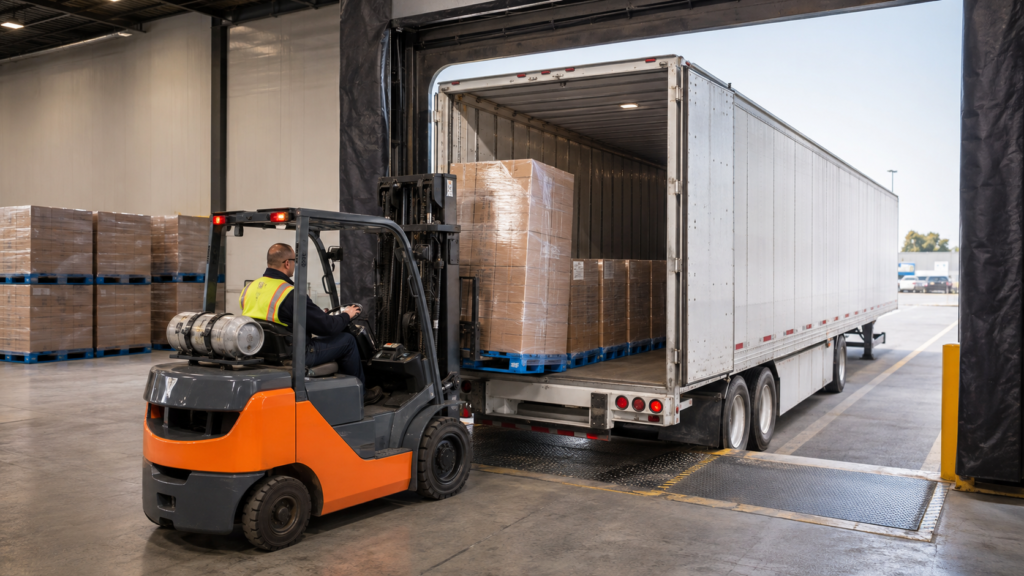
Truck pallet capacity ranges from about 6 standard pallets in a 16-foot box truck to 26 conventional floor positions in a 53-foot dry van. The table below uses single-size 48 × 40 in pallets with no cargo overhang and assumes the full interior floor is usable.
| Truck Or Trailer Type | Typical Single-Layer Planning Count | Possible Tight-Layout Count | Simple Two-Tier Count Before Validation |
|---|---|---|---|
| 53-foot dry van trailer | 26 | Up to 30 | Up to 52 based on the 26-position layout |
| 48-foot dry van trailer | 24 | Up to 28 | Up to 48 based on the 24-position layout |
| 40-foot truck or trailer | 18–20 | Equipment-specific | 36–40 |
| 26-foot box truck | 12 | Sometimes 14 | Up to 24 based on the 12-position layout |
| 24-foot box truck | 10–12 | Equipment-specific | 20–24 |
| 20-foot box truck | About 8 | Sometimes 10 | Up to 16 based on the 8-position layout |
| 16-foot box truck | About 6 | Sometimes 8 | Up to 12 based on the 6-position layout |
These figures are freight-planning estimates, not loading guarantees. Box truck bodies vary considerably, and even trailers with the same advertised length may have different liners, door openings, bulkheads, liftgates or usable interior dimensions.
A logistics team asking how many pallets fit on a 48-foot trailer can start with 24. For how many pallets fit in a 26-foot box truck, use 12 as the baseline; a 24-foot box truck normally carries 10–12, while 20-foot and 16-foot bodies often start near 8 and 6 respectively.
“Double-stacked” also does not mean that every number in the third column is safe. The lower pallet, packaging and product must support the upper unit load, both tiers must clear the door and roof, and the complete shipment must remain within payload and axle limits.
Which Pallet Measurements Change Truck Capacity?
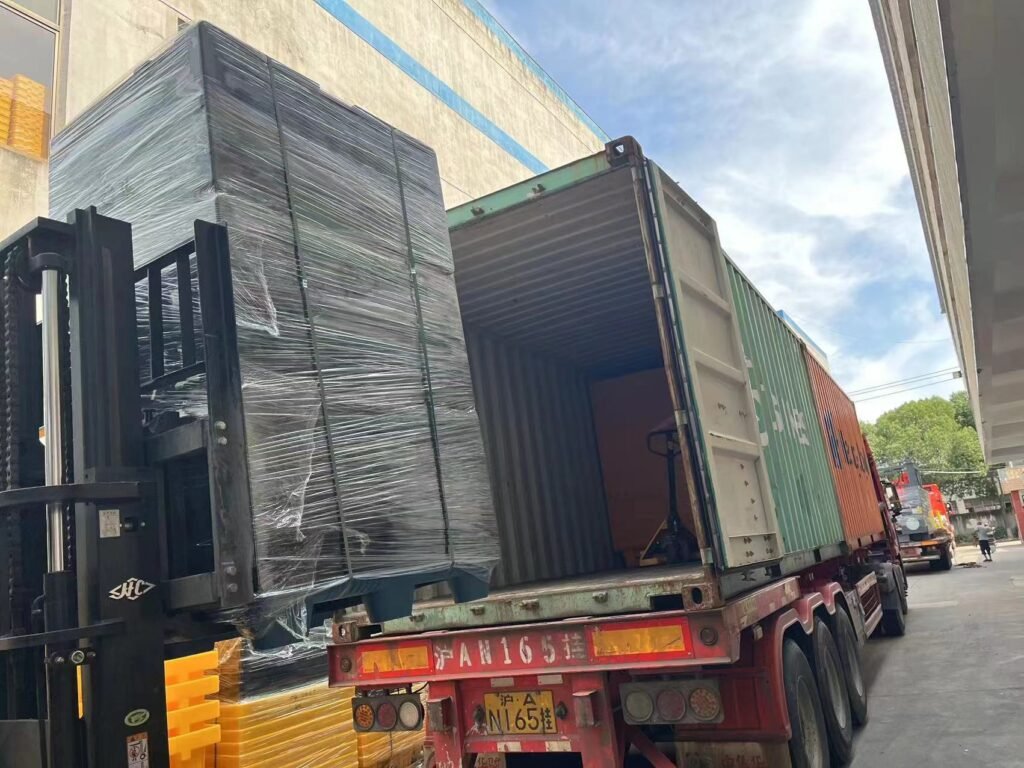
The dimensions that control trailer pallet loading are the maximum outside measurements of the complete unit load, not only the empty pallet deck. Record length, width, loaded height and gross weight after stretch film, corner boards, straps and edge protection have been applied.
The most common nominal pallet footprints include:
| Pallet Type Or Market | Nominal Pallet Measurements | Common Transport Context |
|---|---|---|
| North American GMA footprint | 48 × 40 in / 1219 × 1016 mm | US and Canadian retail, grocery, manufacturing and general freight |
| Euro / EPAL footprint | 1200 × 800 mm / 47.24 × 31.50 in | European distribution, retail and international supply chains |
| Industrial / UK footprint | 1200 × 1000 mm / 47.24 × 39.37 in | Industrial goods, bags, drums and UK distribution |
| Asian T11 footprint | 1100 × 1100 mm / 43.31 × 43.31 in | Japan, Korea and selected Asian networks |
| Square industrial pallet | 48 × 48 in | Drums, barrels and bulk industrial goods |
| Automotive pallet | 48 × 45 in | Automotive and specialized returnable systems |
For example, two nominal 48 in pallets placed across a 100 in interior use 96 in and leave only 4 in total. If each load bulges 1.5 in beyond both pallet edges, that row becomes 102 in wide and no longer fits. Measure the widest production unit rather than a neat sample or an empty pallet.
The often-quoted count of 33 Euro pallets also needs context. A 13.6 m European semi-trailer commonly holds 33, while a North American 53-foot trailer with an assumed 630 × 100 in usable floor can geometrically hold 39 Euro pallets in 13 rows of three. These vehicle types are not interchangeable, so confirm the actual equipment before using either figure.
How Many Pallets Fit On A 53-Foot Trailer?
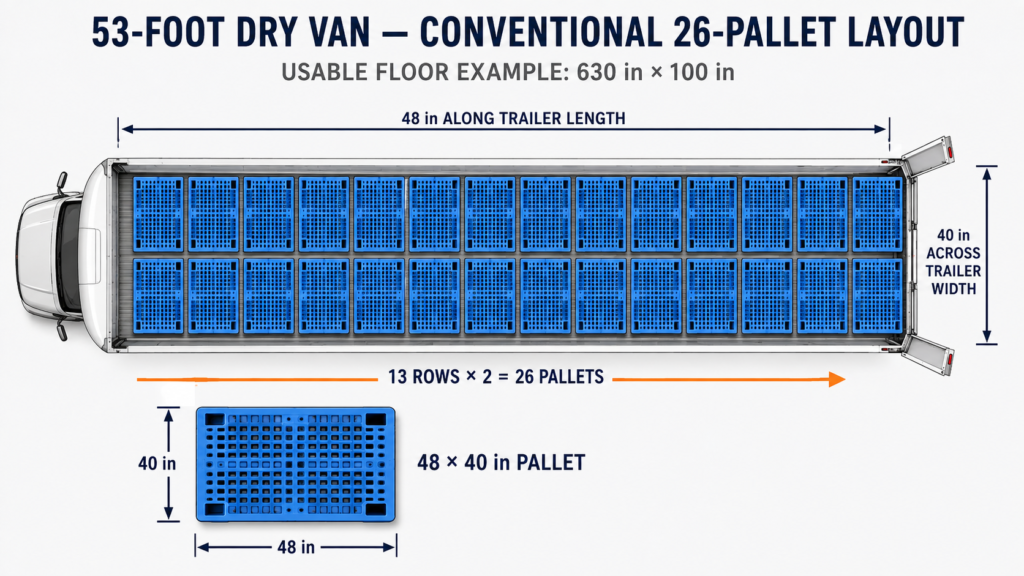
If the question is how many pallets fit on a 53 foot trailer, the standard answer is 26 pallets in a conventional single-layer layout. When calculating how many 48 × 40 pallets fit on a 53-foot trailer with a verified usable floor of about 630 × 100 in, rotating the pallets can produce 30 positions, while a mixed or pinwheel plan may produce an intermediate count.
| 53-Foot Trailer Loading Configuration | Dimension Along Trailer Length | Dimension Across Trailer Width | Calculation | Floor Positions |
|---|---|---|---|---|
| Conventional rows | 48 in | 40 in | floor(630 ÷ 48) × floor(100 ÷ 40) | 13 × 2 = 26 |
| Mixed or pinwheel layout | Mixed | Mixed | Layout-specific | Often 28 when validated |
| Turned rows | 40 in | 48 in | floor(630 ÷ 40) × floor(100 ÷ 48) | 15 × 2 = 30 |
The 26-pallet arrangement leaves more usable clearance across the trailer and is easier to place consistently. This is why freight quotations and full truckload planning commonly start with 26 pallets, even though 30 is mathematically possible.
The 30-pallet configuration uses 600 in of length and 96 in of width. It can work when the trailer is wide enough inside, every unit load stays within its 48 × 40 in footprint, the pallets can be handled from the required direction, and space remains for safe restraint and unloading.
Because loading terms are inconsistent, do not approve a plan marked only “straight” or “sideways.” A useful pallet loading diagram states which pallet edge runs along the trailer length, the number of rows, the units per row, the loading order and the location of restraint equipment.
How Do Trailer Pallet Loading Patterns Change Capacity?
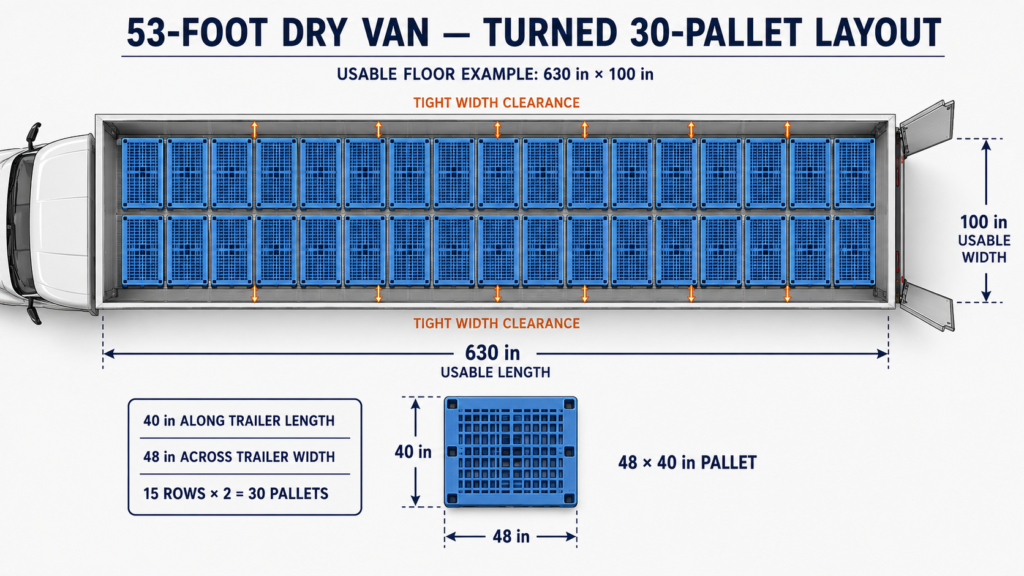
The best pallet loading configuration balances floor utilization with forklift access, loading time, load stability and unloading order. Gaining two or four positions is valuable only when the warehouse can execute the pattern without damaging freight or delaying the route.
| Loading Pattern | Typical Result For 48 × 40 Pallets In A 53-Foot Trailer | Best Use | Main Limitation |
|---|---|---|---|
| Conventional rows, 48 in along trailer length | 26 | Repeatable full truckload shipping and fast dock work | Does not maximize the last available inches |
| Turned rows, 40 in along trailer length | Up to 30 | Uniform, square loads with verified dimensions | Very little width tolerance; handling direction may be restricted |
| Pinwheel or interlocking pattern | Often 28 | Filling otherwise unused floor space | Slower placement and a layout-specific unloading sequence |
| Double-stacked conventional layout | Up to 52 | Light, short and structurally stackable unit loads | Height, compression strength, pallet performance, payload and axle limits |
Turned or pinwheel loading may require access from a different side of the pallet. A four-way forklift pallet can make this easier, but its underside may still prevent a hand pallet truck from entering in all four directions. Check fork openings, load-wheel paths and receiving equipment before selecting a higher-capacity layout.
Double stacking should be treated as a separate engineering and packaging decision. The loaded height must pass through the rear door, the lower product must resist compression, the bottom pallet must remain stable under the actual support pattern, and the upper unit must not create an unsafe center of gravity.
How Do You Calculate Pallet Capacity For Any Truck Or Trailer?
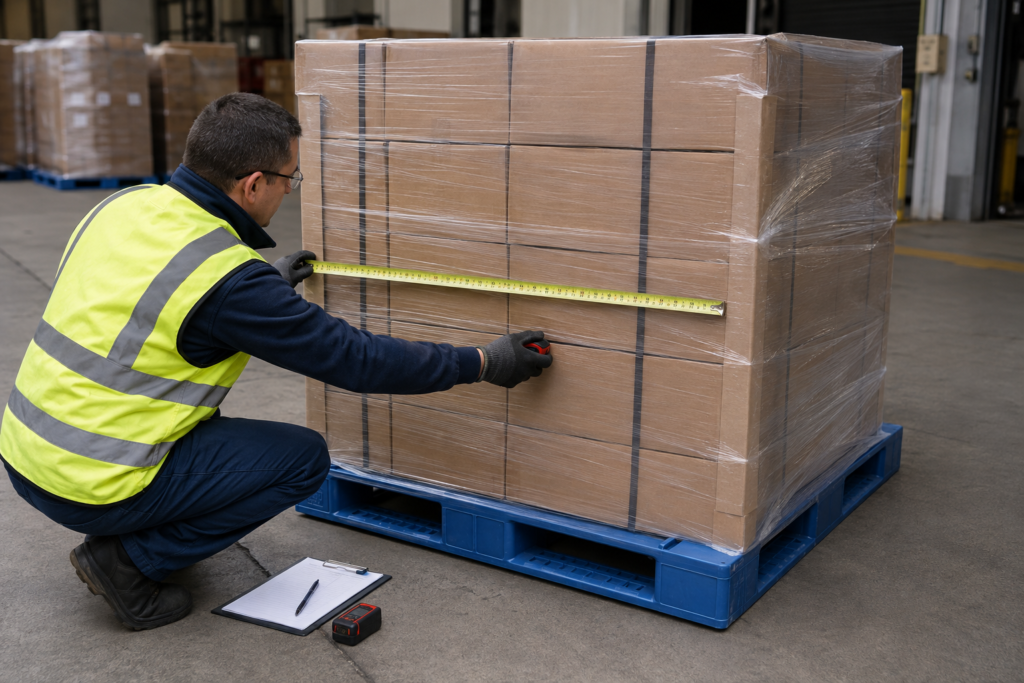
Calculate truck pallet capacity in three stages—floor fit, approved stack levels and allowable weight—then use the lowest valid result. Dividing total trailer floor area by pallet area is not enough because rectangular units cannot always fill the remaining spaces.
Step 1: Calculate Both Floor Orientations
For a uniform pallet size in one direction:
Floor Positions = floor(Usable Interior Length ÷ Pallet Depth) × floor(Usable Interior Width ÷ Pallet Width)
Repeat the formula after rotating the pallet 90 degrees. Use the larger result only if the pallet, unit load and handling equipment support that orientation. Mixed-size or pinwheel loads need a dimensioned layout rather than this simple row formula.
Step 2: Establish Approved Stack Levels
The geometric height check is:
Maximum Geometric Layers = floor(Usable Clear Height ÷ Loaded Unit Height)
Use the smaller of the trailer’s interior height and rear-door height. The approved number of layers may be lower because geometric clearance does not prove that the product, packaging or pallet can carry another tier.
Step 3: Calculate The Weight-Limited Count
Weight-Limited Pallet Count = floor(Allowable Payload ÷ Gross Weight Per Loaded Pallet)
Use the carrier’s allowable payload for the assigned tractor and trailer, not a generic online value. In the United States, FHWA guidance states an 80,000 lb federal gross vehicle weight limit on the Interstate System, together with 20,000 lb single-axle and 34,000 lb tandem-axle limits; the Bridge Formula may impose a lower limit for a particular axle configuration.
Step 4: Use The Lowest Valid Capacity
Final Planned Count = minimum of Geometric Capacity, Weight-Limited Count and Operationally Valid Count
The operationally valid count includes door access, axle distribution, load securement, handling direction and delivery sequence. It prevents a mathematically correct arrangement from becoming an unusable shipping plan.
Consider a 53-foot dry van with a 630 × 100 in usable floor, 44,000 lb assigned payload and 48 × 40 in unit loads weighing 1,800 lb each. The floor may accept 26 conventionally or 30 when turned, but the weight formula allows only floor(44,000 ÷ 1,800) = 24 loaded pallets before checking axle distribution.
For a lighter shipment, assume each loaded pallet is 48 in high, weighs 700 lb and has been approved for two tiers. A 26-position layout gives 52 geometric positions and 36,400 lb of loaded-pallet weight, so weight does not immediately reduce the count; door clearance, axle balance, stack stability and securement still require validation.
Why Is Actual Truck Pallet Capacity Lower Than The Chart?
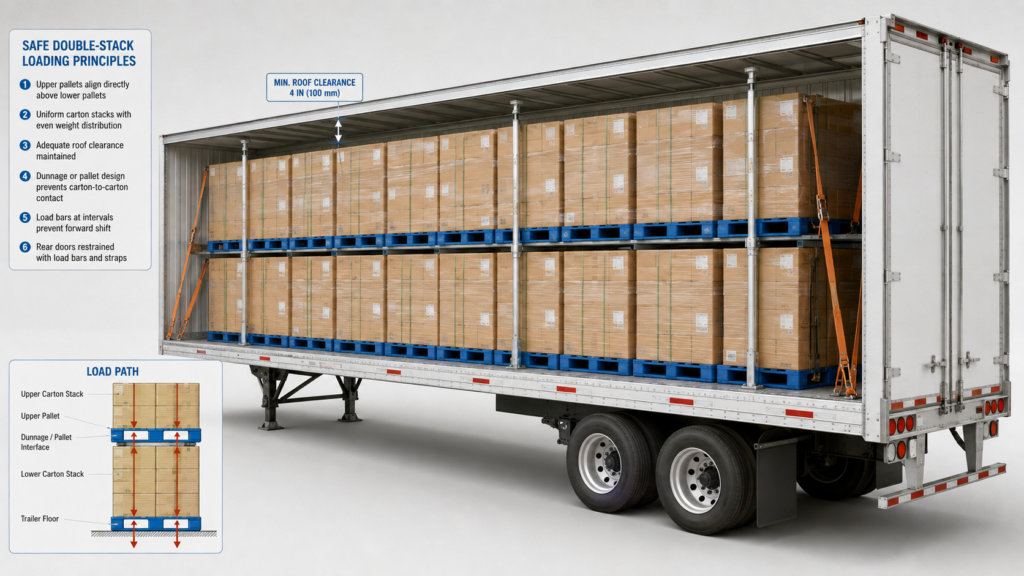
Capacity charts assume clean rectangular space and uniform loads. Actual pallet count falls when the assigned vehicle, packaged product or route removes even a small part of that ideal space.
| Constraint | Why The Planned Count Changes | What To Confirm |
|---|---|---|
| Usable interior dimensions | Liners, bulkheads, posts, refrigeration equipment or body construction reduce space | Minimum clear length, width and height of the assigned vehicle |
| Rear-door opening | A load may fit inside but fail to pass through the door | Clear door width and height, including liftgate hardware |
| Pallet overhang | Cartons, bags, film and corner protection enlarge the working footprint | Maximum production-loaded length and width |
| Cargo height | Tall loads prevent a second tier or contact the roof | Loaded height, door height, stacking clearance and deflection |
| Payload and axle weights | Dense freight may weigh out before it cubes out | Gross unit weight, assigned payload, load center and axle plan |
| Pallet and package strength | The lower tier may bend, crush or become unstable | Approved stacking load, duration, temperature and load distribution |
| Loading equipment | A turned pallet may not be accessible from the required side | Fork direction, entry clearance, pallet-jack wheel path and dock method |
| Securement and delivery sequence | Full geometric use may leave no room for restraint or multi-stop access | Blocking, dunnage, load bars, straps and reverse-stop order |
The US legal vehicle width is not the same as usable cargo width. FHWA identifies 102 in as the commercial vehicle width limit, so using 102 in as a trailer’s internal measurement can overstate the available space.
Cargo restraint can also reduce usable positions. FMCSA cargo securement rules require cargo to be immobilized or secured using structures, dunnage, shoring bars, tiedowns or suitable combinations. A loading plan that fills every gap but provides no valid restraint method is not complete.
How Do Plastic Pallet Specifications Affect Trailer Loading?
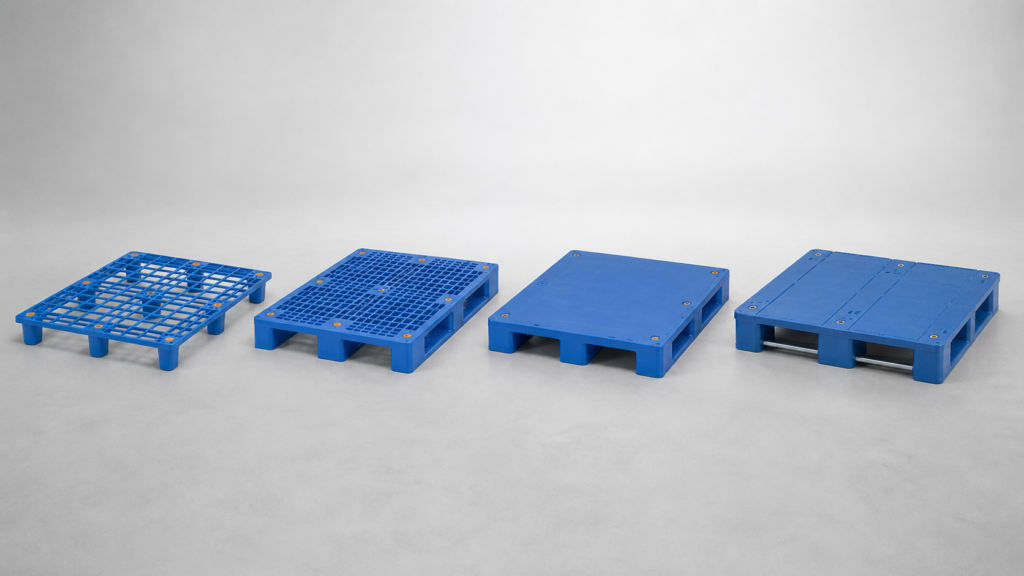
Plastic pallet selection affects whether a loading pattern remains repeatable from one shipment to the next. Footprint is the starting point, but dimensional tolerance, underside design, entry direction, deck features and verified load performance determine whether the pallet works in the complete route.
Footprint Consistency Supports Repeatable Loads
Molded dimensions can make a truck loading diagram more predictable, but only when the packaged goods also remain inside the planned footprint. When comparing plastic pallet sizes and designs, match the exact model drawing to the largest loaded unit and the destination’s receiving specification.
A nominal 48 × 40 plastic pallet is useful for North American trailer loading, while 1200 × 800, 1200 × 1000 and 1100 × 1100 mm footprints suit different regional and industrial networks. A custom footprint is justified only when its recurring freight, product-support or equipment benefit outweighs tooling and validation costs.
Entry And Base Design Control Orientation
Four-way forklift entry can support more loading directions than a two-way design, which matters when a 30-position turned plan requires handling from the 40 in side. However, three-runner, full-perimeter, nine-leg and nestable bases interact differently with pallet jacks, conveyors, racks and vehicle floors.
Before approving the layout, map the forks and load wheels through the pallet base. A truck may accept the footprint while the warehouse cannot place the final row or the receiving site cannot remove it in the planned direction.
Load Ratings Do Not Automatically Approve Double Stacking
Static, dynamic and racking capacities describe different support conditions. None of these numbers alone proves that a loaded pallet is safe as the lower unit in a two-tier truckload, because the product packaging, point loads, pallet deflection, temperature and time under load also matter.
Material labels such as virgin or recycled plastic are not a complete stacking decision either. The exact pallet structure and application-specific performance should control approval, supported by a representative trial with the real product and restraint method.
How Many Empty Plastic Pallets Fit In A Truck?
When shipping empty pallets, nested or stacked height replaces loaded cargo height as the main volume input. Record the first-pallet height, added height per nested pallet, maximum stable stack height, stack weight and the number of stacks that fit on the trailer floor.
A low nest ratio may move many more empty pallets per truck than a non-nestable runner pallet, but there is no responsible universal count. The final quantity depends on the exact pallet model, nesting direction, stack restraint, interior height and allowable payload.
How Should You Build A Reliable Pallet Loading Plan?
A reliable plan starts with actual shipment data and ends with a layout the loading and receiving teams can execute. Use the following sequence before a recurring lane or volume pallet order is approved:
- Request the assigned vehicle specification. Obtain minimum usable interior length, width, height, rear-door opening, payload and any obstructions.
- Measure the finished unit load. Record maximum length, width, height and gross weight after final wrapping and protection.
- Test both orientations. Calculate the conventional and turned patterns, then create a dimensioned plan for any pinwheel or mixed load.
- Apply the weight limit. Compare total shipment weight with payload and have the carrier validate axle distribution.
- Validate handling and stacking. Confirm fork entry, pallet-jack access, door passage, center of gravity and approved stack levels.
- Add securement and route requirements. Reserve the space needed for dunnage, bars or straps and load multi-stop freight in reverse delivery order.
- Run a production-intent trial. Test the actual pallet, product, packaging, forklift, truck body and receiving method before using a tight layout at scale.
For a plastic pallet quotation, provide the pallet footprint, loaded unit drawing, gross weight, load distribution, required entry directions, trailer type, destination, temperature, stack requirement, annual quantity and return model. These inputs allow an existing pallet design and a custom option to be compared on delivered cost rather than unit price alone.
Which Pallet Loading Mistakes Increase Freight Costs?
Most unexpected capacity losses come from approving an assumption instead of a measured condition. Avoid these common trailer pallet loading mistakes:
- Using exterior truck dimensions: The advertised 53 ft length and 102 in legal width are not guaranteed usable cargo dimensions.
- Dividing floor area by pallet area: This ignores row geometry, unusable strips and orientation.
- Measuring only the empty pallet: Product overhang and stretch-film bulge can eliminate an entire row.
- Treating 30 positions as a standard guarantee: The turned pattern has little width tolerance and different handling requirements.
- Automatically doubling the floor count: Height clearance does not prove payload, package compression strength or stack stability.
- Assuming four-way entry works with every device: Forklift access and hand-pallet-truck access can differ.
- Ignoring load order and restraint: An optimized layout can fail when it blocks a delivery stop or leaves no securement space.
- Mixing truck and container benchmarks: A 53-foot dry van, 13.6 m European trailer, reefer and 40-foot ISO container have different internal geometry.
Frequently Asked Questions
How Many Pallets Fit In A 53-Foot Reefer?
A 53-foot reefer commonly starts with the same 26-pallet planning count for 48 × 40 in pallets, but insulation and refrigeration equipment can reduce clear width, height or length. Confirm the assigned reefer’s interior and door dimensions before attempting a 28- or 30-position layout.
Can 26 Pallets Weighing 2,000 Lb Each Fit In A 53-Foot Trailer?
Usually not under a standard US road configuration because the palletized cargo alone would weigh 52,000 lb before accounting for tractor and trailer weight. The assigned carrier must confirm payload, gross weight, axle distribution and route-specific limits.
How Many Pallets Fit In A 40-Foot Shipping Container?
A standard 40-foot ISO container commonly holds about 20 North American 48 × 40 in pallets or about 25 Euro pallets in an optimized single layer. Container width, door opening and mixed loading pattern must be checked because this is not the same geometry as a 40-foot truck.
Can Mixed Pallet Sizes Fit In One Truck?
Yes, but a simple rows-times-columns formula is no longer reliable because each footprint changes the remaining spaces. Use a dimensioned mixed-load plan that also preserves weight balance, handling access and delivery order.
How Many Linear Feet Does One Standard Pallet Use In LTL Freight?
A 48 × 40 in pallet uses 4 linear feet when it occupies a row by itself, while two placed side by side still use one 4-foot row, averaging 2 linear feet per pallet. Carrier pricing and linear-foot rules vary, so confirm how the specific LTL provider measures occupied space.
Final Thoughts
The useful answer to how many pallets fit in a truck is not simply 26, 30 or 52. It is the lowest safe count after the loaded pallet footprint, usable truck dimensions, approved stack levels, payload, axle distribution, handling direction, securement and delivery order have all been checked.
Preface Plast has manufactured plastic pallets since 2003, with ISO 9001 production controls, 60+ injection molding machines, standard regional footprints and OEM/ODM capabilities. Send our team your loaded pallet dimensions, gross weight, truck or container type, handling equipment, destination, quantity and target pallets per truckload; we can compare an existing 48 × 40, 1200 × 800, 1200 × 1000 or 1100 × 1100 mm design with a custom solution that supports repeatable loading and stable long-term supply.