How to Get Free Plastic Pallets: 5 Legal Sources
Before you look for free plastic pallets, do not load pallets from behind a store, near a loading dock, or beside a dumpster into your vehicle. Many plastic pallets are rented, pooled, or still owned by a business. Sitting outside does not mean a pallet has been abandoned.
How to get free plastic pallets legally is simple: look for surplus pallets that the owner has clearly released, recycler stock, and local listings marked “free pickup.” Avoid branded, unknown, contaminated, or badly damaged pallets.
| Where to Look | What You May Find | What to Do First |
|---|---|---|
| Independent stores, wholesalers, garden centres, or furniture shops | Lightweight or one-way pallets they no longer need | Ask whether the pallets are clearly free to take |
| Small factories, printers, packaging plants, or warehouse clear-outs | Overstock, obsolete, or size-mismatched pallets | Take only pallets they have explicitly released |
| Pallet recyclers or used-pallet yards | Odd-size, surplus, or low-value plastic pallets | Call first and ask about free or low-cost stock |
| Local giveaway groups and classified listings | Small quantities marked “free pickup” | Confirm that the poster owns the pallets |
| Regular local haul-away arrangements | Surplus pallets released on an agreed schedule | Make ownership and collection terms clear |
Where Can You Find Free Plastic Pallets?
Free plastic pallets are usually available in small quantities, not as a stable supply. Independent businesses with clearly released surplus stock are often a better place to start than large retail loading docks.
Search local maps, community groups, and classified listings with phrases such as:
free plastic pallets near mefree used plastic palletsplastic pallet recycler near mefree plastic pallets pickupsurplus plastic pallets
If you only need a few pallets for floor storage, workshop use, or a small project, local owner-approved surplus pallets are often the most practical option.
Which Pallets Should You Never Take?
The first rule is simple: if you do not have clear permission, do not take it.
Pallets marked with “Property of,” a company name, an asset label, barcode, serial number, RFID tag, or pallet-pool brand should never be treated as waste. CHEP states that its blue pallets remain CHEP property and may not be sold, traded, reused, or discarded without authorization. CHEP ownership guidance
PECO also states that its red pallets remain PECO property and may not be bought, sold, exchanged, modified, or repurposed. PECO pallet recovery guidance
Do not use colour alone as an ownership test. A black pallet is not automatically free, and a blue or red pallet is not automatically pooled property. Read the markings and ask for permission.
Leave behind pallets that are:
- Marked with an owner, rental, return, or pooling label;
- Located in an active loading, collection, or asset-storage area;
- From chemical, medical, waste-handling, or unknown industrial locations;
- Cracked, permanently bent, oily, chemically stained, heat-damaged, or heavily worn.
How Should You Ask for Free Pallets?
A short, direct question saves time and avoids confusion:
“I need a few plastic pallets for floor storage or workshop use. Have these pallets been released for free collection? I will not take any pallets with rental, recovery, or ownership markings.”
This makes it clear that you are asking for surplus pallets, not taking operational assets.
Bring a tape measure before you collect anything. Plastic pallets come in many footprints, including 48 × 40 in, 1200 × 800 mm, 1200 × 1000 mm, and 1100 × 1100 mm. A free pallet is not useful if it does not fit your vehicle, storage area, cartons, or handling equipment. See our guide to standard plastic pallet sizes.
What Should You Check First?
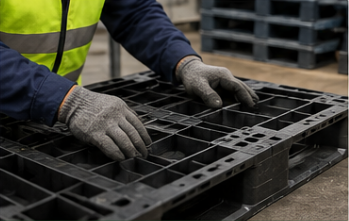
Free is not a specification. Before you reuse a pallet, look at the deck, feet or runners, fork-entry openings, and overall shape.
| What to Check | What It Means |
|---|---|
| Cracks, broken feet, damaged runners, or permanent bending | Do not use it for loaded handling |
| Oil, chemical stains, strong odours, or unknown residue | Do not use it for food, pharmaceutical, medical, or clean operations |
| Length, width, and height | Make sure it fits your space, load, and equipment |
| Unknown load history | Do not use it in racks, conveyors, or automated systems |
The UK Health and Safety Executive lists cracks, deformation, contamination, heat damage, and base damage among the conditions that should remove a pallet from service. HSE pallet safety guidance
Cleaning can remove ordinary dust and surface dirt, but it does not turn a pallet with an unknown history into a suitable pallet for food or clean-area use. For normal washdown guidance, see how to clean plastic pallets.
When Are Free Pallets Not Worth It?
Free pallets work well when you need a few units for light, non-critical use. They become less attractive when you need dozens of identical pallets, reliable load support, rack storage, automated handling, or export-ready packaging.
Collection mileage, sorting time, cleaning, mixed sizes, unknown load capacity, and emergency replacement can quickly cost more than the pallet itself. For one-way shipping, export plastic pallets offer a more consistent option. When empty-pallet storage and return volume matter, nestable plastic pallets are easier to manage than a mixed batch of collected pallets.
Frequently Asked Questions
Can I take plastic pallets from behind stores?
Only when someone with authority has clearly confirmed that the pallets are free to take. Pallets near a store, loading dock, or dumpster may still belong to the store, supplier, recycler, or pallet pool.
Can I take plastic pallets with a company logo?
Not without explicit permission from the owner. Company names, “Property of” labels, return tags, barcodes, and RFID labels are signs that the pallet may still be an asset.
Can free plastic pallets be used for food?
Not when their source or previous use is unknown. Food, pharmaceutical, medical, and clean operations need pallets with a known, clean history and sound condition.
Where can I find free plastic pallets near me?
Try local giveaway listings, pallet recyclers, nearby independent businesses, factory clear-outs, and industrial areas. Always confirm ownership before collection.
Free Only Works When You Can Legally Keep It
Free plastic pallets are useful for small, light, non-critical jobs. The real decision is not simply whether a pallet is available, but whether it has been legally released, remains structurally sound, and fits the work you need it to do.
If you need a consistent supply of matching pallets for export, storage, racking, or repeated circulation, Preface Plast offers nestable, stackable, export, hygienic, rackable, and heavy-duty plastic pallet options for stable long-term use.
Share this article
Help others discover this content