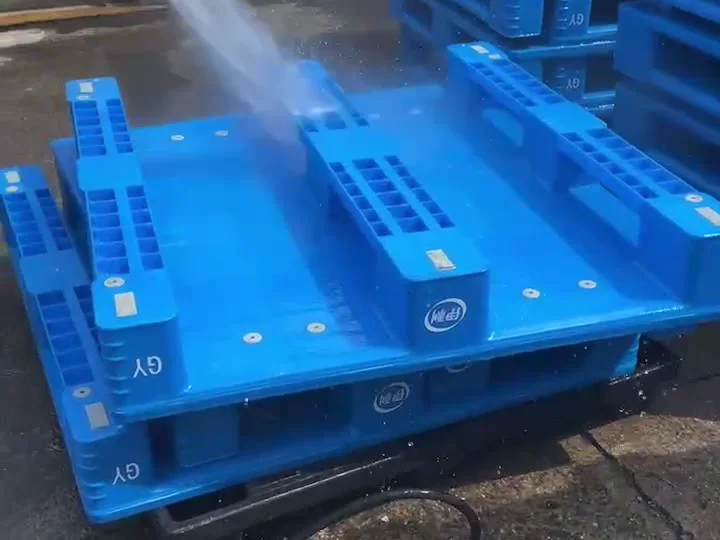
Cleaning a plastic pallet incorrectly can spread allergen or chemical residue, leave sanitizer behind, create slip or freezer-ice hazards, or cause heat and pressure damage. If the contaminant is unknown, quarantine the pallet before it reaches the normal wash line.
If you are deciding how to wash plastic pallets, use this sequence: inspect, remove loose soil, wash every accessible surface with a compatible detergent, rinse, sanitize only when required, then drain, dry, verify, and release. Match each step to the soil, pallet design, hygiene level, and wash equipment.
How To Clean Plastic Pallets Step By Step
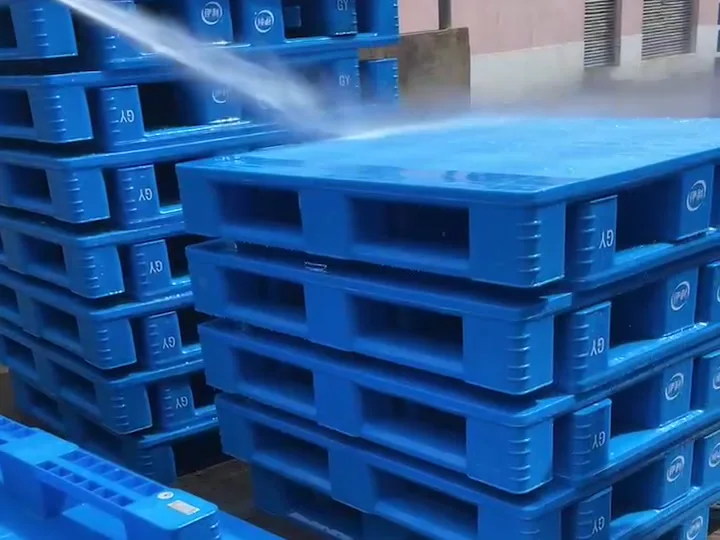
Start with what is on the pallet and where it will go next—not with the strongest available cleaner. Use this six-step plastic pallet washing procedure as a practical plastic pallet cleaning checklist for manual cleaning, pressure washing, or an automated line.
Stop and isolate the pallet if the previous load is unknown, a chemical remains unidentified, a strong odor persists, or the pallet is cracked, warped, or exposing reinforcement.
Step 1: Identify The Contamination And Next Use
Record the pallet model, previous load, route, and next hygiene zone. Dust from a closed warehouse, raw-food residue, lubricating oil, an allergen spill, and an unknown chemical all need different decisions.
When the substance is unknown or hazardous, keep the pallet out of the routine washer. Use the SDS and site EHS procedure to decide containment, PPE, cleaning, and disposal.
Step 2: Inspect The Pallet And Remove Packaging
Take off stretch film, straps, paper, and removable labels. Check the deck, edges, fork openings, feet, runners, welds, drainage points, anti-slip parts, RFID housing, and any steel reinforcement.
Cracks, broken supports, deep gouges, deformation, or sealed areas containing residue are release problems, not cosmetic issues. Set those pallets aside before they consume wash-line time.
Step 3: Remove Loose Soil And Pre-Rinse When Suitable
Use a plastic scraper, nylon brush, or suitable vacuum to remove loose material. Avoid metal tools that score the surface, and avoid uncontrolled compressed air around allergen or hazardous dust.
A pre-rinse can loosen mud and soluble residue, but only in an area that controls splash and wastewater. Low-moisture food areas may need an approved dry-cleaning method instead.
Step 4: Wash Every Accessible Surface
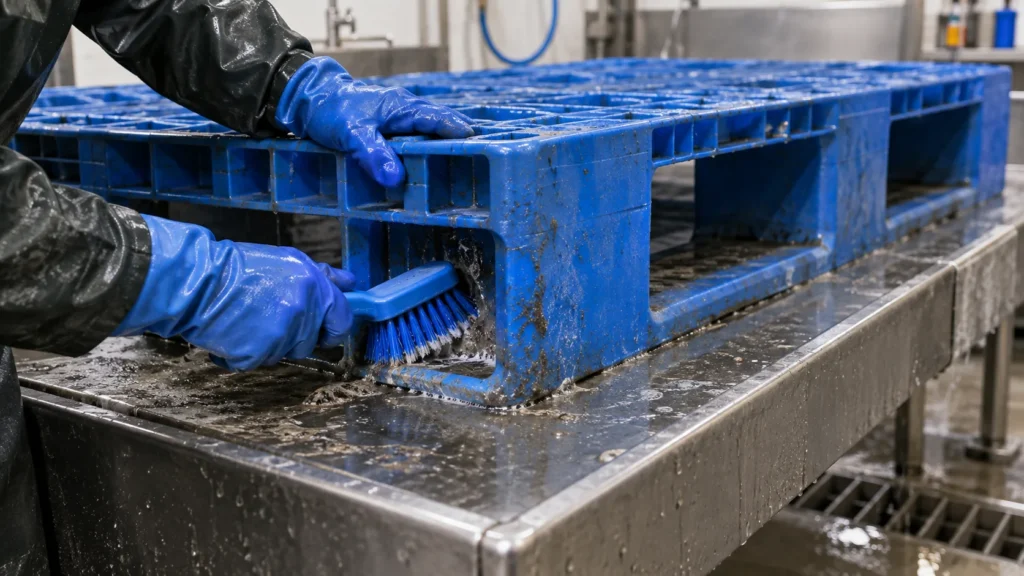
Apply a compatible detergent at its labelled dilution and contact time. Flip the pallet: clean the underside, runners, feet, ribs, nesting pockets, and fork openings as carefully as the upper deck.
A wash line can only clean what its brush or spray can reach. Keep tools assigned to the correct hygiene zone, and replace dirty solution before it becomes another source of contamination.
Step 5: Rinse And Apply Microbial Control Only When Required
Rinse away loosened soil and detergent with water of the quality required by the application. If the hygiene plan calls for a sanitizer or disinfectant, apply it only after the pallet is clean.
Follow the product label for surface type, dilution, temperature, full wet contact time, and final-rinse instructions. More chemical is not a substitute for correct coverage and time.
Step 6: Drain, Dry, Inspect, And Release
Tilt or support the pallet so water can leave grid intersections, runner corners, and nestable feet. Use clean air or a controlled dryer when needed, and avoid tightly stacking or nesting wet pallets.
A routine release starts with practical checks: visibly clean, dry to the approved criterion, no unacceptable odor or residue, and no structural damage. Mark the result as released, rewash, quarantine, or remove from service, then store clean pallets away from dirty returns.
The sequence is straightforward, but the required result determines whether washing alone is enough.
When Do Plastic Pallets Need Sanitizing Or Disinfecting?
Start with cleaning. A sanitizer or disinfectant belongs on an already clean surface only when the hygiene plan, known contamination, or incident response requires it.
| Process | What It Does | When It May Be Needed |
|---|---|---|
| Cleaning | Removes dirt, grease, food residue, allergens, and part of the microbial load | Routine soil removal and the first stage of every hygiene process |
| Sanitizing | Reduces specified bacteria to an accepted level under labelled conditions | Defined food-contact or hygiene-controlled procedures |
| Disinfecting | Inactivates label-specified bacteria and viruses | Known pathogen risk, outbreak response, bodily-fluid event, or another targeted incident |
Routine pallet washing should not be called sterilization. That claim needs a separate validated process, compatible equipment, and evidence that the required conditions reached every relevant surface.
In the United States, use the EPA definitions and registered-product label to control use site, dilution, contact time, and rinsing. Outside the US, use products authorized for the intended application under local requirements.
Once the required outcome is clear, choose the simplest method that can reach every surface at the necessary throughput.
Which Plastic Pallet Cleaning Method Should You Use?
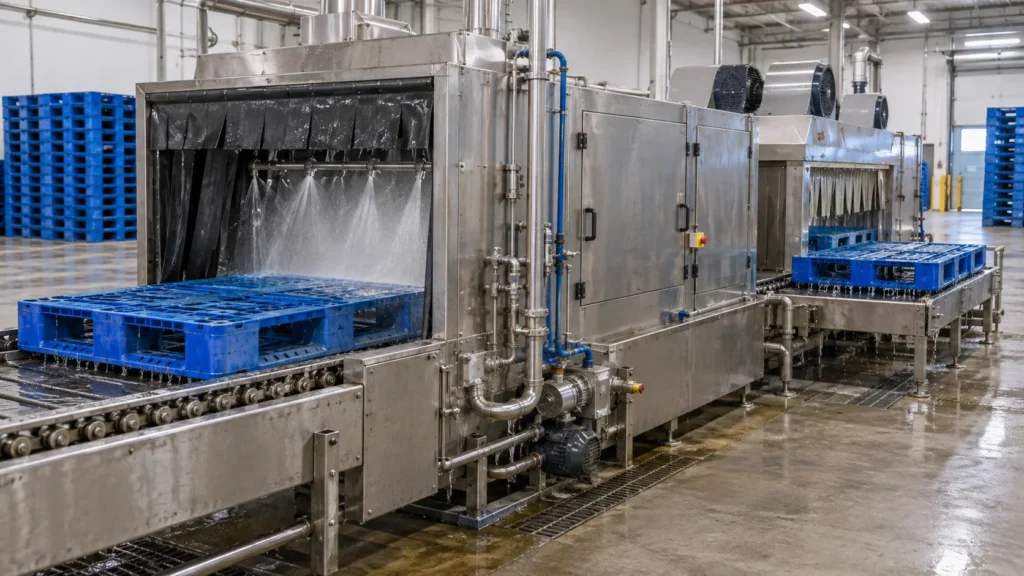
Manual washing may be enough for a small mixed fleet. As volume rises, underside coverage, dirty-to-clean separation, drying capacity, and process repeatability usually matter more than the machine name.
| Method | Best Fit | Main Strength | Watch Point |
|---|---|---|---|
| Manual brush wash | Small batches, varied models, spot cleaning | Flexible access with low capital cost | Labor variation, tool hygiene, and missed areas |
| Pressure washing | Moderate volume, mud, general industrial soil | Faster mechanical removal | Splash, aerosols, excessive force, and drainage |
| Automatic tunnel washer | High-volume reusable fleets | Repeatable stages and higher throughput | Orientation, spray shadows, chemistry, line speed, and dryer capacity |
| Hot-water or steam cleaning | Approved heat-assisted process | Helps loosen selected soils and may support microbial control | Complete-pallet heat limits and actual surface exposure |
| Dry or low-moisture cleaning | Selected powder or low-moisture areas | Limits added water | May not remove sticky or oily residue or meet sanitation needs |
Pressure washing plastic pallets can work when pressure, nozzle distance, angle, drainage, and splash containment are controlled. When cleaning plastic pallets in bulk, an automated plastic pallet washer adds consistency only if it reaches both faces, fits the geometry, separates dirty and clean flow, and dries each pallet at the planned line speed.
Steam also needs honest wording. For steam cleaning plastic pallets, if the coolest pallet surface and its holding time have not been measured, describe the step as steam cleaning, not sanitizing or sterilizing.
A fast cycle with frequent rewash, damage, or wet-pallet rejection can cost more than a slower process that releases pallets correctly the first time.
What Detergent, Temperature, And Pressure Are Safe For Plastic Pallets?
The same washer can be effective or damaging depending on the complete pallet, chemical concentration, temperature, exposure time, mechanical force, and number of repeated cycles. Plastic pallet wash temperature and pressure therefore need model-specific approval; there is no safe universal setting for every pallet.
| What To Check | Questions To Answer |
|---|---|
| Complete pallet | What are the exact resin grade, additives, welds, plugs, labels, anti-slip parts, RFID housing, and reinforcement materials? |
| Chemistry | Is the cleaner approved for the soil and surface? What concentration, pH, water quality, rinse, and disposal instructions apply? |
| Heat and time | What peak temperature and dwell time can the complete pallet tolerate, and what actual surface temperature is achieved? |
| Mechanical action and cycles | What pressure, flow, nozzle distance, brush stiffness, line speed, and lifetime wash-cycle count are approved? |
Most industrial pallets use HDPE or PP, but material names do not define complete-pallet compatibility. HDPE often suits impact and cold handling, while PP may offer useful stiffness and heat resistance; the grade, design, load, additives, and wash cycle still decide performance.
Chemical resistance also changes with temperature, concentration, time, and molded-in stress. LyondellBasell’s technical guidance for PP chemical resistance and HDPE stress cracking shows why a real repeated-cycle trial is more reliable than a resin name.
Review the label and SDS before use. OSHA’s cleaning-chemical guidance emphasizes training, correct dilution, ventilation, and PPE; never mix bleach with ammonia, acids, or other cleaners.
How Should You Handle Grease, Mold, Adhesive, And Unknown Residue?
Match the first action to the contamination. One aggressive cycle for every return can spread allergens, send oil into wastewater, or expose staff to an unidentified substance.
| Contamination | Practical First Action | Hold Or Removal Trigger |
|---|---|---|
| Dust, film, paper, or mud | Remove solids, then pre-rinse or wash if the zone requires it | Material remains inside damage or inaccessible cavities |
| Food residue or allergen | Isolate under the site SSOP; use the validated clean, rinse, and verification sequence | Allergen or cleanliness check fails |
| Oil or grease | Contain it, identify the oil, then use an approved plastic-compatible degreaser | Swelling, softening, persistent odor, or unknown oil |
| Labels or adhesive | Remove without gouging; test the approved remover on the exact pallet and ID system | Barcode/RFID damage or solvent attack |
| Mold or pest evidence | Isolate, clean, and correct the moisture or storage source | Growth or odor persists in cracks or closed voids |
| Chemical leak or unknown previous use | Quarantine, identify the substance, and involve EHS | Safe history or material condition cannot be established |
For allergen-controlled operations, use the facility’s validated allergen-specific method. A UK Food Standards Agency review notes that visual inspection or ATP alone may not establish allergen removal.
If the same ribs, feet, or cavities remain dirty or wet after a correctly run cycle, pallet geometry—not operator effort—may be the limiting factor.
Which Plastic Pallet Designs Are Easiest To Clean And Dry?
The easiest pallet to clean is the one whose surfaces the process can reach, rinse, inspect, and dry. A smooth top helps, but the underside and fitted components still matter.
| Pallet Feature | Possible Advantage | Area To Check |
|---|---|---|
| Smooth closed deck | Accessible upper surface and simple visual inspection | Seams, edges, underside, and runner junctions |
| Open grid deck | Airflow and drainage in a suitable orientation | Ribs, intersections, edges, and spray shadows |
| Nestable feet | Lower empty storage and return volume | Soil and water retained inside foot cavities |
| Runner or full-perimeter base | Stable handling interface | Lower faces, corners, welds, plugs, and reinforcement |
| RFID, labels, and anti-slip inserts | Traceability or load grip | Heat, chemical, pressure, sealing, and attachment integrity |
A closed deck is not automatically the best choice. Open designs may drain faster, while smooth hygienic plastic pallets can reduce hard-to-inspect areas; compare both sides, the wash and drying process, load, and handling equipment.
Hygienic design, food-contact documentation, and an approved cleaning procedure are separate checks. A white or blue pallet is still only a color until the material and documents for the exact model are confirmed.
How Often Should Plastic Pallets Be Cleaned?
Use event- and risk-based triggers rather than copying a daily or monthly schedule. The previous load, return route, hygiene-zone change, visible condition, and verification history should set the interval.
| Situation | Practical Trigger |
|---|---|
| Visible soil, spill, odor, or pest evidence | Isolate and clean immediately |
| Returned, shared, or externally routed pallets | Clean before release into the approved pool or cleaner zone |
| Raw-to-ready, allergen, or hygiene-zone transfer | Follow the approved changeover and verification procedure |
| Sealed goods in a controlled internal loop | Inspect every turn; clean when soiled and on the justified site schedule |
| Failed post-wash check | Hold, find the cause, then rewash or remove the pallet |
For example, US food-manufacturing rules link cleaning frequency to contamination and allergen cross-contact risk rather than one universal calendar. High-care and controlled areas normally need stricter written release rules than a dry warehouse moving sealed cartons.
How Does Plastic Pallet Cleaning Change By Industry?
Food-grade plastic pallet cleaning, pharmaceutical plastic pallet cleaning, and cold-storage pallet cleaning share a familiar base sequence. The release standard becomes stricter as the pallet moves closer to exposed product or a controlled area.
| Application | Extra Risk To Control | Practical Requirement |
|---|---|---|
| Food and beverage | Organic residue, allergens, raw/ready separation, chemical residue | Define contact status, chemistry, rinse water, verification, and material documents |
| Pharmaceutical or cleanroom | Carryover, particles, cleaning-agent residue, controlled transfer | Use a documented transfer and release process; a dedicated internal pallet or validated wash may be required |
| Cold chain | Condensation, ice, wet re-entry, thermal cycling, cold impact | Define the warm-wash-to-cold-use cycle, dry criterion, and lowest handling temperature |
| Chemical and industrial | Unknown residue, incompatibility, exposure, wastewater | Keep unknown chemicals out of the routine line until SDS and EHS review is complete |
| Pallet pool or 3PL | Mixed loads, high throughput, status errors, rewash cost | Set contamination categories, dirty-to-clean routing, traceable release, and reject rules |
Scope note: The FDA Food Code 2026 is a US retail and food-service model, and it excludes certain pallets used only for cased or overwrapped packaged food from its equipment definition. Other manufacturing, transport, pharmaceutical, EU, or local requirements may apply, so classify the actual use before writing the SOP.
A pallet itself should not be described as “HACCP certified” or “GMP certified.” It can support a controlled programme only when its material, design, cleaning method, records, and handling flow fit that programme.
When Should A Plastic Pallet Be Quarantined Or Replaced?
Quarantine the pallet when its cleanliness, chemical history, or structural condition cannot be verified. A second wash is not the answer to every failure.
Remove it from normal use when there is:
- A crack, broken foot or runner, deformation, or sharp damage;
- Inaccessible residue, a failed weld, or water trapped inside a damaged area;
- A loose insert, plug, RFID housing, label, or reinforcement component;
- Persistent odor, recurring growth, or repeated cleaning failure;
- Swelling, softening, brittleness, cracking, or warping after chemical or heat exposure;
- Unknown chemical, bodily-fluid, pest, or previous-load exposure.
Return a pallet to structural service only through a documented, model-approved repair or disposition process. Cleaning can remove soil; it cannot restore load capacity.
Frequently Asked Questions
Can You Pressure Wash Plastic Pallets?
Yes, when the exact pallet model permits it and the process controls pressure, nozzle distance, angle, temperature, drainage, and splash. Test repeated cycles because excessive force can damage surfaces, labels, inserts, or fitted components.
What Is The Best Detergent For Plastic Pallets?
The best cleaner for plastic pallets is the least aggressive product that removes the identified soil and is compatible with the complete pallet. Follow the cleaner label, SDS, pallet limits, and required rinse rather than choosing by pH or brand alone.
How Do You Sanitize Plastic Pallets For Food Use?
Clean and rinse first, then use a sanitizer authorized for the intended surface and application at its labelled concentration and full wet contact time. Rinse afterward when the label or local procedure requires it, then dry and verify before release.
How Do You Dry Plastic Pallets After Washing?
Orient the pallet so cavities and runners drain, then use clean air or a controlled dryer if natural drainage cannot meet the release time. Do not nest or tightly stack wet pallets because trapped moisture encourages recontamination and can become ice in cold storage.
Do New Plastic Pallets Need Cleaning Before First Use?
Follow the facility’s entry procedure because storage and transport may introduce dust even when the pallet is new. Controlled areas may require documented cleaning or transfer regardless of appearance.
Can Plastic Pallets Be Autoclaved?
Only an exact model approved and validated for the required temperature, pressure, dwell time, and cycle count should enter an autoclave. “PP” or “plastic pallet” alone is not proof of compatibility.
Does A White Or Blue Pallet Prove It Is Food Grade?
No; color can support zone control but does not prove resin suitability, cleanability, intended food contact, or documentation. Confirm those points for the exact material and model.
How Should Clean Plastic Pallets Be Stored?
Store released pallets dry and protected from dust, pests, splash, chemicals, weather, and dirty traffic. Keep clean, dirty, quarantine, and rejected status easy to distinguish.
Final Thoughts
The right way to clean plastic pallets does not start with the strongest chemical. It starts with the soil, the exact pallet, and the result the operation must verify; if the same recesses remain dirty or wet after every correctly run cycle, changing the pallet specification may work better than intensifying the wash.
Share your footprint, payload, hygiene zone, wash chemistry, temperature, pressure, drying method, equipment interfaces, documents, destination, and volume with Preface Plast. We can compare hygienic or custom HDPE/PP options and prepare a model review, sample plan, and bulk quotation around your handling system and budget.