Plastic pallets are usually the better fit for controlled reuse, washdown environments, automated handling, and export routes that want to avoid solid-wood treatment. Wood pallets usually make more economic sense for low-cost one-way domestic shipments, irregular loads, or networks built around local repair and exchange.
Neither material is automatically stronger, greener, or cheaper. The right choice depends on cost per completed trip, the real load and support condition, equipment, hygiene, destination rules, recovery rate, and end of life.
Plastic Pallets Vs. Wood Pallets: What Is The Practical Difference?
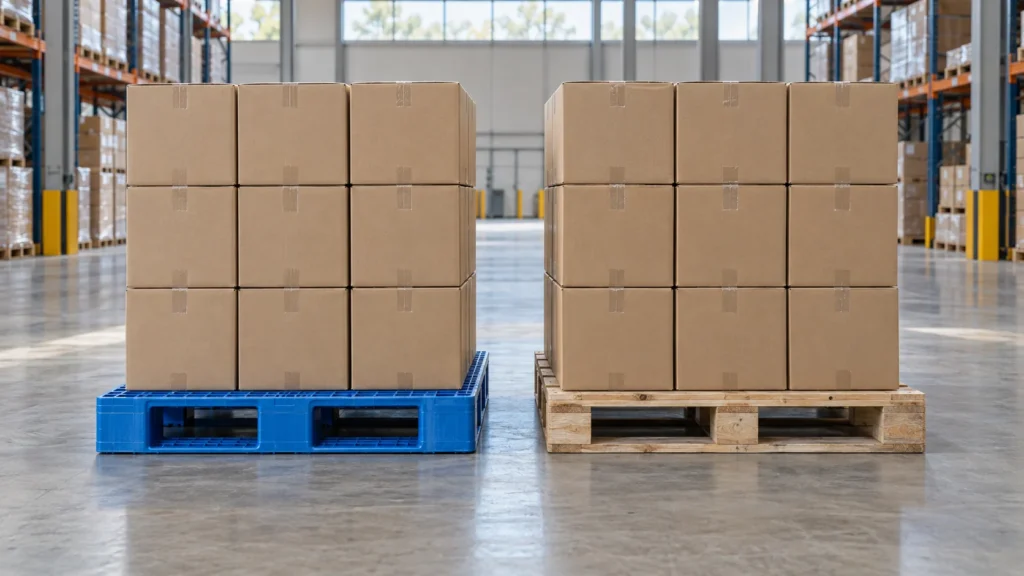
When we evaluate a wood-to-plastic conversion, the first question is not “Which material is better?” It is “Which problem must the pallet solve?” A molded plastic pallet can provide repeatable geometry, moisture resistance, and cleanable surfaces. Wood normally offers a lower entry price, broad availability, and practical repair.
The exact design matters more than the label. A lightweight nestable plastic pallet and a steel-reinforced rackable pallet serve very different jobs, just as a new standardized block pallet and a repaired stringer pallet do.
| Decision Factor | Plastic Pallet | Wood Pallet | Practical Meaning |
|---|---|---|---|
| Initial cost | Often higher, although export models vary | Usually lower | Wood often wins when the pallet will not return |
| Cost per trip | Can fall with reliable recovery and repeated reuse | Can remain competitive through repair or pooling | Real trips and loss rate determine the result |
| Dimensions | Molded geometry can be held to an agreed tolerance | Moisture, wear, and repair can increase variation | Plastic often suits repeatable machine interfaces |
| Cleaning | Polymer does not absorb water, but cavities can retain soil | Wood can absorb moisture and takes longer to dry | A hygienic plastic design often fits washdown better |
| Damage | No wooden splinters or exposed nails; many one-piece models are difficult to repair | Boards, blocks, and fasteners can often be replaced | Plastic needs removal and recycling criteria; wood needs repair control |
| Racking | Creep, span, temperature, and dwell time must be checked | Stiffness varies with construction and condition | Neither material is approved by a floor-load rating |
| Export | All-plastic pallets are outside the ISPM 15 wood-treatment regime | Raw-wood packaging may require treatment and marking | Plastic can simplify pallet-related phytosanitary preparation |
| Weight | Ranges from lightweight nestable to heavy reinforced designs | Varies with construction, repair, and moisture | Compare measured tare, not a material stereotype |
| Automation | Repeatable runners and openings can help | Standardized wood can work under strict inspection | Tolerances and condition control matter most |
The industrial plastic pallet range illustrates why plastic is not one specification: nestable, stackable, rackable, hygienic, export, heavy-duty, and AS/RS structures address different routes.
Which Costs Less: Plastic Pallets Or Wood Pallets?
Wood pallets usually cost less to buy; plastic pallets may cost less to use. A meaningful plastic pallet vs. wood pallet cost comparison includes purchase, freight, repair or replacement, cleaning, handling, tracking, return freight, loss, product damage, disposal, and recovery value.
Cost Per Completed Trip = Total Life-Cycle Cost ÷ Completed Usable Trips
We do not use a universal lifespan or payback claim. A reusable plastic pallet cannot recover its higher price if it disappears after one delivery, while a cheap wood pallet can become expensive when repair labor, rejected loads, treatment administration, or package damage repeats.
| Route Condition | Better Cost Starting Point | Cost Often Missed |
|---|---|---|
| One-way domestic route with no recovery | Wood or lightweight export plastic | Disposal, product damage, and delivered weight |
| Controlled plant-to-warehouse loop | Reusable plastic deserves a trial | Loss, washing, tracking, and reverse transport |
| Open exchange network with local repair | Standardized wood may remain practical | Repair quality, rejection, and pool fees |
| Frequent empty returns | Nestable plastic pallets may reduce return cube | Verified nesting increment and stack stability |
Use fleet records or a pilot to count completed trips, losses, damage, washing, operator interventions, and rejected units. A quotation alone cannot establish total cost of ownership.
Which Pallet Is Stronger For Heavy Loads, Racking, And Automation?

There is no universal plastic vs. wood pallet load-capacity winner. Deck geometry, base construction, material, reinforcement, condition, payload pattern, support, temperature, and storage time control performance. “Heavy-duty” is not a test condition.
Plastic resists moisture-related weight change, but thermoplastics can deflect under sustained load. Wood can provide useful stiffness and is repairable, but cracked boards, loose fasteners, decay, and inconsistent repairs reduce capacity.
| Condition | Support | Data We Need Before Recommending A Pallet |
|---|---|---|
| Static load | Flat, rigid floor | Load pattern, lower-package strength, duration, and stacking method |
| Dynamic load | Forklift or pallet jack | Fork position, travel route, impacts, restraint, and temperature |
| Racking load | Beams, rails, or partial support | Clear span, bearing width, orientation, dwell time, and deflection limit |
| Conveyor or AS/RS | Rollers, chains, forks, or shuttle interfaces | Contact drawing, transfer gaps, sensors, starts, stops, and loaded deformation |
The static, dynamic, and racking load guide explains why ratings are not interchangeable. ISO 8611-1:2025 provides test methods for new flat pallets and notes that testing does not replace field trials on a specific design.
For open beam storage, compare wood with a purpose-designed rackable plastic pallet at the same payload, span, direction, temperature, and dwell. A short floor test cannot prove long-term rackability.
Automation adds another layer. Before recommending an AS/RS plastic pallet, we check fork openings, pallet-jack wheel paths, runner centers, roller or chain contact, flatness, diagonals, sensor surfaces, stops, friction, and loaded creep. Production-intent samples then need to complete the real route.
Are Plastic Pallets Better For Food And Pharmaceutical Use?
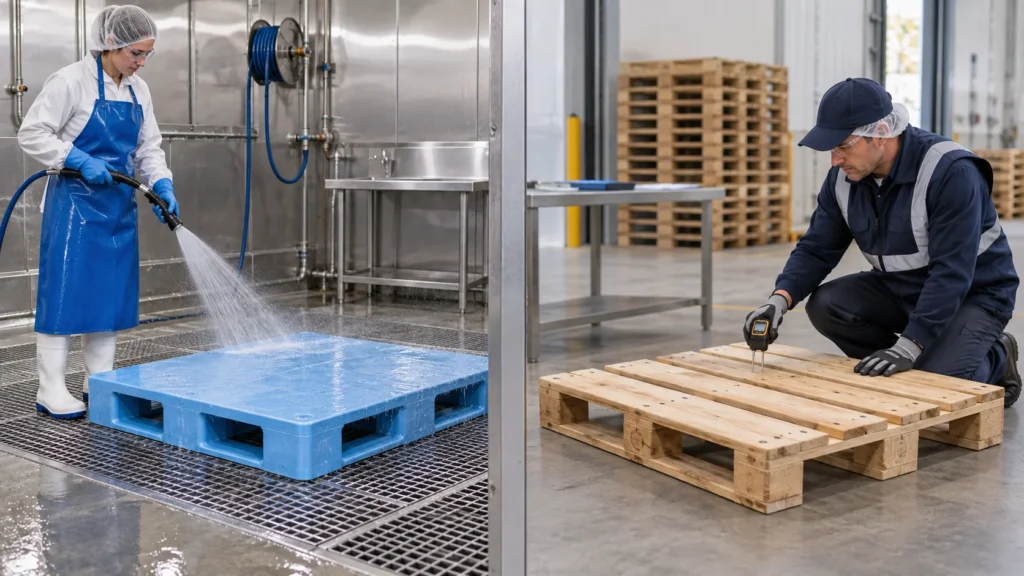
Plastic often supports a more repeatable wash-and-inspect program, but it is not automatically food-safe or contamination-proof. The advantage comes from combining documented material with cleanable geometry, drainage, validated washing, damage limits, and traceability.
Wood can absorb water and may be harder to wet-clean and dry repeatedly. Damaged boards and protruding fasteners also need control. This does not make every wood pallet unsafe; clean, sound wood can remain acceptable where the hazard analysis, packaging barrier, handling zone, and inspection program permit it.
The FDA’s sanitary transportation requirements require transportation equipment, including pallets, to be suitable and adequately cleanable for its intended use. They do not make one pallet material universally compliant.
For a food, beverage, pharmaceutical, or cleanroom project, we ask about the contact scenario, resin and additive documents, soil type, cleaning chemical, temperature, pressure, drying, drainage, inspection, and lot traceability. A washable hygienic plastic pallet is a starting point; the finished model and cleaning process must be approved together.
Do Plastic Pallets Need ISPM 15 Treatment For Export?
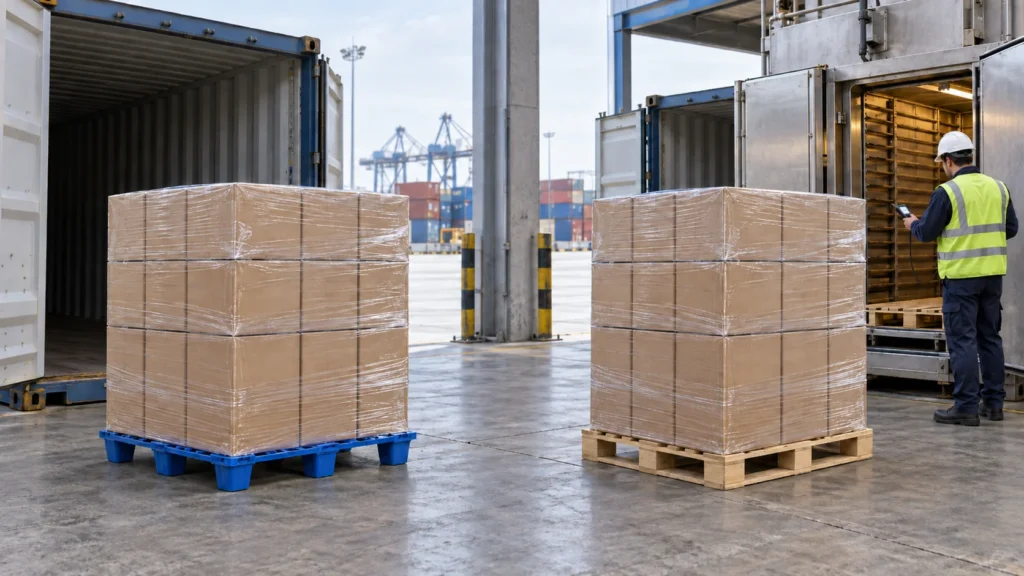
All-plastic pallets do not need ISPM 15 heat treatment, fumigation, or an IPPC wood mark because they are not raw-wood packaging. ISPM 15 covers wood packaging made from raw wood, including pallets and dunnage; processed wood such as plywood is treated differently under the standard.
The official IPPC standard summary defines this scope, and USDA APHIS lists plastic pallets among alternatives not subject to its wood-packaging regulation.
Use accurate purchase language: “all-plastic pallet; ISPM 15 wood treatment not applicable.” Plastic is not “ISPM 15 certified.” Destination import rules, carrier requirements, commodity controls, cleanliness, fire rules, and receiving specifications still apply.
For a one-way route, compare treated wood with one-way export plastic pallets by landed cost, tare, load support, fork access, destination acceptance, and local recovery—not by treatment status alone.
What Disadvantages Of Plastic Pallets Should A Supplier Discuss?
A reliable recommendation includes the limitations, not only the advantages:
- Higher acquisition cost: The premium needs enough retained trips or a measurable operating benefit.
- Loss exposure: Plastic has poor economics in an uncontrolled route unless a lightweight one-way model fits.
- Limited repair: Many molded pallets cannot be repaired like wood after structural damage; component replacement is model-specific.
- Rack creep: Long dwell, heat, and unsupported spans can create deflection without immediate breakage.
- Slip: Smooth plastic may move on fork tines, steel, or packaged goods; anti-slip parts require a real trial.
- Temperature and UV: Resin, additives, impacts, outdoor time, and minimum temperature must match the application.
- Fire protection: Both materials burn, but non-approved plastic pallets can change idle-storage and sprinkler requirements.
FM’s idle pallet storage guidance distinguishes non-FM-Approved plastic pallets from wood and FM-Approved plastic pallets. Before a fleet change, the insurer and fire-protection team need the material, approval status, quantity, stack height, storage arrangement, and sprinkler data.
Sustainability also needs a balanced comparison. A peer-reviewed review of wood and plastic pallet LCAs found major differences in study assumptions and recommends comparing trips. Material mass, completed trips, repair, loss, wash energy, payload, empty-return distance, recycled content, and actual end of life can change the result.
When Should You Choose Plastic Pallets Instead Of Wood?
| Application | Better Starting Point | Condition To Verify |
|---|---|---|
| Low-cost one-way domestic shipment | Wood | Load, condition, receiver rules, and disposal |
| Open exchange or local repair network | Standardized wood or an established pool | Repair quality, pool acceptance, and fees |
| Controlled closed-loop distribution | Reusable plastic | Trips, loss rate, tracking, cleaning, and return freight |
| Wet production or repeat washdown | Hygienic plastic design | Surface access, drainage, chemistry, and documentation |
| Food, beverage, pharmaceutical, or cleanroom flow | Application-approved plastic is often preferred | Contact scenario, cleaning validation, and traceability |
| International one-way export | Treated wood or lightweight all-plastic | Destination rules, load support, and landed cost |
| Conveyors, AGVs, or AS/RS | Controlled plastic or tightly managed standardized wood | Tolerances, inspection, and route trial |
| Unsupported racking or concentrated loads | Tested wood or reinforced plastic | Support drawing, point load, temperature, dwell, and deflection |
| Strict fire-insurance limits | Facility-specific decision | Approval, idle storage, sprinkler design, and local code |
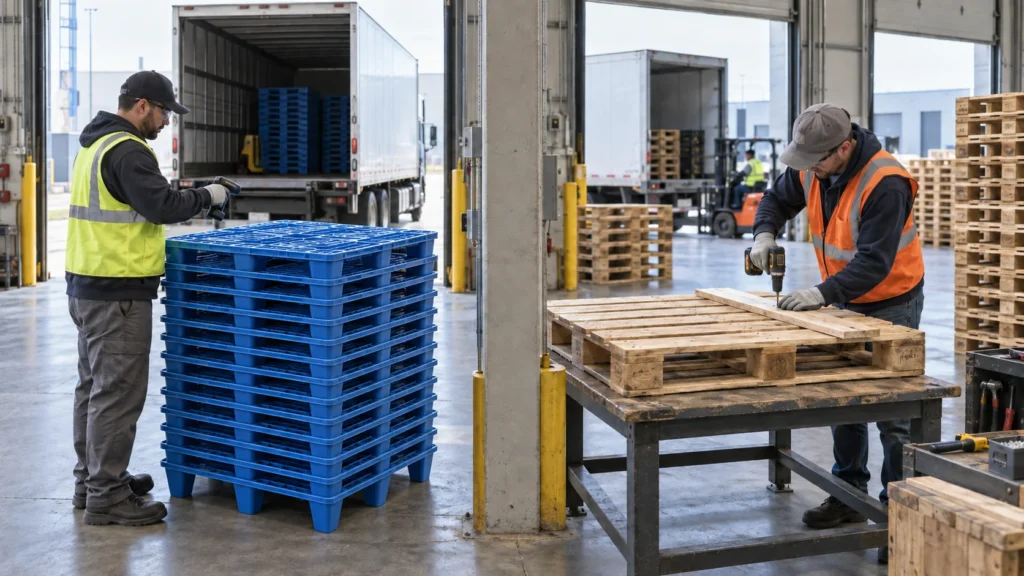
A hybrid program can be the right answer. Some operations keep plastic inside production, cold storage, or automation, then transfer outbound loads to wood or a lower-cost export pallet. Include transfer labor, equipment, product risk, and pallet recovery in the comparison.
What Information Changes A Plastic Pallet Recommendation?
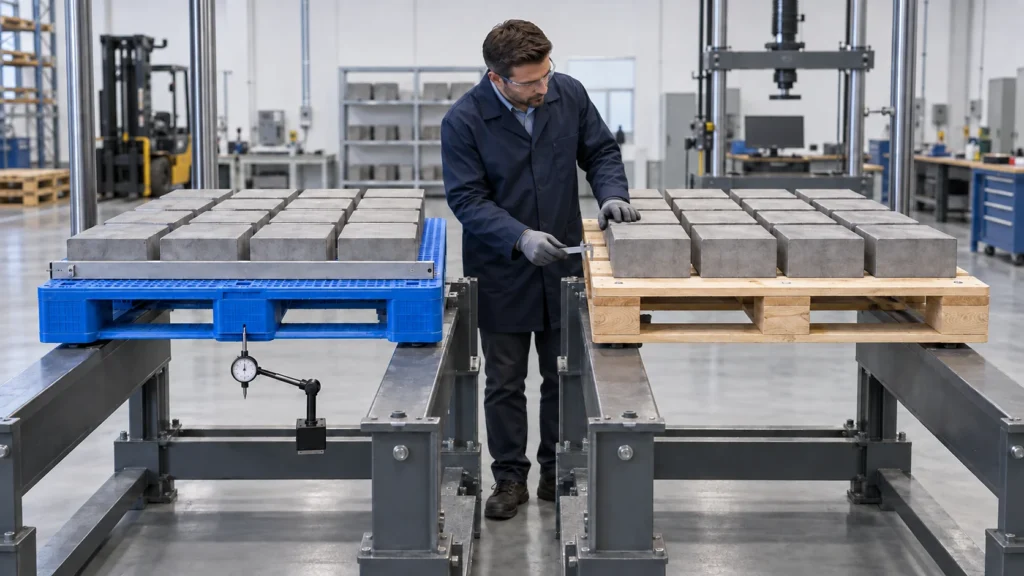
Useful selection starts with the application, not a catalog load number. When we assess a wood-to-plastic replacement, these inputs change the model, resin, reinforcement, and price:
- Product, packaging, gross unit load, pattern, point loads, overhang, and center of gravity
- Pallet footprint, height, fork entry, pallet-jack wheel path, and receiving standard
- Floor, stacked, rack, rail, conveyor, AGV, or AS/RS support drawings
- Minimum and maximum temperature, dwell time, moisture, UV, chemicals, and cleaning
- Route, destination, expected returns, loss rate, empty-storage and return constraints
- Hygiene documents, fire requirements, inspection criteria, annual volume, and budget
If an existing mold cannot fit the load or equipment, custom plastic pallet design and mold development can evaluate ribs, runners, steel reinforcement, anti-slip features, identification, and tooling as one system. The approval sample should use the intended material and complete the actual loaded route before volume production.
Frequently Asked Questions
Are Black Plastic Pallets Always Made From Recycled Plastic?
No. Color does not prove resin type or recycled percentage; request a material declaration and batch requirements when composition matters.
Can A Cracked Plastic Pallet Be Repaired?
Some assembled designs allow approved component replacement, but many one-piece pallets should leave structural service after critical damage. Never rely on an unvalidated weld for racking or safety-critical use.
Will A Plastic Pallet Fit The Same Pallet Jack As Wood?
Not necessarily. The footprint may match while fork height, spacing, load-wheel path, or bottom geometry blocks travel under load.
Can Plastic Pallets Be Stored Outdoors?
Only when the resin, UV package, drainage, temperature range, and stacking method suit the exposure. Outdoor suitability belongs to the exact model, not the word “plastic.”
Which Pallet Is Better For Cold Storage?
A low-temperature-qualified plastic pallet can manage moisture and washdown well, while wood remains viable in other freezer routes. Test the exact load, impacts, ice conditions, rack support, and minimum temperature.
Do Plastic Pallets Need Anti-Slip Inserts?
Only when trials show insufficient friction between the pallet, load, forks, rack, or conveyor. Inserts may improve control but also affect cleaning, replacement, and recycling.
Choose The Pallet Around The Route, Not The Material Label
The correct choice is the pallet that completes the required trips, supports the real load, fits every machine and receiving rule, controls hygiene and safety risks, and reaches an acceptable cost per completed trip. A model-level comparison and a production-intent trial are more useful than a generic list of material advantages.
Preface Plast manufactures nestable, stackable, rackable, hygienic, export, heavy-duty, and AS/RS plastic pallets with standard and OEM/ODM options. Share your current wood-pallet drawing, payload pattern, rack or conveyor details, temperature, cleaning method, destination, annual volume, and budget; the team can compare existing molds with a custom design, plan application-specific testing, and recommend a lower-risk transition with stable long-term supply.