
Cold Storage Plastic Pallets & Pallet Boxes for Frozen Industries
From deep-freeze handling to warm wash or transfer zones.
Choose the load carrier around the complete temperature cycle.
Compare plastic pallets, rigid pallet boxes and vented bulk bins for frozen seafood, meat, poultry, ready meals, ice cream and IQF products. Selected published options cover −40°C to +70°C; final suitability depends on the exact model, resin, load and handling conditions.
Have a load drawing, box specification or freezer layout? Include it with your enquiry.
Model-specific selection.
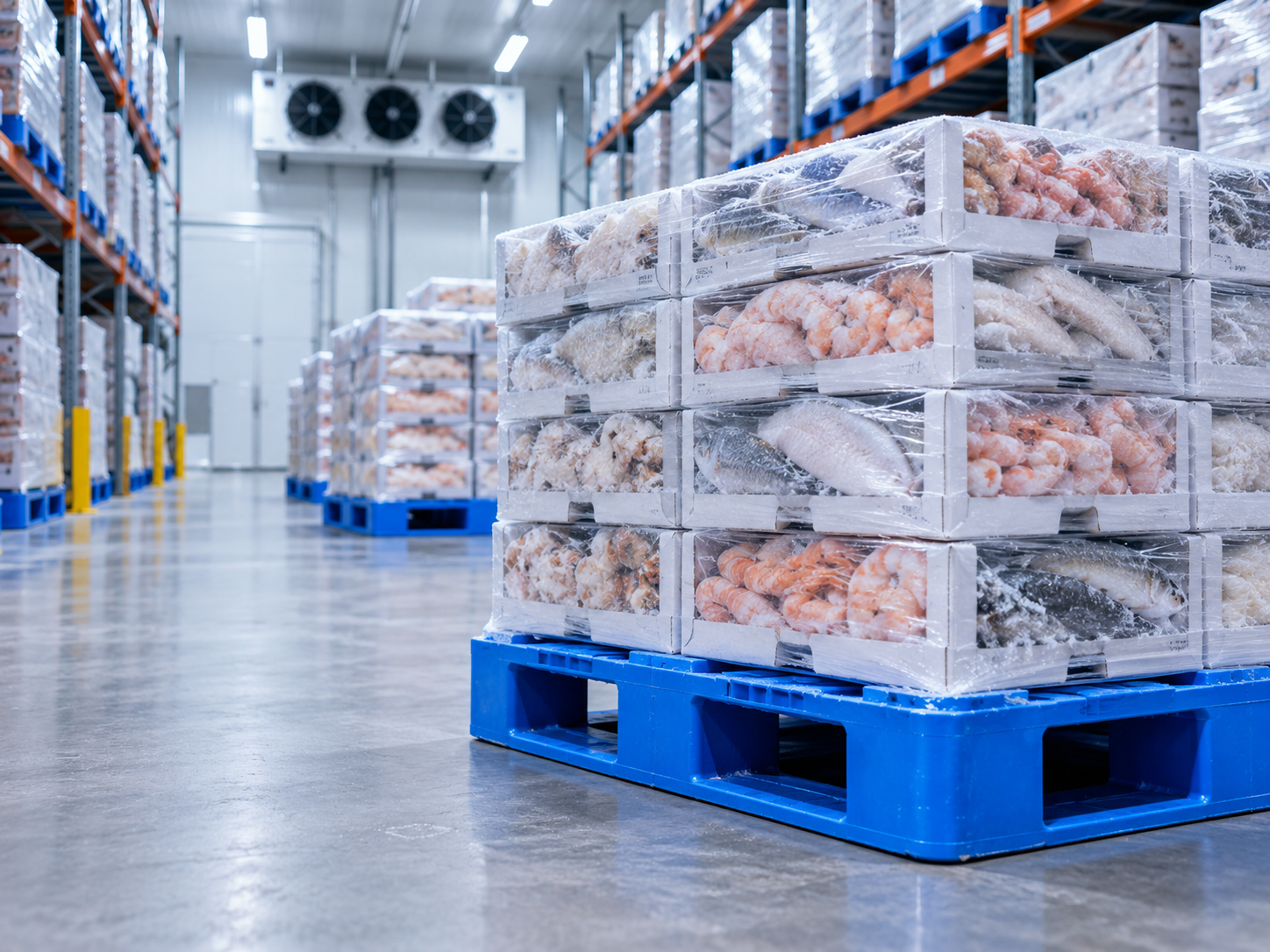
Application illustration, not a customer installation or rated load test.
Should the Load Travel on a Pallet or Inside a Pallet Box?
Cartons and wrapped unit loads may need a pallet; loose, lined, iced or irregular product may need sidewall containment. Define the product state, temperature cycle and every support point before selecting the load carrier.
Your Application Review
Send These Requirements →Compare Plastic Pallet Options for Cold Storage
These catalogue designs are starting points for a project review—not a list of pre-approved freezer pallets. Confirm the exact resin, temperature cycle, load arrangement and equipment fit for the quoted configuration.
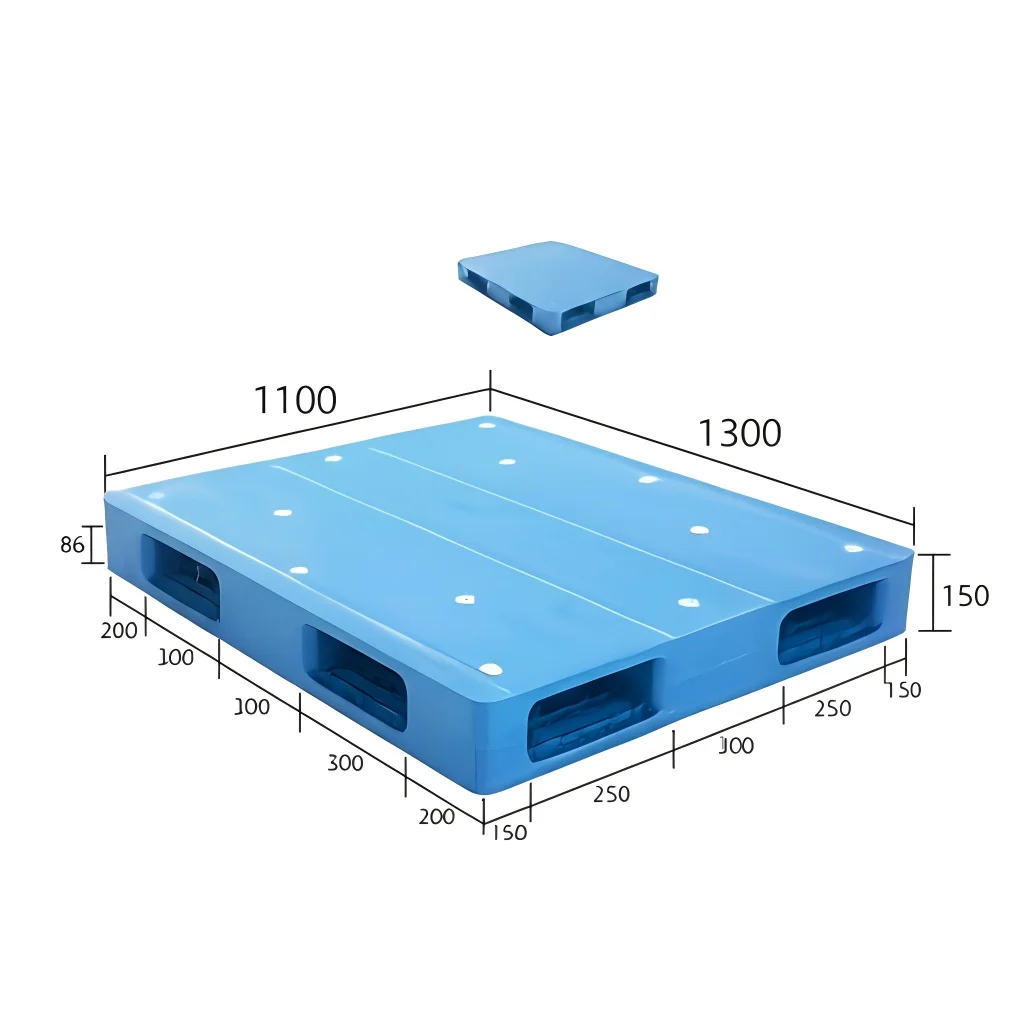
1300 × 1100 Solid-Deck Pallet
A continuous support surface for packaged loads. Review the double-faced structure, support arrangement and cold-handling requirements before choosing a configuration.
- Dimensions
- 1300 × 1100 mm footprint
- Deck / base
- Solid deck / double-faced
- Material
- HDPE; confirm selected grade
- Cold-storage use
- Application review required
Catalogue & configuration notes
The catalogue lists 24.5 kg plastic weight and unreinforced references of 1,500 kg dynamic and 6,000 kg static. These are not verified freezer or rack ratings. Request the exact configuration and test conditions.
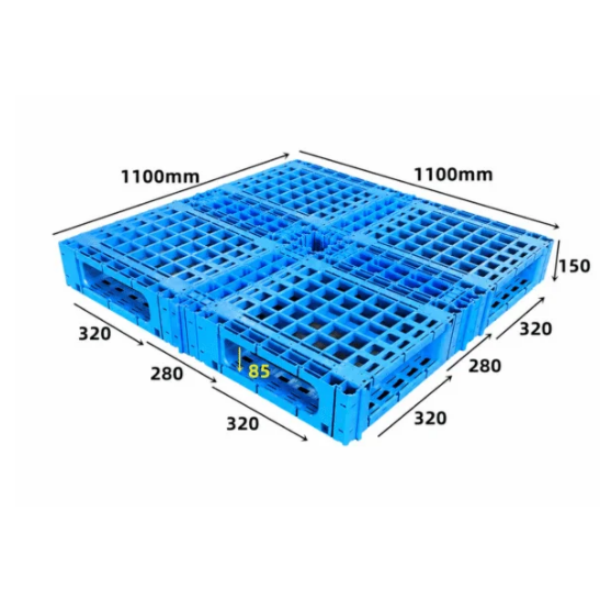
1100 × 1100 Modular Pallet
A modular structure to review where footprint, module layout or reinforcement needs adjustment. Include joint geometry, cleaning access and equipment interfaces in the specification.
- Dimensions
- 1100 × 1100 × 150 mm
- Deck / base
- Vented deck / full perimeter
- Material
- HDPE or PP; grade-specific
- Cold-storage use
- Application review required
Catalogue & configuration notes
Module layout, resin, weight and reinforcement must match the approved drawing. Request one configuration-specific temperature and load specification for the proposed version.
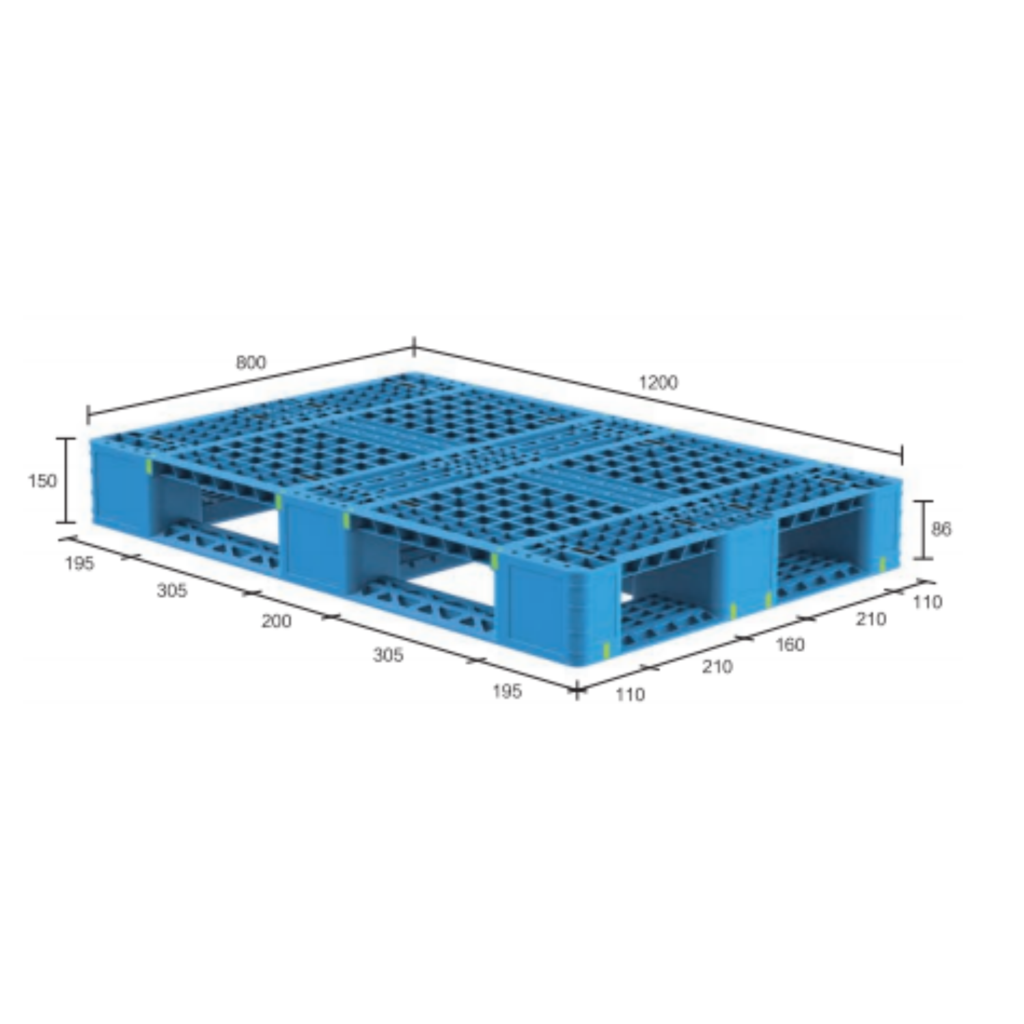
1200 × 800 Open-Deck Pallet
A Euro-footprint design for comparing carton or crate support and warehouse interfaces. Review standard and reinforced versions separately for the intended storage route.
- Dimensions
- 1200 × 800 × 150 mm
- Deck / base
- Open deck / full perimeter
- Material
- HDPE; confirm selected grade
- Cold-storage use
- Application review required
Catalogue & configuration notes
Confirm the final drawing, tare weight and reinforcement for the selected version. Rack capability and pallet-truck access require a model-specific review; a footprint alone does not establish either.
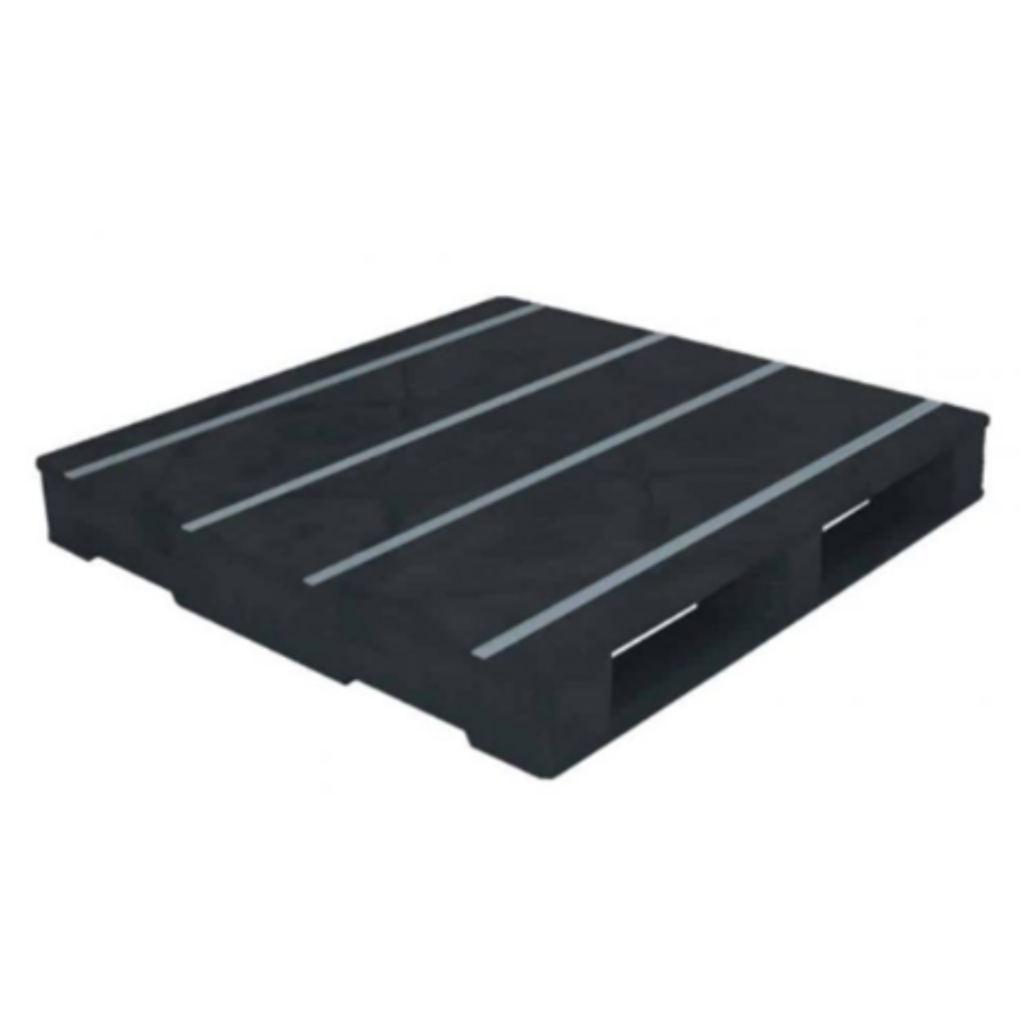
1165 × 1165 Heavy-Duty Pallet
A substantial flat-deck structure for dense packaged goods. Assess reinforcement, load footprint and support geometry together with the requested low-temperature formulation.
- Dimensions
- 1165 × 1165 × 150 mm
- Deck / base
- Flat deck / grid-style base
- Material
- Specify resin in the quotation
- Cold-storage use
- Application review required
Catalogue & configuration notes
The catalogue lists 23.2 kg plastic weight and optional 5 kg steel reinforcement. Black color does not establish recycled content. Confirm material availability and the performance evidence for the quoted version.
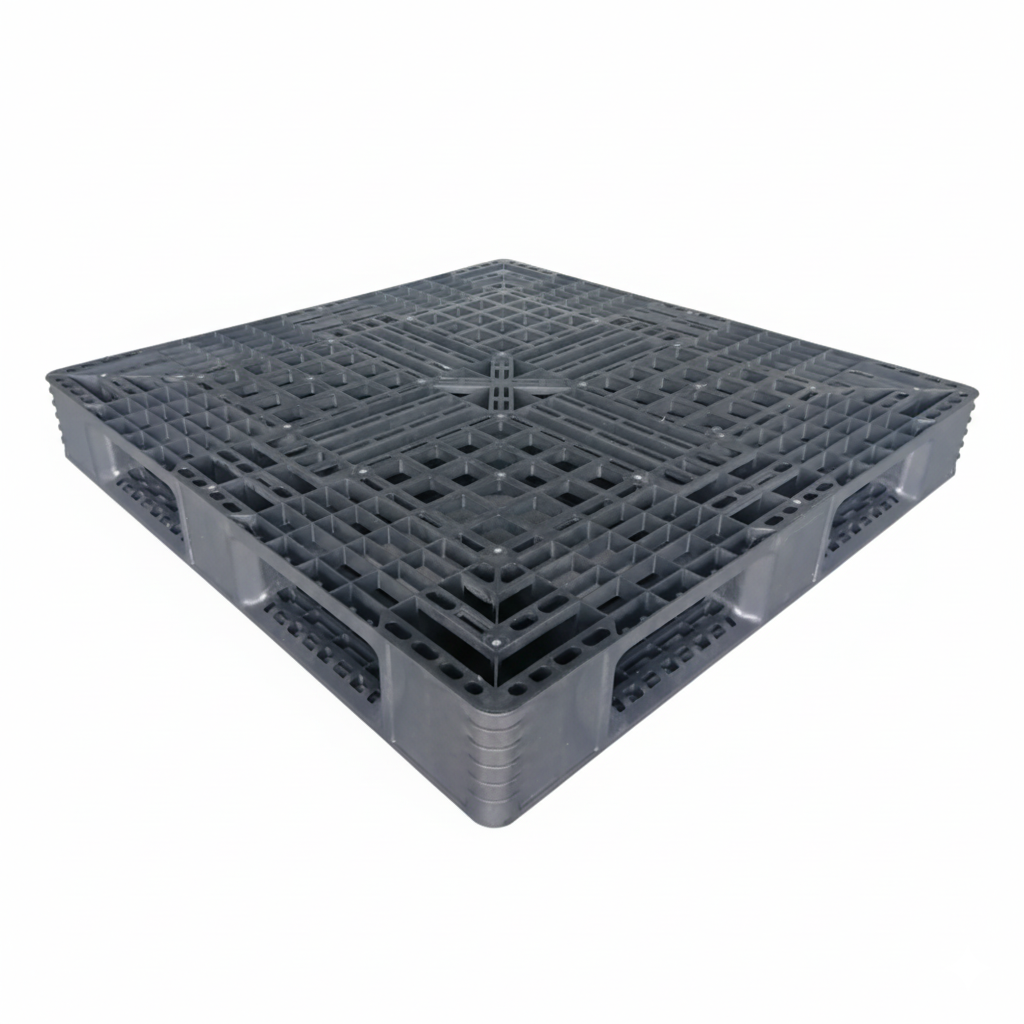
1100 × 1100 Distribution Pallet
A square grid-deck design for evaluating packaged-goods circulation. Check deck contact, handling access and the cold-storage route rather than choosing by pallet color.
- Dimensions
- 1100 × 1100 × 150 mm
- Deck / base
- Grid deck / perimeter base
- Material
- Confirm resin and recycled content
- Cold-storage use
- Application review required
Catalogue & configuration notes
The model-specific catalogue references are 11 kg plastic weight, 800 kg dynamic and 2,000 kg static without steel. They are not freezer or rack approvals. Do not substitute higher generic reference values.

1150 × 750 Nine-Leg Pallet
An empty-nesting option to assess for suitable floor-handling and distribution routes. Compare packaging support, handling equipment and the actual return process.
- Dimensions
- 1150 × 750 × 150 mm
- Deck / base
- Flat surface / nine-leg nestable
- Material
- Confirm resin and cold-use evidence
- Cold-storage use
- Application review required
Catalogue & configuration notes
The catalogue lists 6.8 kg weight and references of 500 kg dynamic and 1,000 kg static. Racking is not recommended. Nesting refers to empty pallets, not approval for loaded stacking or freezer service.
6 catalogue models available. Cold-storage suitability requires a separate review.
Plastic Pallet Boxes for Frozen and Deep-Freeze Operations
Use a rigid or vented pallet box when the load needs sidewalls, bulk capacity, airflow or controlled liquid handling. The two Preface Plast models below publish a −40°C to +70°C operating range; assess every other product separately.
This is a model-level operating window, not a blanket claim for the whole catalogue. Combine temperature with the actual load, impact, support, stacking, exposure time and cleaning conditions.

450 L Solid-Wall Pallet Box
A contained load carrier to review for frozen seafood, lined ingredients, ice-heavy handling and other bulk goods that need sidewalls rather than only a flat deck.
- Dimensions
- 1200 × 1000 × 580 mm
- Volume / tare
- 450 L / 33 kg ±5%
- Material / handling
- HDPE / PP · 3 runners / 4-way entry
- Published range
- −40°C to +70°C
Published data & application checks
Published references: 1,000 kg dynamic and 4,000 kg static. Confirm the quoted resin, drain or lid options, load distribution, loaded stacking and low-temperature impact conditions. Static load is not a stack or rack rating.
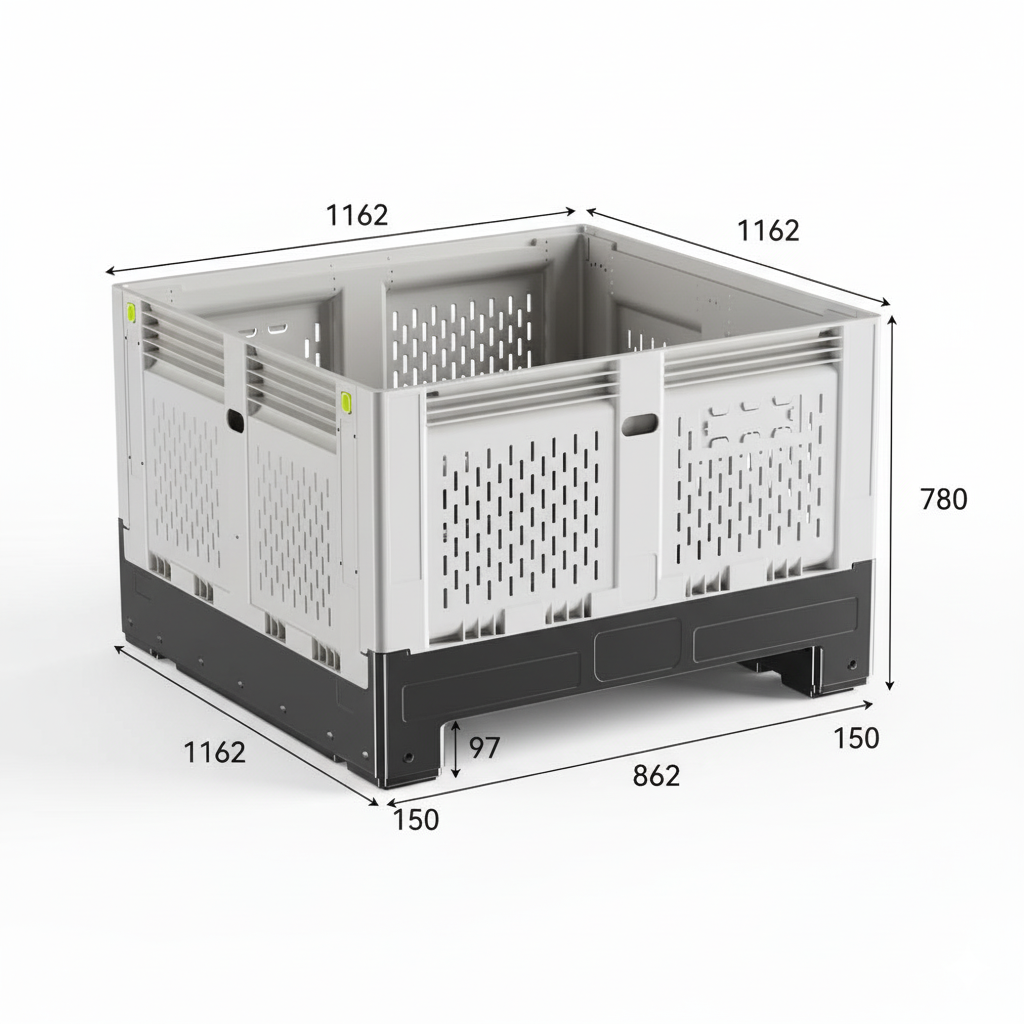
780 L Vented Nally Mega Bin
A high-volume vented option to assess where airflow, batch cooling and compact empty returns matter for frozen produce, seafood or processing ingredients.
- Dimensions
- 1162 × 1162 × 780 mm
- Volume / tare
- 780 L / 48 kg
- Material / handling
- PP · Internal 1090 × 1080 × 635 mm
- Published range
- −40°C to +70°C
Published data & application checks
Published references: 1,000 kg dynamic, 4,000 kg static, maximum stack of 6 units and 2.8:1 folding ratio. Verify the load, product protection, vent pattern, stack interface and temperature-conditioned trial for your operation.
Pallet and Pallet-Box Applications Across Frozen Supply Chains
Compare load-carrier decisions for seafood, frozen protein, ice cream, IQF produce, prepared foods and freezer distribution. These are selection scenarios, not claimed customer projects.
Bulk Carriers for Frozen Seafood & Shellfish
Iced, lined or frozen bulk product can need containment that a flat pallet cannot provide.
- A selection approach
- Compare solid-wall, vented and insulated box formats with pallets used for sealed cartons.
- What to verify
- Meltwater route, liner or lid, loaded mass, fork entry and lowest handling temperature.
Load Units for Frozen Meat & Poultry
Cartons, lined tubs and ingredient blocks create different base contact and containment needs.
- A selection approach
- Select the pack or bulk format first, then verify the pallet or box against floor, stack or rack support.
- What to verify
- Bottom contact, center of gravity, restraint, rack span and temperature-conditioned impact.
Plastic Pallets for Ice Cream & Frozen Desserts
Temperature-sensitive cartons move between hardening, frozen storage, picking and dispatch.
- A selection approach
- Review deck contact, unit-load stability and every cold-to-dock transition.
- What to verify
- Carton compression, overhang, wrap pattern, door clearances and handling frequency.
Vented Bins for IQF Fruit & Vegetable Processing
Bulk ingredients may require rapid airflow before packing, while finished cartons need stable pallet support.
- A selection approach
- Separate the pre-pack cooling carrier from the finished-goods transport pallet and validate both routes.
- What to verify
- Vent pattern, fill depth, airflow, product protection, empty return and sanitation method.
Pallets and Boxes for Frozen Bakery & Ready Meals
Trays, bags and cartons vary in stiffness and may shift during freezing or order picking.
- A selection approach
- Match openings, sidewalls and restraint to the weakest package and the actual picking process.
- What to verify
- Point loads, deck gaps, mixed-SKU stability, dwell time and receiving equipment.
Reusable Load Carriers for Freezer 3PL & Automated Stores
Mixed customers, different freezer zones and repeated transfers increase interface risk.
- A selection approach
- Create an approved matrix for each pallet or box, load family, support method and handling route.
- What to verify
- Identification, conveyor or shuttle contact, recovery, inspection and configuration control.
Plastic Pallets and Pallet Boxes for Protein & Ready-Meal Freezers
Boxed cuts, lined poultry tubs, ingredient blocks and finished ready meals create different load footprints. A pallet supports strapped or wrapped cartons; a solid-wall pallet box consolidates lined or bulk material.
Start at packing and follow the load through hard freezing, racking or floor stacking, order picking and the dock. Match the deck or sidewall, base, lid and supports to every hand-off, then verify the chosen configuration at the lowest service temperature.
Cartons, bags or lined bulk loads?
Record the pack format, bottom contact area, overhang, center of gravity and whether the load needs sidewall containment. Select the load unit first, then match the pallet or box material to it.
What happens at the freezer threshold?
State product-entry temperature, air setpoint, residence time and the number of cold-to-warm cycles. Include impacts after the plastic has been conditioned at the minimum temperature.
Rack, floor stack or mobile buffer?
A rackable pallet requirement is not transferable to a pallet box, and a box static figure is not a stack or rack rating. Define supports, loaded height, lid or rim engagement, duration and allowable deformation separately.
How does the load leave the freezer?
Check fork approach, doorway and conveyor clearances, restraint, dock temperature change and receiving equipment. The dispatch hand-off can determine whether a pallet or contained box is appropriate.

Pallet Boxes for Frozen Seafood & Cold-Room Handling
Fish, shellfish and processed seafood may reach the freezer in cartons, liners, ice or loose bulk loads. Use plastic pallets for sealed unit loads; use rigid or vented pallet boxes when the product, ice or liquid needs sidewall containment.
Map the route from landing or intake through glazing, blast freezing, frozen holding and dispatch. Product state, drainage or liquid retention, lid fit, fork entry, loaded stacking and the cold-to-warm cycle determine the container—not the seafood label alone.

Iced & Wet Intake
Decide whether meltwater must be retained, drained at a controlled point or separated from the product. Specify plugs, lids and liners.
Blast-Freezer Transfer
Record loaded mass, product-entry temperature, room setpoint, dwell time and repeated warm-to-cold transitions.
Frozen Bulk Holding
Confirm footprint, runner layout, lid or rim engagement, floor condition and approved loaded stack height.
Return, Wash & Batch Control
Compare rigid and collapsible formats against empty returns, residue access, drain cleaning and lot identification.
The 450 L Dolav box shown above publishes −40°C to +70°C. Confirm the quoted resin and combined load, impact and temperature conditions before approval.
Specify −40°C to +70°C Without Generalizing the Whole Catalogue
Selected virgin-material pallet configurations and the two pallet boxes shown above publish an operating window from −40°C to +70°C. Resin grade, geometry, loading, support and impact conditions still need to be reviewed together.
HDPE Pallets for Cold Storage
HDPE is a relevant option for low-temperature handling, but the selected grade and complete pallet design still matter. Request evidence for the actual load and service conditions.
PP Is Not One Uniform Formulation
Polypropylene grades differ. Review the specified formulation and its cold-impact performance instead of assuming every PP pallet behaves the same way.
Virgin or Recycled: Specify the Version
Confirm material source, composition controls and batch consistency. The same mold in another formulation is a different specification; color cannot establish its performance.
Storage → Handling → Cleaning → Reuse
Specify the lowest and highest service temperatures, exposure duration and movement between zones. Include whether the pallet will be handled while cold—not only stored at a low temperature.
Continuous service vs. cleaning exposure
Operating temperature and washing temperature are separate requirements. Include chemical concentration, contact time, water pressure, drying and fitted components in the cleaning review.
Freezer storage vs. a blast-freezing process
Do not assume a pallet approved for storage is suitable for every freezing process. Provide the process temperature, exposure time, packaging, airflow arrangement and handling sequence for a separate assessment.
Impact performance vs. load capacity
Load support and resistance to sudden handling impact are different properties. Include impacts at the actual service temperature in the review where relevant; do not infer one from the other.
Rackable Plastic Pallets for Cold Storage
Specify how the loaded pallet is supported before comparing capacity. Floor storage, loaded stacking and racking produce different load paths and require separate evaluation.
Static Load
Performance under a defined load arrangement with the pallet supported on a flat, rigid floor. This does not establish the safety of a loaded stack.
Dynamic Load
Loaded handling with specified equipment. Fork position, movement, impact exposure and load distribution are part of the operating condition.
Racking Load
Performance across defined rack supports. Span, orientation, temperature, duration and acceptable deformation must accompany the requirement.
| Storage method | What needs support | Confirm before selection |
|---|---|---|
| Floor Storage | Deck and packaging contact; full support on the floor. | Load distribution, handling access and floor condition. |
| Loaded Stacking | Load transfer through goods, packaging and stacking interfaces. | Package compression, upper-pallet contact, restraint and stack stability. |
| Beam Racking | A loaded pallet bridging defined supports. | Span, support direction, contact area, load duration and allowable deflection. |
| Drive-In / Shuttle | A specific rail-support and equipment interface. | Rail geometry, runner contact, clearances and the integrator’s criteria. |
Build the Order Around an Agreed Pallet Specification
Before a bulk purchase, define what the selected pallet must achieve and how acceptance will be checked. A material datasheet, a complete-pallet test and a site trial provide different evidence.
Define the Application
Record the goods, packaging, maximum load, temperature cycle, support arrangement and handling route.
Agree on the Configuration
Identify the model, resin, dimensions, base, reinforcement and any project-specific fitted components.
Review Available Evidence
Check the tested configuration, conditioning, load arrangement, method, duration and acceptance criteria.
Plan a Relevant Site Trial
Where required, agree how the pallet will be evaluated under representative equipment and operating conditions.
Align Samples and Production
Use the approved specification to define material, dimension, weight, assembly and inspection requirements.
Verify Before Shipment
Confirm the selected configuration, quantity, markings, packaging and the agreed acceptance records.
Source Cold Storage Plastic Pallets From China With a Clear Plan
Compare the specification and delivery plan alongside the unit price. For an overseas order, the quotation should identify the pallet version, quantity, inspection requirements and shipping basis.
Compare Delivered Cost
Request the loading quantity for the exact model and packing arrangement. Include relevant freight, destination costs and your agreed delivery terms.
Set Acceptance and Claims Procedures
Agree on inspection criteria, retained records and the process for reporting a nonconforming delivery before the pallets are shipped.
Review Cost per Recovered Trip
For reusable fleets, include purchase, cleaning, loss, inspection, replacement and empty-return freight. Recovery and actual usage determine the result.
Custom Cold Storage Pallet Requirements
Send your load and interface requirements before deciding whether a new mold is needed. Existing models or available modular configurations may offer a starting point.
Dimensions and base geometry
Confirm footprint, height, fork openings and runner positions. Major changes can require tooling; modular adjustment depends on the model and approved layout.
Reinforcement and anti-slip features
Assess reinforcement, surface friction and load restraint for the actual support, packaging and environment. Availability is model-specific.
Material, color and identification
Specify resin origin and polymer separately from color. Review marking, barcode or RFID provisions against the selected mold and site requirements.
Generally 300 Pieces
Model, material, stock, color and customization can change the confirmed MOQ. The final quantity is agreed with your quotation.
Sample Review
Confirm availability, sample charges, freight, trial requirements and the acceptance process for your project.
Model-Specific Plan
Request production lead time, container quantity and delivery terms for the final configuration—not a range-wide promise.
Cold Storage Pallet & Pallet-Box FAQs
Practical answers about the −40°C to +70°C range, load-carrier choice, seafood bins, stacking, racking and validation.
Temperature, Material & Food Use
Which published products cover −40°C to +70°C?
The 450 L Dolav pallet box and 780 L vented Nally Mega Bin shown on this page publish that operating range. Preface also states the range for selected virgin-material stackable pallet configurations, subject to model, load and handling conditions. Confirm it on the quotation and technical sheet for the exact product.
When should I choose a pallet instead of a pallet box?
Use a pallet as the starting point for stable cartons or wrapped unit loads. Consider a pallet box for loose, lined, iced, liquid-prone or irregular product that needs sidewall containment. The complete route may use both.
Should frozen seafood use a solid or vented pallet box?
A solid wall can retain liners, ice or liquid; a vented wall can support airflow and drainage. Product protection, meltwater control, fill depth, freezing method and cleaning determine the choice.
Does the +70°C endpoint approve hot washing?
No. An operating-temperature range and a wash process are different specifications. Confirm water temperature, chemicals, pressure, contact time, drying and any fitted components for the exact model.
Handling, Samples & Procurement
Can I calculate pallet-box stack height from static load?
No. Static load describes a defined floor-supported condition. Loaded stacking also depends on rim or lid engagement, product weight, load distribution, temperature, duration, floor condition and the manufacturer’s approved stack limit.
Can a pallet box go into pallet racking?
Only when the exact box and support arrangement have a verified rack rating. A pallet rack figure does not transfer to a box, and a box dynamic or static figure is not a rack approval.
Can I test a sample before a bulk order?
Request the proposed resin and configuration, then agree on a temperature-conditioned trial covering the representative load, impacts, supports, stacking and handling equipment before planning the bulk order.
What information is needed for a frozen-industry quote?
Send the product state and packaging, pallet or box preference, quantity, destination, dimensions, loaded weight, temperature cycle, floor/stack/rack supports and handling equipment. Add a drawing or process photo where available.
Tell Us About Your Frozen-Industry Project
Share the goods, pack or bulk format, temperature cycle, loaded weight and storage method. Tell us whether you expect a pallet, pallet box or a comparison of both.
For racks, loaded box stacking, conveyors or blast-freezer transfers, a drawing or equipment specification is particularly useful.
−40°C to +70°C Options
Match only products whose published or quoted range covers the process.
Pallet or Pallet Box
Compare deck support with solid-wall or vented containment.
Support & Stack Review
Define floor, rack, lid/rim and handling interfaces separately.
Model-Specific Evidence
Confirm the resin, configuration, load references and trial plan.
Request a Load-Carrier Recommendation
Start with the essentials. Add technical details or a drawing when available.