
Static load capacity is the stated load a pallet can support while stationary under defined conditions. Dynamic load capacity applies while the pallet is lifted or moved under defined handling conditions. The same plastic pallet can therefore have very different ratings, and neither number automatically proves that it is safe for warehouse racking.
This guide explains how to compare static, dynamic, and racking load ratings, check the conditions behind each number, and specify the right pallet for the complete operating route.
Static Load Vs. Dynamic Load At A Glance
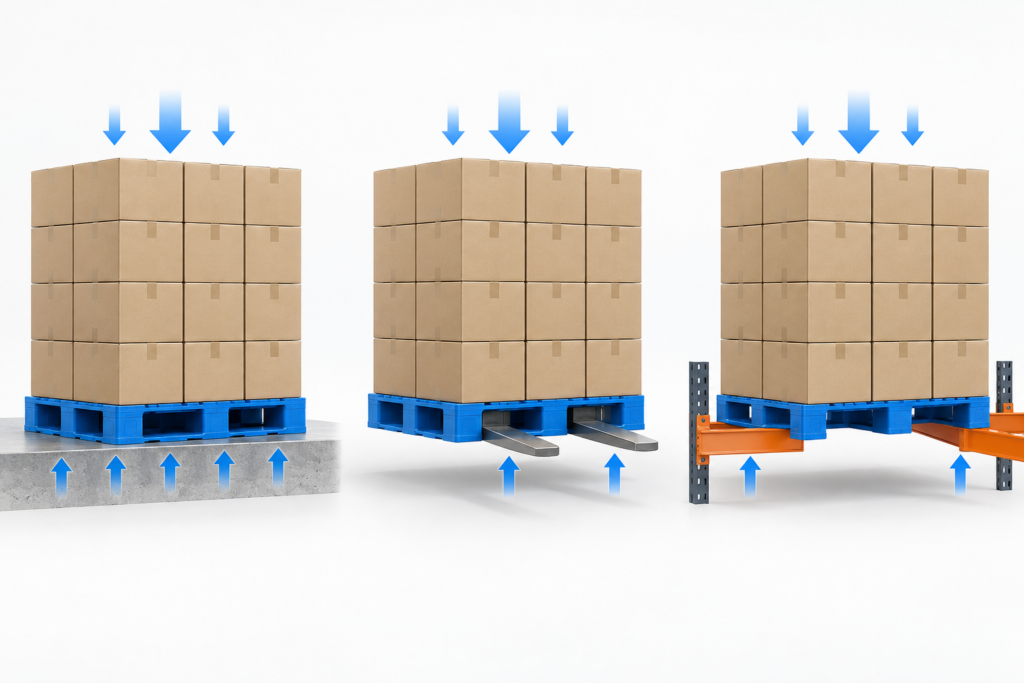
The main difference between static loading and dynamic loading is not the cargo itself. It is the combination of movement and support: a floor supports most of the pallet base, while fork tines and rack beams support much smaller areas.
| Load Rating | What It Means | Typical Support Condition | Where It Applies | What It Does Not Prove |
|---|---|---|---|---|
| Static load | Stated capacity while the pallet remains at rest | Flat, level, rigid, fully supporting surface | Floor storage and approved floor stacking | Forklift, conveyor, or open-rack performance |
| Dynamic load | Stated capacity while the pallet is lifted or moved | Forklift or pallet-jack tines under defined conditions | Internal handling, loading, and transfer | Every impact, abrupt stop, off-center load, or moving support system |
| Racking load | Stated capacity while the pallet spans defined supports | Rack beams, side rails, or another specified interface | Selective racks, drive-in racks, and high-bay storage | A different span, orientation, rail width, temperature, or duration |
This is why static load vs. dynamic load cannot be reduced to “still” versus “moving.” A valid comparison also identifies the load pattern, support points, equipment, temperature, storage time, and exact pallet configuration.
Some product sheets use “static weight” and “dynamic weight.” In pallet specifications, static load rating and dynamic load rating are clearer because the cargo’s mass does not change; the operating condition does.
What Is A Static Load?
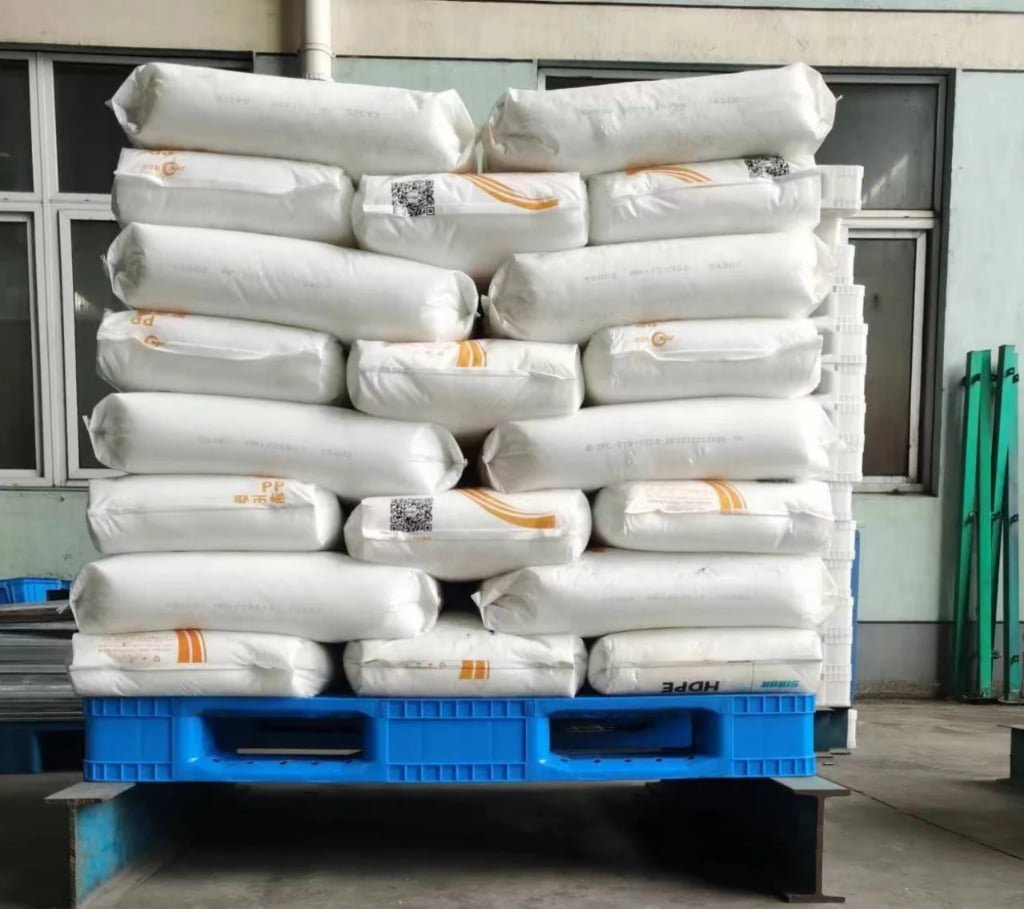
A static load is a load that remains stationary. For a plastic pallet, static load capacity normally means the maximum stated payload the pallet can support on a flat, stable, fully supporting surface under the datasheet’s stated load distribution and temperature.
In practical pallet terms, “statically loaded” means the pallet is at rest under that defined support condition. The static load meaning does not extend to any situation merely because the pallet has stopped moving: a stationary pallet across open rack beams is still a racking application, not a floor-supported static application.
Static capacity is most relevant when pallets are:
- Staged or stored directly on a sound warehouse floor.
- Used as a stationary base for an evenly distributed load.
- Floor-stacked under an approved unit-load and stacking plan.
For stacked loads, do not use the pallet number alone to set stack height. The load transferred to the bottom unit, package compression strength, contact points, alignment, restraint, floor condition, and overall stability also matter.
What Is A Dynamic Load?
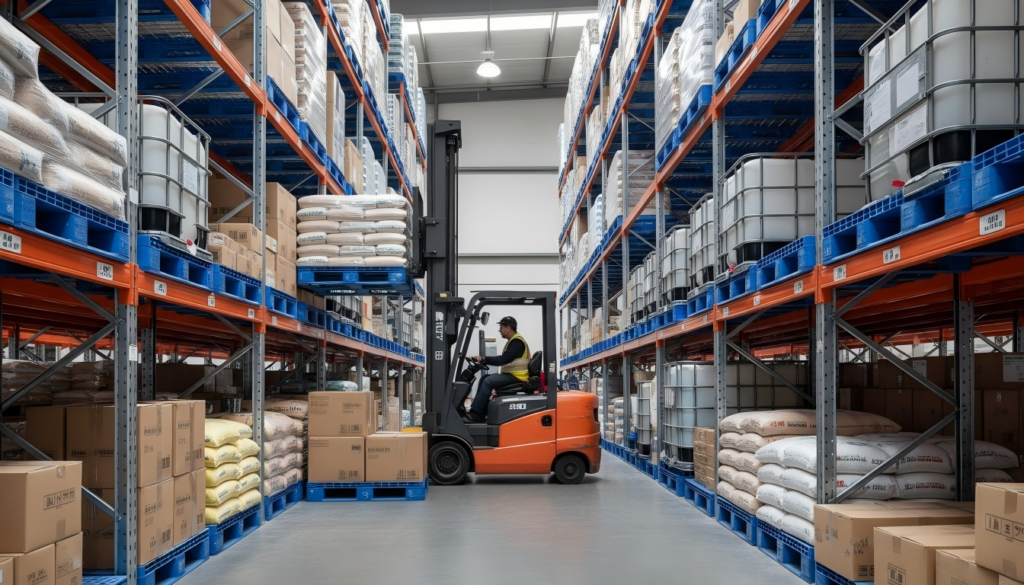
The simplest way to define dynamic load in pallet handling is the load carried while the pallet is lifted or transported on material-handling equipment. Dynamic load capacity commonly applies to a forklift or pallet jack supporting the pallet on its tines under the declared test and operating conditions.
Movement adds starts, stops, turns, vibration, and possible load shift, while the tines concentrate support beneath limited areas. A dynamic loading definition therefore needs more than the word “moving”: it should state the equipment, fork arrangement, load pattern, entry direction, and pallet configuration.
Before relying on a dynamic load rating, confirm:
- Fork or tine length, width, spacing, and insertion depth.
- Pallet entry direction and underside clearance.
- Payload footprint, center of gravity, overhang, and restraint.
- Normal starts, stops, turns, gradients, transfers, and handling frequency.
A published dynamic rating does not cover every collision, drop, short fork insertion, high-speed turn, or severe eccentric load. A moving pallet on rollers or chains also needs a conveyor-specific review because those contact points differ from fork support.
Why Is Dynamic Load Capacity Usually Lower Than Static Load Capacity?

Dynamic load capacity is often lower because the pallet receives less continuous support and encounters changing forces. Four differences normally explain the gap:
- Localized support: A floor supports broad areas of the base, while fork tines carry the load through narrow contact zones.
- Acceleration and braking: Starting, stopping, and turning transfer force through the deck, ribs, feet, or runners.
- Load shift: Liquids, bags, loosely restrained cartons, and high centers of gravity can move or lean during handling.
- Repeated handling: Fork entry, set-downs, transfer gaps, and routine impacts can affect durability even when a single lift appears acceptable.
The ratio is not universal. Two pallets can share the same static load capacity but have different dynamic capacity because their rib layout, bottom structure, welds, material, reinforcement, and fork support differ.
Never calculate dynamic capacity by multiplying the static figure by a fixed percentage. Use the dynamic rating for the exact model and configuration, then validate unusual load patterns or handling conditions.
What Is Racking Load Capacity?
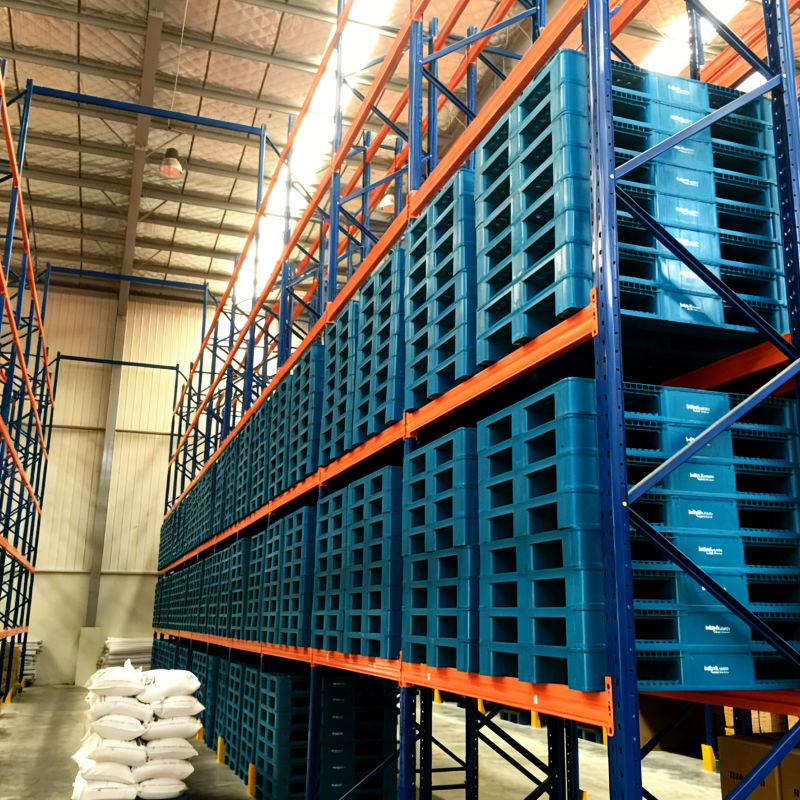
Racking load capacity is the stated payload a pallet can support when it bridges specified rack beams or rails without full support below the deck. An edge-rackable load capacity normally assumes defined bearing surfaces along two sides, but other rack systems may support runners or selected zones instead.
A pallet in a rack may be stationary in the everyday sense, yet its static floor rating still does not apply. The unsupported span creates bending, and a plastic pallet can continue to deflect under a sustained load. Beam spacing, support width, pallet orientation, temperature, storage duration, and acceptable retrieval clearance must accompany the number.
Rackable and stackable plastic pallets answer different questions. A stackable model supports approved loads through the units or floor beneath it; a rackable model must control strength and deflection across a defined open span. Review the plastic pallet racking guide or start with a purpose-designed rackable plastic pallet when elevated storage is part of the route.
Which Pallet Load Rating Applies At Each Supply Chain Stage?
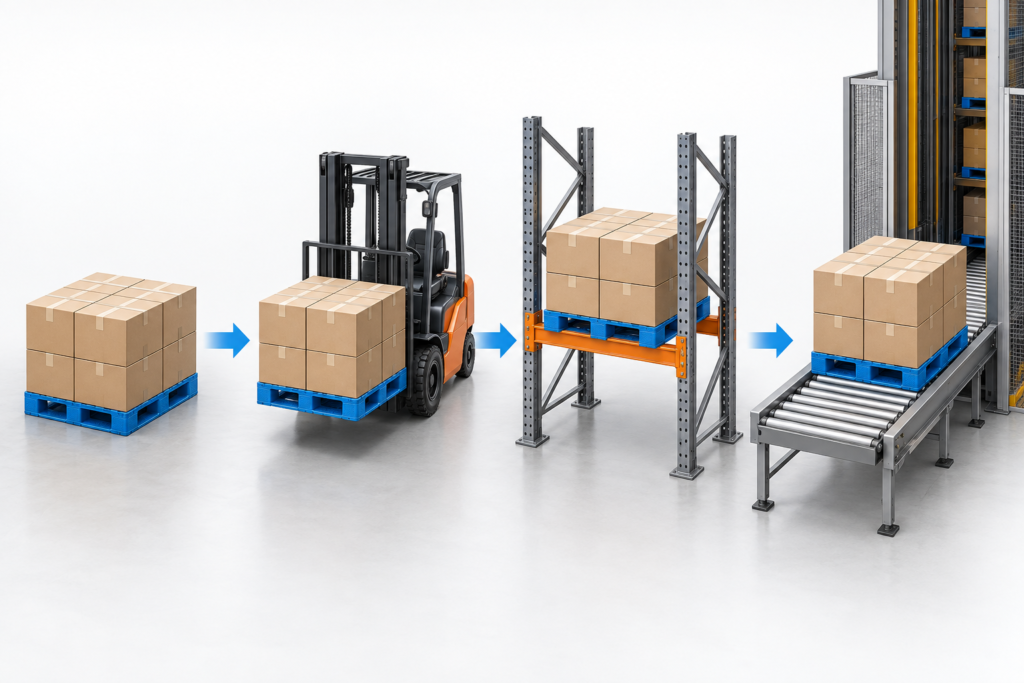
Use the rating that matches each stage, then select against the most restrictive applicable condition. A single “maximum pallet load” cannot describe a route that changes from floor support to forks, beams, rollers, or automated interfaces.
| Operating Stage | How The Pallet Is Supported | Rating Or Evidence To Review | Information To Confirm |
|---|---|---|---|
| Floor staging or storage | Broad support under the base | Static load capacity | Floor condition, payload pattern, temperature, and duration |
| Forklift handling | Tines beneath limited areas | Dynamic load capacity | Tine geometry, full insertion, entry direction, load center, and restraint |
| Pallet-jack handling | Forks and load wheels interact with the base | Dynamic rating plus equipment compatibility | Opening height, wheel path, bottom structure, and turning conditions |
| Open beam or rail racking | Defined beams or rails with an unsupported span | Racking load capacity | Clear span, bearing width, orientation, dwell time, temperature, and deflection limit |
| Loaded pallets stacked on a floor | Load transfers through pallets and packages | Static rating plus stack validation | Levels, transferred load, package compression, alignment, and stability |
| Conveyor or pallet-flow system | Rollers, chains, or short-span supports | Application-specific conveyor evidence | Contact pitch, gaps, direction, transitions, and underside geometry |
| AGV, shuttle, or AS/RS | Forks, rails, lifting pads, and transfer interfaces | Application-specific test and trial | Tolerances, flatness, deflection, sensor surfaces, and retrieval clearance |
For the complete system, use the lowest applicable limit among the pallet, forklift or pallet jack, rack or decking, packaging, and facility requirements. Material-handling equipment carries the gross loaded unit—including pallet tare—not only the payload stated on the pallet sheet.
Automated routes deserve a separate interface check. Even if a published plastic pallet dynamic load capacity covers the payload, the pallet can still sag into a transfer gap, miss a sensor, or interfere with a shuttle. These conditions should be reviewed from the beginning for AS/RS plastic pallets.
What Affects Plastic Pallet Load Capacity?
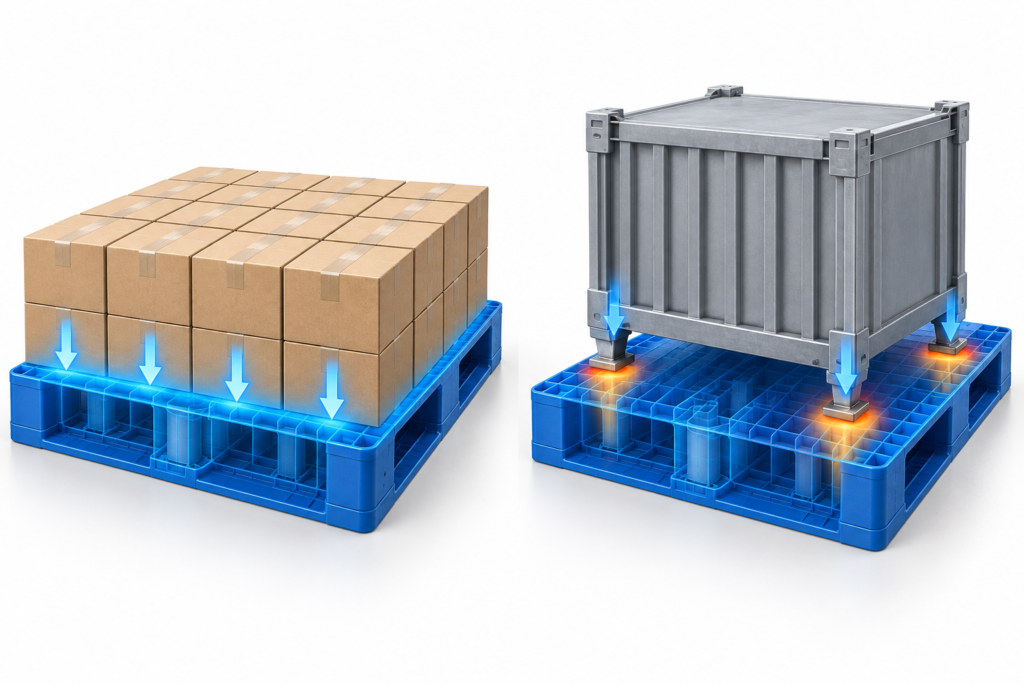
Plastic pallet load capacity comes from the complete manufactured configuration and its use conditions. Outside dimensions or resin name alone cannot establish a static, dynamic, or rackable value.
Load Distribution And Cargo Contact Area
Published ratings commonly assume an evenly or uniformly distributed load. A uniformly distributed load on a pallet, often shortened to UDL, spreads force across the deck in the pattern defined for the test. A centered center of gravity does not by itself prove UDL; enough of the deck must receive the load.
Machine feet, IBC legs, drum rings, coils, rigid bins, and crate corners can create point or concentrated loads. The Virginia Tech Center for Packaging and Unit Load Design distinguishes flexible and rigid distributed loads, line loads, point loads, and actual-product loads because each transfers force differently.
When comparing a pallet point load vs. a uniformly distributed load, provide the contact footprint, number and position of contact points, center of gravity, overhang, and a load-pattern drawing. A generic bag test may not represent a rigid machine, drum set, or IBC.
Pallet Structure, Material, And Reinforcement
Deck geometry, molded ribs, feet or runners, welded parts, and reinforcement determine how force travels from cargo to support. The same 48 × 40 in, 1200 × 800 mm, or 1200 × 1000 mm footprint can therefore have very different plastic pallet load ratings.
Do not compare HDPE vs. PP pallet load capacity by polymer name alone. Grade, recycled-content control, additives, molding quality, wall and rib geometry, and service temperature all contribute to the finished result. A heavier pallet is not automatically stronger either.
A steel-reinforced plastic pallet’s load capacity depends on tube position, direction, quantity, retention, and the test condition. Reinforcement that improves one rack orientation may have less effect during another support case, so the reinforced version needs its own drawing and declared ratings.
Temperature, Storage Time, And Plastic Creep
Temperature can change thermoplastic stiffness and impact behavior. A room-temperature rating should not be extended to a freezer, heated process, outdoor exposure, or repeated hot wash without evidence for that material and configuration.
Plastic pallet creep under load is gradual, time-dependent deformation. It matters most during long rack dwell because deflection can continue to increase even though the payload does not change. ISO/TS 8611-4:2013 specifically addresses prediction of creep response in plastic-pallet stiffness tests at ambient temperature.
For long-term storage, specify temperature, duration, support span, orientation, and allowable loaded deflection. Avoiding immediate breakage is not enough if the pallet later loses fork, sensor, or retrieval clearance.
Support Geometry, Equipment, And Pallet Condition
Rack beam span and support direction change bending. Fork spacing and insertion depth change the dynamic load path. Roller pitch, chain centers, transfer gaps, and shuttle pads can expose unsupported deck or runner areas that a floor or fork test does not represent.
Condition matters as well. Cracked runners, opened welds, crushed bearing zones, permanent distortion, exposed reinforcement, or severe gouges can interrupt the intended load path. A rating developed for a new pallet should not be assumed for a damaged or improperly repaired one.
How Are Plastic Pallet Load Ratings Tested?
Good testing connects one identified pallet configuration to the intended payload and support condition. ISO 8611-1:2025 covers test methods for nominal load, maximum working load, and durability comparison of new flat pallets; it also notes the continuing value of field trials on a specific design.
ISO 8611-2:2025 covers performance requirements and test selection for handling environments and payloads. ISO 8611-3:2011, confirmed in 2022, addresses maximum working loads for known payloads in different handling environments.
| Test Term | How To Read It In A Purchasing Decision |
|---|---|
| Nominal load | A value used to establish or compare performance under specified standard conditions; not a universal real-world payload |
| Maximum working load | The allowable payload for a known load and defined support or handling condition |
| Ultimate or failure load | A laboratory result associated with failure or unacceptable performance; not an operating target |
| Durability comparison | A way to compare repeated handling performance; not a substitute for every application-specific capacity check |
A credible qualification plan normally identifies the mold or model, material, pallet weight, welds, inserts, anti-slip parts, and steel layout before testing. It then reproduces the relevant payload, load pattern, supports, orientation, temperature, duration, and acceptance criteria.
Ask for measured deflection, damage observations, and recovery where relevant—not only “pass.” When the application includes concentrated cargo, extended storage, unusual temperature, conveyors, or automation, test the production-intent sample with the real unit load and equipment before volume release.
Use the wording “tested in accordance with ISO 8611” when supported by evidence. “ISO-certified pallet” is not interchangeable wording because ISO publishes standards but does not itself certify products.
How Do You Read A Pallet Load Capacity Chart?
Start by linking every number to one exact model and revision. A family brochure is useful for screening, but the order specification should identify the supplied deck, base, material, reinforcement, dimensions, weight, and accessories.
Use these seven questions when reading a pallet load capacity chart:
- Which configuration was rated? Confirm the model, drawing revision, resin route, steel tubes, grommets, welds, and other options.
- Which rating is shown? Separate static, dynamic, racking, and conveyor or automation conditions.
- How was the payload applied? Look for UDL, rigid load, point load, or actual product.
- How was the pallet supported? Record fork arrangement or the rack span, bearing width, and orientation.
- Which environment applies? Check temperature, dwell time, moisture, chemicals, and wash conditions.
- What test supports the figure? Identify the standard, method, result type, samples, and report.
- What are the restrictions? Look for limits on stacking, pallet jacks, unsupported racks, conveyors, damage, or outdoor use.
Pallet tare and payload must remain separate. The pallet rating normally concerns the load carried on the pallet, while a forklift, rack system, vehicle, or automated device may need to support the entire unit: pallet, cargo, packaging, restraints, and attached components.
For current product-category ranges and a deeper answer to how much weight a plastic pallet can hold, use the dedicated capacity guide. This page focuses on choosing the correct rating and conditions, which prevents the two resources from duplicating the same decision.
Worked Example: Which Rating Governs?
Consider an illustrative operation with a 1,200 kg payload. A candidate datasheet lists 6,000 kg static, 1,500 kg dynamic, and 1,000 kg racking capacity under a UDL at stated ambient and support conditions. The route goes from floor staging to forklift handling and then into an open beam rack.
| Check | Comparison | Result |
|---|---|---|
| Floor stage | 1,200 kg payload vs. 6,000 kg static rating | Within the stated figure if all static conditions match |
| Forklift stage | 1,200 kg payload vs. 1,500 kg dynamic rating | Within the stated figure if the UDL, forks, entry, and environment match |
| Rack stage | 1,200 kg payload vs. 1,000 kg racking rating | Not acceptable for that rack condition |
The high static figure cannot rescue the rack stage. The practical options are to select a configuration with a suitable verified rack rating, reduce the payload, or have the support system redesigned and approved by the responsible engineering parties.
If the pallet itself weighs 25 kg, the forklift and rack system may need to support at least 1,225 kg of gross unit load, plus whatever operating provisions their own ratings require. The pallet sheet and the equipment or rack rating must be checked separately.
How Do You Calculate The Required Pallet Load Capacity?
For procurement, calculate the maximum required payload first; do not try to derive a pallet’s tested capacity from its dimensions or static number. A useful starting equation is:
Required pallet payload = product + all packaging + dunnage + restraints and components carried on the pallet
For equipment, storage, and freight planning, use:
Gross unit load = required pallet payload + pallet tare and attached pallet accessories
Then follow this sequence:
- Record the maximum real payload, not an average order weight.
- Map every stage from loading and floor staging through forks, transport, racks, conveyors, and unloading.
- Describe whether the load is distributed, rigid, concentrated, eccentric, liquid, or capable of shifting.
- Add fork geometry, rack or conveyor drawings, support direction, span, and overhang.
- State minimum and maximum temperature, storage duration, wash conditions, and expected reuse.
- Compare every stage with the exact model’s documented rating and use the most restrictive applicable condition.
- Apply the facility’s approved risk controls and validate the real unit load when conditions differ from the published test.
A pallet load capacity calculator can total package weights and pallet tare, but it cannot certify static, dynamic, or racking capacity. There is no safe universal formula for converting one rating into the others.
Which Load-Rating Mistakes Cause Pallet Failure?
Most capacity errors begin with an incomplete specification rather than an obviously defective pallet. These mistakes are especially important when comparing two quotations.
| Common Mistake | Why It Creates Risk | Better Requirement |
|---|---|---|
| Selecting the largest number | The static figure may not govern handling or racking | Map every route stage to its applicable rating |
| Converting static to dynamic by a fixed ratio | Design and support conditions do not scale uniformly | Request model-specific test or declared data |
| Treating stationary rack storage as floor static load | Open beams create bending and time-dependent deflection | Use a rack rating tied to span, direction, time, and temperature |
| Assuming “heavy-duty” means rackable | A high floor rating does not prove open-span performance | Request an exact racking condition and report |
| Ignoring UDL language | Drums, IBCs, machinery, or bags may create concentrated or flexible loading | Supply the actual load pattern and contact drawing |
| Treating every moving system as dynamic fork handling | Conveyors and shuttles use different contact points | Validate the real interface and transitions |
| Comparing different configurations | Optional steel, resin, welds, and weight can change performance | Freeze the quoted model and revision |
| Checking only the pallet | Forklift, rack, packaging, or restraint may govern the system | Verify every component against the gross unit load |
| Reusing the new-pallet rating after damage | Cracks, distortion, and repairs can change the load path | Define inspection, rejection, and approved repair criteria |
What Should A Plastic Pallet Capacity RFQ Include?
A technically useful RFQ lets the manufacturing team compare existing molds, materials, reinforcement options, and application tests against one defined route. Send the following information instead of requesting only “a heavy-duty pallet”:
- Maximum and normal product-plus-packaging payload.
- Cargo footprint, contact points, center of gravity, overhang, and restraint method.
- Required pallet footprint, height, entry direction, deck, and base.
- Floor storage, loaded stacking, forklift, pallet-jack, vehicle, rack, and automation stages.
- Rack type, clear span, bearing width, pallet orientation, dwell time, and allowable deflection.
- Fork dimensions, conveyor roller or chain layout, shuttle pads, and other equipment drawings.
- Minimum and maximum operating, storage, washing, and transport temperatures.
- Material, recycled-content, hygiene, chemical, anti-slip, color, RFID, and logo requirements.
- Required standard, test report, product traceability, sample trial, and change-control terms.
- Order quantity, annual demand, destination, delivery schedule, and target budget.
The core requirement can be copied into an inquiry:
Please recommend a plastic pallet for a maximum payload of [kg/lb] with the attached load-pattern and support drawings. The route includes [floor/forklift/pallet jack/rack/conveyor/AS/RS], with [span and orientation] for [duration] at [temperature range]. Please state the exact model, material, pallet weight, reinforcement, static/dynamic/racking conditions, test evidence, sample plan, production tolerances, price, and lead time.
Before approving a volume order, trial a production-intent sample with the real cargo, packaging, equipment, supports, and environmental conditions. Record the approved configuration so a later change in resin, reinforcement, weight, mold, or assembly cannot enter the route without review.
Frequently Asked Questions
Can Dynamic Load Capacity Be Calculated From Static Load Capacity?
No universal ratio can do this reliably because the deck, base, forks, load pattern, material, and reinforcement affect the two conditions differently. Use the exact model’s declared or tested dynamic load capacity.
Does A Pallet Jack Use The Dynamic Load Rating?
The dynamic rating is relevant, but you must also confirm opening height, fork and load-wheel path, entry direction, and full support. A pallet that accepts forklift tines may still be incompatible with a pallet jack.
What Is The Difference Between Dynamic Weight And Static Weight?
When comparing dynamic weight vs. static weight, the cargo’s mass does not change; the pallet’s support and handling condition does. On a datasheet, use “dynamic load” and “static load” as the more precise terms.
Does Temperature Affect Plastic Pallet Load Capacity?
Yes, temperature can change polymer stiffness and impact behavior, so use only a rating validated for your operating range. Provide minimum, maximum, and wash temperatures before approval.
Does Steel Reinforcement Increase Every Load Rating?
Not equally or automatically. Check the tube position, direction, retention, pallet configuration, and the specific static, dynamic, or racking test result.
Is Dynamic Pallet Storage The Same As Dynamic Load?
No. Dynamic pallet storage usually describes pallet-flow, push-back, mobile, or other moving storage systems, while dynamic load capacity describes a pallet’s handling condition.
How Much Weight Can A Plastic Pallet Hold?
Capacity varies by model, structure, load pattern, support, temperature, and duration rather than by material name alone. Compare current model ranges in the plastic pallet weight-capacity guide, then verify the exact application.
Match The Rating To The Complete Load Path
The right pallet is not the one with the largest advertised static load. It is the configuration whose verified floor, handling, rack, and equipment performance matches the real payload, support conditions, temperature, duration, and operating route without adding unnecessary material or cost.
Preface Plast manufactures standard and OEM/ODM plastic pallet configurations for floor storage, repeated handling, racking, and automated systems. Share your unit-load data, fork and support drawings, environment, quantity, and budget so our team can compare available molds, evaluate reinforcement, and define a production-intent sample plan that reduces specification risk and supports stable long-term supply.