The plastic pallet manufacturing process turns a defined unit-load requirement into a repeatable molded platform. Most industrial pallets are made by injection molding, while blow molding, rotational molding, thermoforming, compression molding, and profile extrusion serve different structures, volumes, and applications.
This guide follows the step-by-step production process of plastic pallets, from material and mold decisions to molding, finishing, testing, and shipment. It also explains which process is likely to fit your load, equipment, hygiene requirements, order volume, and budget.
How Are Plastic Pallets Made?
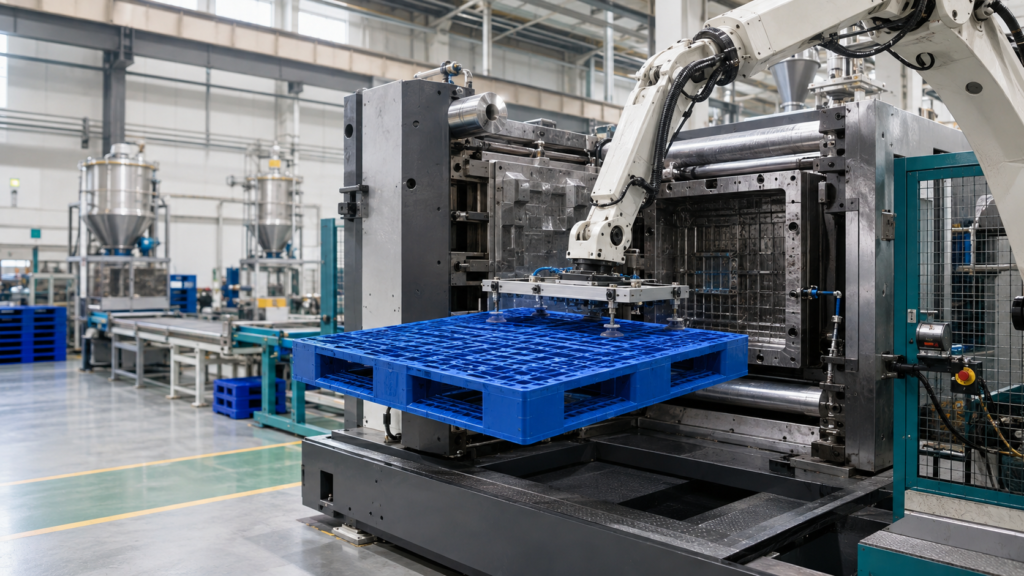
Plastic pallets are made by preparing HDPE, PP, or another specified plastic, forming it in or against a pallet mold, cooling or curing the shape, completing secondary operations, and inspecting the finished product. The exact forming step changes with the manufacturing method, but the complete plastic pallet production process normally follows this sequence:
- Define the unit load, support conditions, equipment, environment, and required pallet life.
- Select an existing pallet design or develop a custom pallet mold.
- Approve the resin, recycled-content limit, color masterbatch, and functional additives.
- Inspect, condition, measure, and mix the raw materials.
- Form the pallet by injection molding, blow molding, rotational molding, or another selected method.
- Cool and demold the pallet without distorting its deck, feet, or runners.
- Trim flash and complete welding, reinforcement, anti-slip, labeling, or tracking features.
- Inspect dimensions and appearance, then perform the required qualification or batch tests.
- Identify the production lot, pack the pallets, and release them for shipment.
The molding machine does not determine quality by itself. Pallet design, material control, process stability, cooling, secondary assembly, and application-specific testing all contribute to the finished result.
Which Plastic Pallet Manufacturing Methods Are Used?
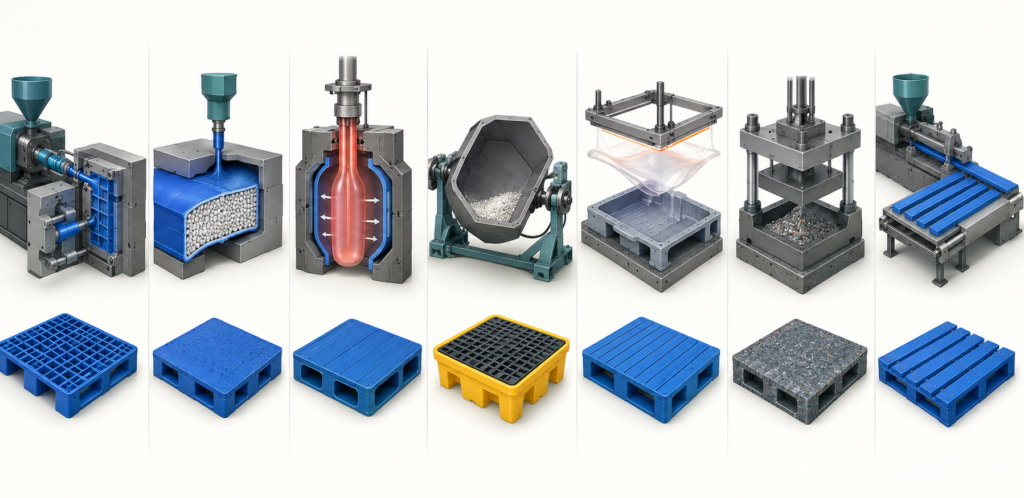
Injection molding is the most common manufacturing method for high-volume industrial plastic pallets, but it is not the only option. A process should be selected for the required geometry, tolerance, impact behavior, tooling budget, production quantity, and intended support condition.
| Plastic Pallet Manufacturing Method | How The Pallet Is Formed | Typical Result | Best Starting Fit | Main Trade-Off To Check |
|---|---|---|---|---|
| High-Pressure Injection Molding | Molten plastic is injected into a closed mold, packed, cooled, and ejected | One-piece or welded designs with detailed ribs and repeatable geometry | Reusable, stackable, rackable, hygienic, and automation-ready pallets at scale | Large tooling and machine investment |
| Structural Foam Molding | A gas or foaming agent expands the melt inside a lower-pressure mold | Dense outer skin with a cellular core and useful stiffness-to-weight balance | Large or thick-section pallets where lower pressure is valuable | Surface detail, tolerance, and long-term deflection need model-specific review |
| Blow Molding | An extruded hot tube, called a parison, is enclosed in a mold and inflated with air | Hollow, double-wall pallet with impact-tolerant construction | Rough floor handling and selected heavy-duty or nestable designs | Wall distribution, flatness, racking, and automation fit require validation |
| Rotational Molding | Plastic powder is heated inside a mold rotating on two axes | Seamless, hollow, thick-wall product | Spill-containment pallets and large specialty products | Long cycles and wider dimensional variation than precision injection molding |
| Thermoforming | A heated plastic sheet or two sheets are formed by vacuum or pressure | Lightweight single- or twin-sheet construction | Selected short-run, returnable packaging, or lightweight projects | Sheet thinning, tooling limits, and support condition must be checked |
| Compression Molding | A measured charge is pressed between heated mold halves | Thick molded pallet that can accommodate selected recycled or composite feedstocks | Cost-focused or material-recovery programs | Weight, finish, batch consistency, and load evidence vary by formulation |
| Profile Extrusion | Continuous plastic profiles are extruded, cut, and assembled | Board-and-block construction similar to a wood pallet | Nonstandard dimensions and low-to-medium-volume projects | Joints and assembly quality become structural variables |
These methods are not simple quality grades. An injection-molded pallet can be unsuitable for a rack, while a carefully designed pallet from another process may perform well in its intended route. The product drawing and test basis matter more than the process name alone.
What Is The Step-by-Step Injection Molding Process For Plastic Pallets?
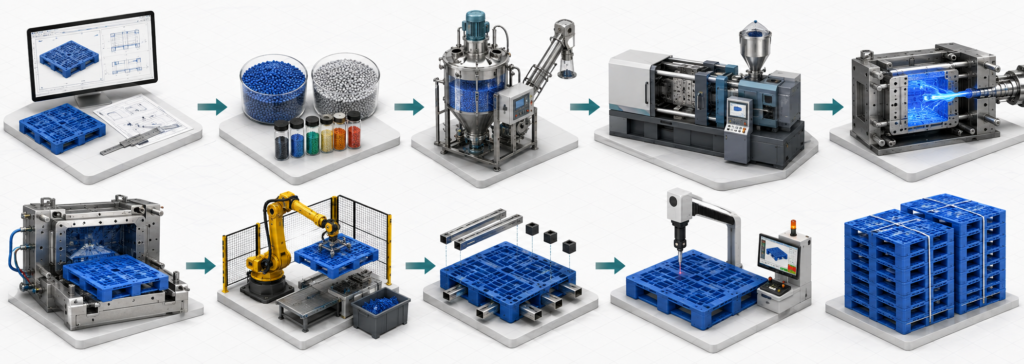
The injection molding process for plastic pallets is a controlled sequence of specification, tooling, material preparation, plasticizing, high-pressure filling, cooling, demolding, finishing, and verification. Because a pallet is a large molded part with long flow paths and many ribs, decisions made before the first production cycle strongly affect batch consistency.
Step 1: Convert The Application Into A Pallet Specification
Production starts with the route, not the resin hopper. The required length, width, height, deck, fork openings, feet or runners, load distribution, rack span, conveyor contacts, temperature, cleaning method, and expected trips define the pallet that needs to be made.
Static, dynamic, and racking loads are different support conditions. A headline load figure cannot replace details about the actual payload and where the pallet is supported.
Step 2: Select An Existing Mold Or Develop A New Pallet Mold
An existing mold usually reduces tooling cost and development time when its geometry already fits the application. Before approval, compare the drawing—not just the nominal footprint—with package support, pallet-jack wheels, fork clearance, rack beams, conveyors, stops, sensors, and loaded stacking.
If no existing model fits, custom plastic pallet services can adapt dimensions, deck and base geometry, reinforcement, identification, and material around the real handling cycle. Custom tooling makes commercial sense when the recurring operating benefit justifies development and validation.
Step 3: Approve The Plastic Pallet Material Formula
HDPE and PP are the two most common plastic pallet materials. HDPE is often considered for impact, moisture, and lower-temperature requirements, while PP is useful when stiffness and warmer operating conditions carry more weight. The final choice still depends on the grade, additives, molded structure, and tested environment.
Virgin resin, controlled regrind, and post-consumer or post-industrial recycled material can behave differently during molding and service. Specify the permitted material source, recycled content, color, odor, contamination limits, and required declarations before production rather than accepting “new” or “recycled” as a complete specification.
Step 4: Inspect And Prepare The Raw Materials
Incoming material inspection confirms the resin identity, lot, appearance, contamination status, and documentation required by the order. Masterbatch may add color, while UV stabilizers, impact modifiers, antistatic packages, or other additives may be used when the application calls for them.
HDPE and PP are generally low-moisture-absorption polymers, so they are not automatically dried in the same way as hygroscopic engineering plastics. Storage condensation, surface moisture, fillers, regrind, and certain additive packages can still require conditioning or drying under the approved processing instruction.
Step 5: Measure, Mix, And Feed The Material
The approved components are dosed and mixed so resin, color, and additives remain consistent across the production lot. Material then moves through a hopper or automated feeding system into the injection molding machine.
Poor mixing can show up as color streaks, variable flow, weak local areas, odor, or inconsistent pallet weight. Production records should connect each batch to its material lots and formulation.
Step 6: Melt And Plasticize The Resin
Inside the heated barrel, a rotating screw conveys, melts, and blends the plastic into a controlled shot. Barrel temperature, screw speed, back pressure, residence time, and material condition must work together; simply using a higher melt temperature does not guarantee better filling.
The objective is a uniform melt that can travel through the pallet’s long flow paths without excessive degradation. Stable plasticizing also helps keep shot weight and surface appearance repeatable.
Step 7: Close The Mold, Inject, And Pack
The machine clamps the pallet mold closed before the screw drives molten plastic through the sprue, runners, and gates into the cavity. The melt fills the deck, ribs, feet, runners, edges, and molded identification features.
After initial filling, packing pressure compensates for material shrinkage as the plastic begins to cool. Inadequate filling can leave incomplete ribs or edges; excessive pressure or an unstable mold-clamping condition can contribute to flash and dimensional variation.
Step 8: Cool The Pallet In The Mold
Cooling gives the pallet enough stiffness to hold its geometry during ejection. Cooling-channel design, wall and rib thickness, mold temperature, and cycle time influence shrinkage, flatness, sink marks, and warpage.
Opening the mold too early may shorten the machine cycle but transfer distortion into the finished pallet. Uneven cooling is especially important on large decks and long runners because small local differences can change conveyor contact or rack fit.
Step 9: Demold, Trim, And Complete Secondary Operations
Ejectors or robotic handling remove the pallet after the mold opens. Operators then trim gates or flash and inspect critical edges, fork openings, feet, and runners before the part moves to assembly or conditioning.
Depending on the design, secondary work may include:
- Welding separately molded upper and lower sections
- Installing steel reinforcement for selected rackable designs
- Fitting anti-slip plugs, grommets, or deck inserts
- Applying printed identification, barcodes, or labels
- Installing protected RFID or tracking components
- Completing removable runners or other modular parts
A one-piece pallet and a welded or assembled pallet need different inspection points. Weld continuity, reinforcement position, insert retention, and component traceability should be included when those features carry load or guide equipment.
Step 10: Inspect, Test, Identify, And Pack The Finished Pallets
Finished pallets are checked against the approved drawing and acceptance criteria. Dimensions, flatness, weight, appearance, fork openings, deck and runner geometry, inserts, welds, and anti-slip components can be included in routine inspection.
Qualification tests prove a design for stated conditions; batch-release checks confirm that ongoing production remains within its approved window. Mixing these two purposes creates either too little evidence or unnecessary repeated testing.
Approved pallets receive the required lot identification and are stacked or nested for shipment. Packing quantity, stack height, restraint, container loading, and unloading method should protect the same dimensional and surface features that were controlled during manufacturing.
How Does Pallet Mold Design Affect The Finished Product?
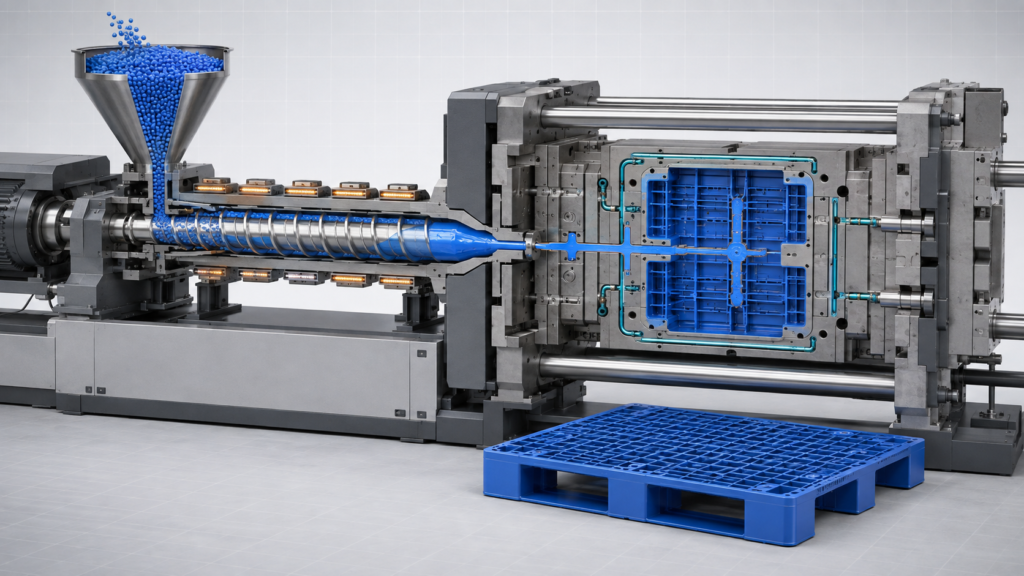
The mold converts the pallet specification into repeatable geometry, so it influences fill balance, cooling, ejection, surface detail, cycle stability, and the locations where stress concentrates in use. A large machine cannot compensate for a deck, runner, gate, or cooling layout that does not suit the load.
Important pallet mold and product-design decisions include:
- Wall and rib transitions: Abrupt thick-to-thin changes can complicate filling and cooling; rib placement must support the payload without unnecessary mass.
- Gate and flow layout: Melt must reach distant edges, feet, and runners before the flow front freezes or degrades.
- Cooling channels: Balanced heat removal helps control cycle time, shrinkage, deck flatness, and runner straightness.
- Draft and ejection: The pallet must release without damaging ribs, textures, openings, or corners.
- Fork and wheel paths: Molded clearances must match the forklifts and pallet jacks used on the route.
- Rack and conveyor interfaces: Runner spacing, bottom contact, reinforcement pockets, and sensor surfaces need to match the equipment drawing.
- Cleaning and drainage: Hygienic designs reduce inaccessible cavities and allow effective washing, draining, drying, and inspection.
For a standard warehouse project, the plastic pallet product range is a practical place to compare existing deck and underside structures before funding a new mold.
How Do Material And Recycled Content Affect Production?
Material consistency affects both molding stability and pallet performance. A change in resin grade, melt-flow behavior, contamination, filler, color package, or recycled feedstock can alter filling, shrinkage, impact behavior, stiffness, odor, appearance, and long-term deflection.
| Material Decision | Manufacturing Effect To Control | Application Question |
|---|---|---|
| HDPE Grade | Flow, shrinkage, cooling, impact behavior, and dimensional response | Will the pallet face cold, impact, moisture, or chemical exposure? |
| PP Grade | Flow, stiffness, shrinkage, and lower-temperature impact behavior | Is rigidity or warmer service more important than cold-impact tolerance? |
| Virgin Resin | Usually offers a more defined and repeatable source specification | Does the application require specific declarations, appearance, or tight batch consistency? |
| Recycled Resin | Source variation, contamination, odor, color, and melt behavior need tighter incoming control | Is recycled content permitted, and what performance evidence is required? |
| Color Masterbatch | Dispersion and dosage affect shade and processing | Is color for branding, sorting, visibility, or contamination control? |
| Functional Additives | Dispersion and compatibility can affect performance and declarations | Are UV, antistatic, flame, impact, or other properties actually required? |
A dark pallet is not proof of recycled content, and a bright pallet is not proof of virgin resin. Require material identification and relevant documentation for the exact formulation instead of judging the plastic by color.
What Quality Checks Follow Plastic Pallet Production?
Plastic pallet quality control should connect each check to an application risk. Appearance inspection catches visible defects, but it does not prove dynamic handling, long-term racking, cold impact, or compatibility with an automated line.
Routine production checks may include material and lot verification, pallet weight, key dimensions, flatness, surface condition, flash, incomplete filling, welds, reinforcement, anti-slip parts, labeling, and packing. Statistical sampling can be used where the approved quality plan permits it; critical characteristics may require tighter control.
| Observed Issue | Production Area To Review | Why It Matters In Use |
|---|---|---|
| Warped Deck Or Runners | Cooling balance, ejection timing, mold temperature, material, and storage after molding | Can create unstable loads, poor stacking, or missed conveyor contacts |
| Short Shot Or Incomplete Rib | Material feed, melt condition, venting, gates, injection, and packing | Removes intended support and may create a local weak point |
| Excess Flash | Mold condition, clamping, injection pressure, and parting-line fit | Can interfere with handling, cleaning, stacking, or worker contact |
| Sink Mark Or Local Depression | Wall/rib transition, packing, cooling, and material shrinkage | May indicate uneven solidification and change deck support |
| Burn Mark Or Discoloration | Trapped gas, venting, residence time, contamination, or excessive heat | Can indicate degraded material or unstable processing |
| Inconsistent Pallet Weight | Dosing, feed, shot size, packing, leakage, or material variation | Signals a process shift that may affect structure or dimensions |
| Loose Insert Or Poor Weld | Assembly settings, component fit, welding energy, and inspection | Can reduce reinforcement, hygiene, or service reliability |
Design qualification should match the intended handling environment. ISO 8611-1:2025 provides test methods for new flat pallets and explicitly notes that load-capacity tests do not replace field trials on specific pallet designs. For a beam-rack project, evaluate a purpose-designed rackable plastic pallet with the actual payload, span, support direction, temperature, and storage time.
Which Manufacturing Process Fits Your Application?
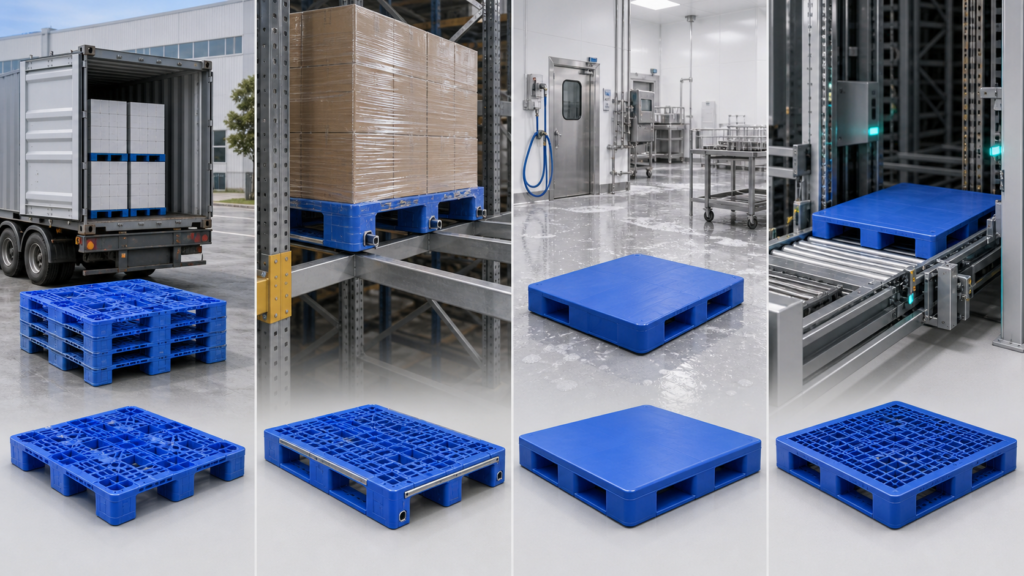
Choose the plastic pallet production method by the complete operating route, not by a generic claim that one process is strongest. The same manufacturing process can produce light or heavy designs, and final performance depends on material, geometry, reinforcement, process control, and test conditions.
| Application | Useful Process Starting Point | Product And Approval Focus |
|---|---|---|
| One-Way Export And High Empty Returns | Injection-molded nestable or other lightweight molded design | Dynamic handling, package support, nesting ratio, container quantity, and destination acceptance |
| Reusable Floor Handling And Loaded Stacking | Injection molding or selected blow-molded design | Impact points, base stability, load distribution, and completed trips |
| Beam Racking | Reinforced injection-molded or design-qualified rackable construction | Beam span, runner direction, payload, temperature, time, and permitted deflection |
| Conveyors, AGVs, And AS/RS | Precision injection molding is a common starting point | Tolerance, bottom contact, runner straightness, sensor zones, stops, and deflection |
| Food, Beverage, Pharmaceutical, Or Washdown | Injection-molded hygienic construction is often preferred | Exact resin and declarations, surface access, drainage, drying, and cleaning validation |
| Rough Handling Or Hollow Heavy-Duty Design | Blow molding may suit selected projects | Wall distribution, impact, repair policy, automation, and rack limitations |
| Chemical Spill Containment | Rotational molding is a common fit | Sump capacity, chemical compatibility, load, drainage, and regulatory requirements |
| Unusual Footprint Or Lower-Volume Project | Existing modular design, profile extrusion, thermoforming, or custom tooling | Joint strength, tolerance, lifecycle volume, and validation cost |
For a North American rack and automation route, a 48 × 40 rackable plastic pallet illustrates an injection-molded, welded, and steel-reinforced construction. European projects can compare the footprint and secondary assembly of a 1200 × 800 mm Euro plastic pallet.
If automated interfaces drive the decision, begin with the tighter geometry and validation questions used for AS/RS plastic pallets. For controlled wash programs, compare hygienic plastic pallets instead of assuming every injection-molded deck is equally cleanable.
What Affects Plastic Pallet Manufacturing Cost, MOQ, And Lead Time?
Tooling status, material mass, cycle time, secondary work, testing, and order volume drive manufacturing economics. The lowest unit price may come from an existing mold at scale, while a special low-volume project can favor a process with cheaper tooling even when its per-part cost is higher.
The main cost and lead-time factors are:
- Existing mold versus new tooling: A suitable production-ready mold avoids design, machining, sampling, and correction time.
- Pallet size and material weight: Larger or heavier designs consume more resin and occupy machine capacity.
- Resin and additive package: Virgin or recycled grade, traceability, color, UV, antistatic, impact, and other requirements affect sourcing and control.
- Machine and cycle requirements: Clamp size, shot size, cooling time, automation, energy, and changeovers influence throughput.
- Secondary operations: Welding, steel reinforcement, anti-slip parts, printing, labels, RFID, and assembly add materials and steps.
- Qualification and documentation: Drawings, samples, lab tests, declarations, inspections, and third-party verification need to be planned before the order.
- Order quantity and repeat demand: Volume spreads tooling and setup cost, while a stable forecast supports material and capacity planning.
- Packing and freight: Nesting, stack height, pallet weight, container loading, and unloading limitations affect delivered cost.
When comparing quotations, require the same pallet specification, material formula, options, test basis, packing method, and Incoterm. Otherwise, a lower quote may simply describe a different product.
How Should You Evaluate A Plastic Pallet Manufacturer?
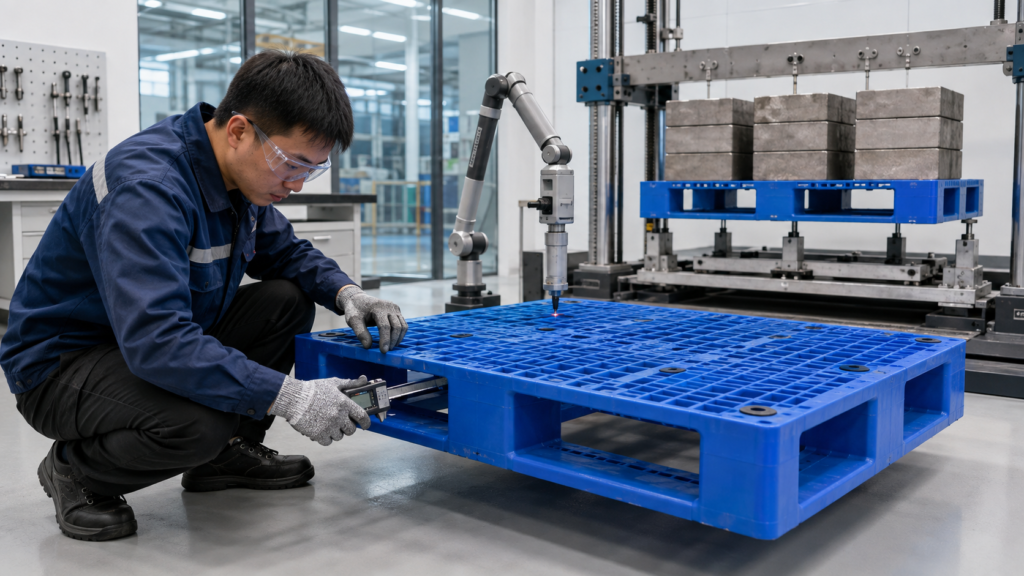
A useful factory evaluation links production capability to your actual pallet rather than collecting certificates alone. The objective is to confirm that the manufacturer can control the selected material, mold, molding method, secondary assembly, inspection, and delivery plan across repeat orders.
Before approving production, provide and review:
- Unit-load dimensions, gross weight, contact pattern, center of gravity, and stacking method
- Static, moving, stacked, racked, conveyor, and vehicle-floor support conditions
- Forklift, pallet-jack, rack, conveyor, AGV, or AS/RS drawings and clearances
- Temperature, chemicals, UV exposure, cleaning, hygiene, and fire requirements
- Pallet footprint, height, deck, base, entry, reinforcement, color, and identification
- Material grade, recycled-content rule, declarations, and traceability expectations
- Qualification tests, production inspection points, sampling plan, and acceptance limits
- Quantity, forecast, tooling ownership, sample stages, lead time, packing, and delivery terms
Ask to see a production-intent sample and the exact drawing revision behind the quotation. A showroom pallet from another mold cannot prove the material, tolerance, assembly, or load performance of the model being purchased.
Frequently Asked Questions
How Long Does It Take To Manufacture A Plastic Pallet?
There is no universal cycle time because pallet size, wall thickness, material, molding method, cooling, and secondary assembly differ. Separate the machine cycle from total lead time, which may also include material sourcing, mold changes, sampling, testing, packing, and transport.
Are All Plastic Pallets Injection Molded?
No. Injection molding is common, but plastic pallets can also be blow molded, rotationally molded, thermoformed, compression molded, or assembled from extruded profiles.
What Machines Are Used To Make Plastic Pallets?
The equipment depends on the process and may include an injection molding press, blow molding machine, rotational molding carousel or oven, thermoformer, compression press, or profile extrusion line. Feeding, mixing, robots, chillers, welders, trimmers, and test equipment may complete the plastic pallet production line.
Must HDPE And PP Be Dried Before Molding?
Not always, because HDPE and PP are generally non-hygroscopic; however, condensation, surface moisture, regrind, fillers, or some additives may require conditioning. Follow the approved resin and formulation processing instruction instead of applying one drying rule to every batch.
Can Recycled Plastic Be Used To Manufacture Pallets?
Yes, when the source, contamination, formulation, batch consistency, application restrictions, and finished-pallet tests are controlled. Recycled content should be specified as a technical and supply-chain requirement, not inferred from color or price.
Is A Blow-Molded Pallet Stronger Than An Injection-Molded Pallet?
Not in every condition. Blow molding can create an impact-tolerant hollow structure, while injection molding can provide detailed ribs, reinforcement options, and repeatable interfaces; compare the exact models under the same load and support conditions.
Why Do Plastic Pallets Warp After Molding?
Warpage can result from uneven cooling, unbalanced geometry, early ejection, material variation, or storage while the part is still stabilizing. The corrective action must address the mold, settings, material, and part handling together.
Can Logos, Colors, And RFID Be Added During Production?
Yes. Color can be introduced through an approved masterbatch, identification can be molded, printed, or labeled, and protected RFID features can be designed into selected pallets; each option should be checked for cleaning, durability, readability, and recycling.
Do Plastic Pallets Need ISPM 15 Treatment?
ISPM 15 regulates wood packaging material, so molded plastic pallets do not require the heat treatment or fumigation used for regulated solid wood. Destination, sanitation, material, and receiving requirements still need confirmation.
Final Thoughts
The best plastic pallet manufacturing process is the one that repeatedly produces the required geometry and performance at an acceptable total cost. Before choosing injection molding, blow molding, rotational molding, or another route, define the load, support, equipment, environment, volume, and evidence needed for approval.
Preface Plast has manufactured plastic material-handling products since 2003, with ISO 9001-certified production, 60+ molding machines, and a broad library of existing pallet molds. Share your unit-load drawing, equipment interfaces, temperature and hygiene conditions, annual quantity, target budget, and customization needs through our plastic pallet inquiry page. Our team can compare an existing mold with an OEM/ODM design, recommend material and reinforcement options, arrange production-intent validation, and support stable long-term supply while reducing the cost of choosing the wrong pallet process.