A tall empty-pallet stack that leans, jams during separation or blocks an aisle can turn a space-saving project into a safety problem. Loaded pallets can also slide or collapse when the pallet, packaging and stacking plan do not work together.
If empty pallets consume your floor space or return freight, start with a nestable plastic pallet. If loaded unit loads need stable floor stacking, start with a verified stackable pallet. If the pallet sits on rack beams, neither label is enough—you need a model rated for that rack condition.
Where Is Your Storage Problem—Empty Pallets or Loaded Goods?
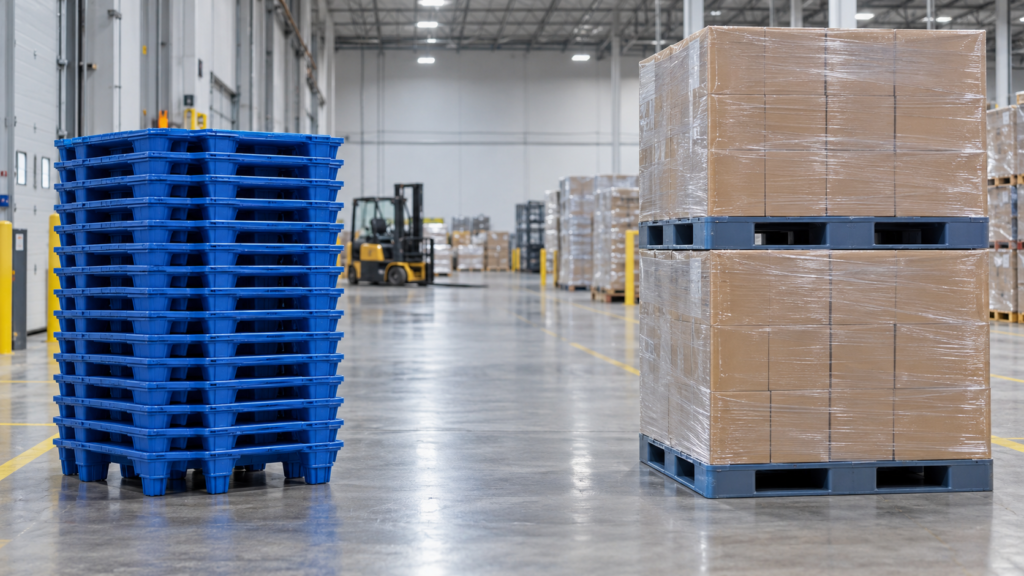
First, identify what is occupying the space. Nestable pallets reduce the cube used by empty pallets. Stackable pallets may help you use vertical space with loaded unit loads. Rackable pallets solve a different problem: supporting a load across beams or rails.
| What You See in the Warehouse | Real Constraint | Better Starting Point | What Still Needs Verification |
|---|---|---|---|
| Too many empty pallet stacks | Empty-pallet floor space | Nestable plastic pallet | Nested height, safe stack count and denesting method |
| Expensive empty return trips | Return transport cube | Nestable plastic pallet | Vehicle height, payload, restraint and unloading |
| Loaded pallets stored one-high | Loaded floor positions | Stackable pallet | Packaging compression, load stability and approved tiers |
| Pallet must span rack beams | Unsupported bending load | Rackable pallet | Beam span, direction, temperature, load and dwell time |
| Pallet runs through conveyors or dispensers | Equipment interface | System-tested model | Runner layout, transfer gaps, sensors and release reliability |
This distinction prevents the most common specification mistake: asking one pallet to solve every warehouse problem. A lightweight nestable pallet may be excellent for empty return logistics yet unsuitable for beam racking. A heavy runner pallet may support loaded storage but waste space when hundreds sit empty.
When Do Nestable Plastic Pallets Save the Most Space?
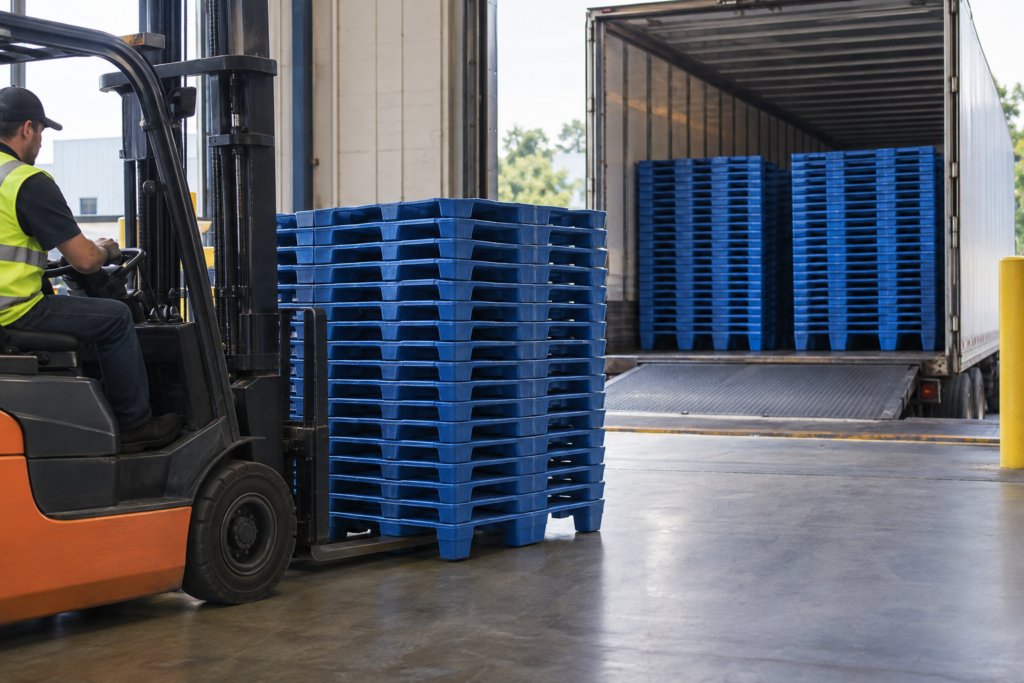
Nestable pallets work best when empty units accumulate, wait between seasons or return without cargo. Their feet enter the pallet below, so every additional unit adds only the model’s nesting increment rather than its full height.
Do not purchase a generic “75% space saving” claim. Ask for the overall pallet height, nesting increment, approved pallets per stack and measured height at 10, 20 or 40 pallets. The footprint of one stack does not shrink; the saving comes from placing more empty pallets in each floor position.
The nestable plastic pallet range is a practical starting point for empty pallet storage, retail distribution and reverse logistics. For one-way routes, compare it with export plastic pallets designed around shipment weight, destination handling and container loading.
What Can a Model-Specific Comparison Show?
Consider an illustrative warehouse holding 600 empty 1200 × 1000 mm pallets. A non-nesting model approved for 15 pallets per stack needs 40 floor positions, or 48 m² of net pallet footprint. A nestable model approved for 40 pallets per stack needs 15 positions, or 18 m².
That releases 30 m² before aisles and safety clearances are added. The result is not a universal nesting ratio: it applies only if both stack limits, heights, floor conditions and handling methods are approved for the site.
Return freight follows the same logic, but vehicle cube is only one limit. Payload, door height, stack restraint and unloading method can reduce the theoretical quantity. Use the measured stack plan from the selected model, then confirm it against your vehicle or container. Our guide to pallet size, container utilization and landed cost explains why geometric capacity is not a booking guarantee.
When Do Stackable Plastic Pallets Free Loaded Floor Space?
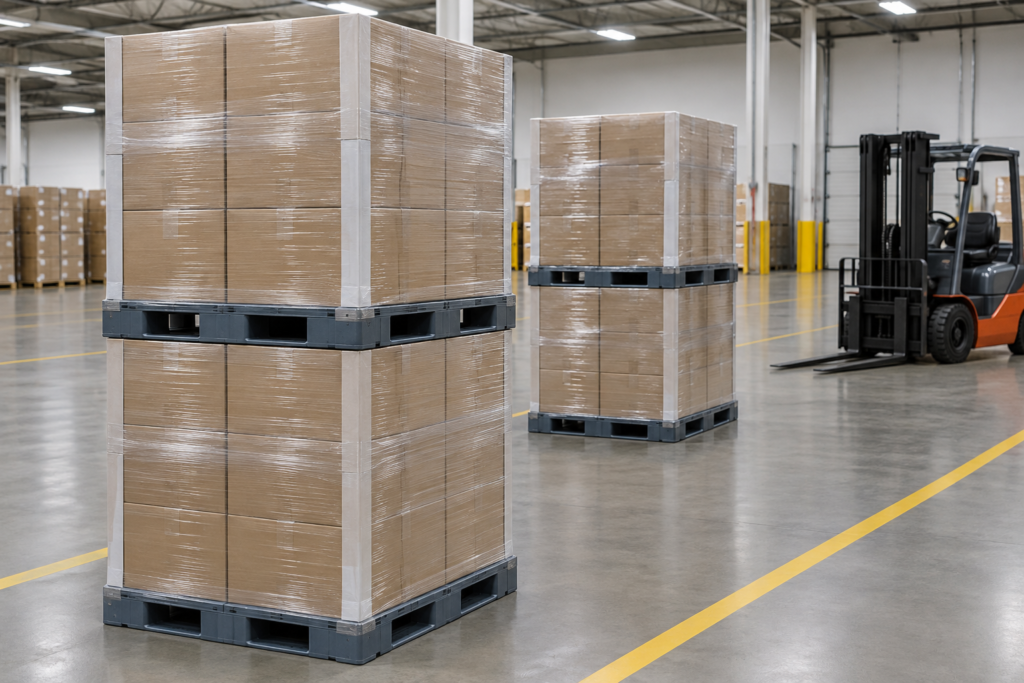
Stackable plastic pallets can reduce loaded floor positions only when the complete unit load is approved for pallet-on-pallet storage. A stable bottom deck helps, but cartons, bags, drums or containers on the lower level must also carry the upper load without crushing, leaning or shifting.
Check the loaded weight, contact area, load distribution, center of gravity, packaging strength, restraint, floor condition, humidity and storage time. The interface between the upper pallet and lower load also matters; narrow feet can concentrate pressure even when the total weight looks acceptable.
Use stackable plastic pallets as a model shortlist, then validate the real unit load. The loaded pallet stacking safety guide covers packaging compression, lean, restraint and warehouse clearances in more detail.
How Much Floor Space Could Verified Two-High Storage Release?
Suppose 240 loaded 1200 × 1000 mm pallets currently sit one-high. They use 240 floor positions, equal to 288 m² of net pallet footprint. If testing approves the complete unit load for two-high floor stacking, the same inventory uses 120 positions, or 144 m².
This example shows the opportunity, not permission to increase stack height. The pallet’s static rating alone cannot approve the change. Product packaging, storage duration, site rules, handling accuracy and the upper pallet’s contact pattern must all support the plan.
Why Doesn’t Stackable Automatically Mean Rackable?
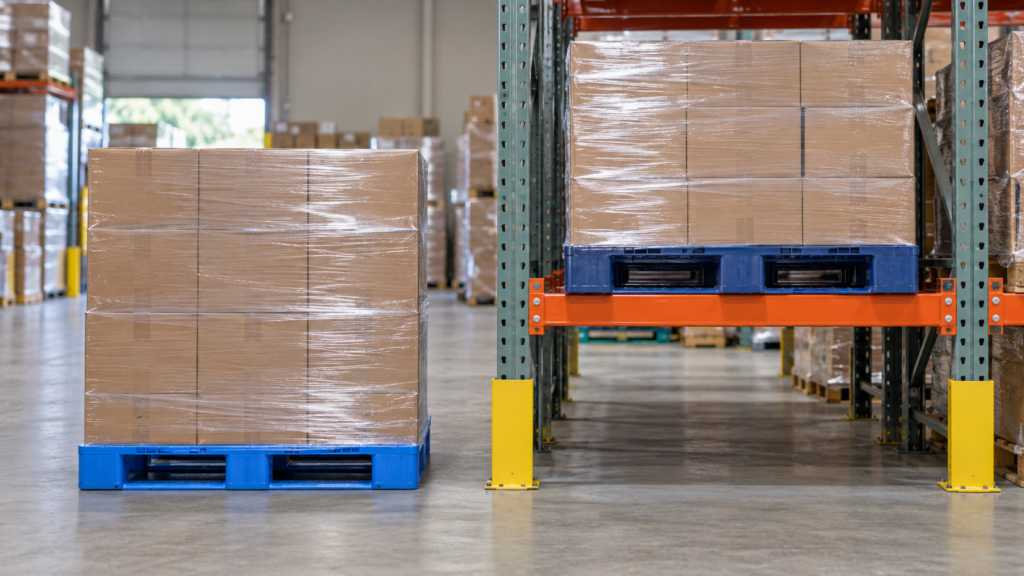
A stackable pallet normally receives broad support from a floor or the unit load below. On open-beam racking, the pallet spans an unsupported gap and remains under bending stress. That is a separate load condition, so static or dynamic capacity cannot replace a racking rating.
| Rating or Claim | What It Usually Describes | What It Does Not Prove |
|---|---|---|
| Static load | Stationary pallet on a level, continuously supported floor | Forklift movement, beam racking or loaded stacking |
| Dynamic load | Pallet lifted and moved under defined fork and load conditions | Performance across rack beams |
| Loaded floor stacking | One verified unit load placed on another | Suitability for unsupported racking |
| Racking load | Pallet spanning specified supports | Other spans, directions, temperatures or long dwell times |
| “Stackable” product label | Empty stacking or a claimed loaded-stacking use | The exact support and test condition unless stated |
Before using rackable plastic pallets, confirm the exact model, reinforcement configuration, clear beam span, support direction, pallet orientation, load distribution, temperature, storage time and permitted deflection. Virgin resin or steel reinforcement does not create a rack rating by itself.
ISO 8611-1:2025 covers test methods for new flat pallets and notes that load tests do not replace field trials on a specific pallet design. Use the plastic pallet load-capacity guide to translate static, dynamic and racking figures into the correct handling condition.
How Can You Keep Empty Pallet Stacks Safe?
Nesting saves space only when the stack remains stable and separates predictably. A high stack can lean as damaged feet, warped decks, dirt or mixed pallet models change the way each unit sits.
- Use the model-specific maximum empty stack count and height.
- Keep the stack on a level, hard surface away from impact routes.
- Nest the same model in the same orientation; do not mix sizes or designs.
- Remove cracked, warped or contaminated pallets before stacking.
- Keep aisles, exits, fire equipment and pedestrian routes clear.
- Define a safe denesting point and approved mechanical-handling method.
- Secure stacks for transport; nesting alone is not cargo restraint.
- Recheck representative used pallets because wear can change the fit.
In the United States, OSHA 29 CFR 1910.176 requires tiered material storage to be stable and secure against sliding or collapse. Other locations may apply different rules, and concentrated idle plastic-pallet storage should also be reviewed against local fire-protection requirements.
Which Pallet Fits Each Warehouse Zone?
One pallet does not have to serve every zone. Matching the structure to each stage often releases more space with less risk than forcing a universal model through storage, transport and automation.
| Warehouse or Transport Zone | Practical Starting Point | Main Approval Question |
|---|---|---|
| Empty pallet staging | Nestable pallet | How many used pallets remain stable at the approved height? |
| Empty return lane | Nestable returnable pallet | How many fit within vehicle height, payload and restraint limits? |
| One-way export | Lightweight nestable pallet | Does it support the actual load and destination equipment? |
| Loaded block stacking | Verified stackable pallet | Can the entire lower unit load carry the tier above? |
| Open-beam rack | Model-specific rackable pallet | What span, direction, temperature and dwell time were tested? |
| Conveyor, dispenser or AS/RS | Equipment-tested pallet | Does the base stay aligned and transfer without jams? |
| Hygiene-controlled area | Cleanable zone-approved model | Can it be washed, inspected, dried and segregated correctly? |
For seasonal or export flows, a lighter nestable model may serve the outbound and empty-return stages. Production storage may need a runner or full-perimeter base. High-bay locations require a separate AS/RS plastic pallet review rather than an assumption based on footprint alone.
Will the Pallet Work With Your Forklifts and Automation?
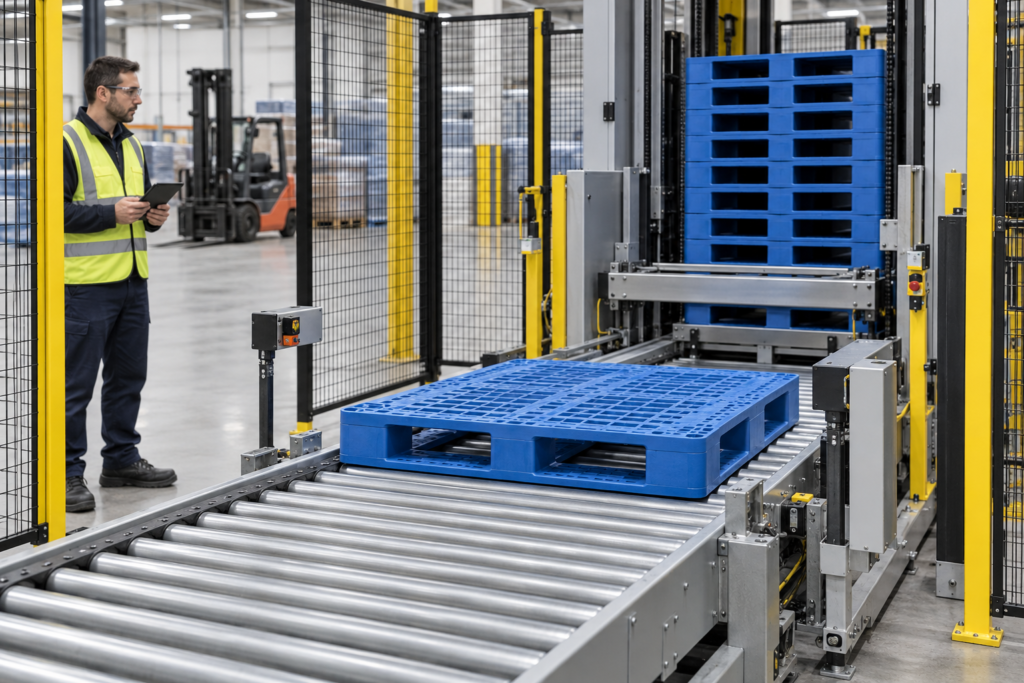
Four-way entry tells you where forks may enter; it does not prove four-way pallet-jack access, reliable conveyor travel or clean release from an automatic dispenser. Underside geometry and dimensional consistency control those interfaces.
For forklifts and pallet jacks, check fork spacing, fork thickness, wheel path, center blocks, entry height and planned approach direction. The 2-way vs 4-way pallet guide helps separate forklift access from pallet-jack access.
For conveyors and pallet dispensers, provide roller diameter and pitch, transfer gaps, chain positions, direction of travel, gripping method, sensor positions and permitted flatness variation. A useful trial includes production-intent and representative used pallets; new samples alone may hide separation force, stack lean or wear-related jams.
What Should You Compare Before Placing an Order?
Compare exact models under the same route conditions. A quotation that says only “nestable, 1,500 kg dynamic load” does not show nested height, loaded stacking ability, rack performance or equipment compatibility.
Ask for these model-specific details:
- Footprint, total height, weight and dimensional tolerances
- Nesting increment, approved stack count and measured nested height
- Complete unit-load weight, distribution and contact points
- Approved loaded floor-stacking condition, if required
- Static, dynamic and racking ratings with test conditions
- Forklift, pallet-jack, conveyor, dispenser and AS/RS interfaces
- Temperature, cleaning, indoor or outdoor exposure and storage time
- Packing method, container or truck quantity and stack restraint
- Production sample, drawing revision and bulk acceptance criteria
Do not compare a nesting percentage from one quotation with a stack quantity from another. Request the same output—for example, measured height at 20 or 40 pallets—and repeat the check on the sample. If a model jams, leans or cannot be denested safely, the theoretical space saving has little operational value.
Could a Mixed Pallet Fleet Solve More Than One Problem?
A mixed pallet fleet is often the practical answer when empty and loaded storage create different constraints. Nestable pallets can cover retail delivery, export and empty-return stages; stackable or rackable models can stay in production, block storage, conveyors and high-bay zones.
The trade-off is control. Use clear model identification, zone rules and pallet tracking so the lightweight nestable model does not enter a rack and the heavier runner pallet does not travel unnecessarily on an empty-return lane. This is usually easier to manage than over-specifying every pallet for the most demanding condition.
What Else Should You Know Before Switching Pallets?
Can One Plastic Pallet Be Both Nestable and Stackable?
Some models can nest when feet or removable runners are configured one way and stack in another configuration. Confirm load ratings, nesting height, loose-part control and equipment compatibility for every approved configuration.
Why Do Nested Plastic Pallets Sometimes Stick Together?
Dirt, dimensional variation, warped decks, damaged feet and excessive stack pressure can increase separation force. Include repeated nesting and denesting of representative used pallets in the sample trial.
Do Nestable Plastic Pallets Work With Pallet Jacks?
Some do, but many nine-leg designs lack the continuous base or wheel path a hand pallet jack needs. Four-way forklift entry does not automatically mean four-way pallet-jack access.
How High Can Empty Plastic Pallets Be Stored?
There is no universal safe height. Follow the selected model’s approved count, stack weight and site risk assessment, then keep the stack stable and clear of traffic, exits and fire equipment.
Do Plastic Export Pallets Require ISPM 15 Treatment?
ISPM 15 applies to regulated raw-wood packaging, not molded all-plastic pallets. Confirm destination and receiver requirements, especially if wood components are added to the shipment.
Which Pallet Should You Test First?
Start with the space you can actually recover. If empty pallets dominate the staging area or return route, test a nestable model and record real stack height, separation and vehicle quantity. If loaded inventory stays one-high, test the entire unit load on a compatible stackable pallet. If rack beams are involved, begin with the exact racking condition.
Still deciding between nestable and stackable plastic pallets? Share your pallet size, unit-load weight and packaging, storage method, handling equipment, operating temperature, return distance and annual quantity with Preface Plast. We can compare existing nestable, stackable and rackable models, arrange a sample trial or OEM/ODM option, and prepare a model-specific quotation that reduces selection risk and supports stable long-term supply.