

Pallets don’t have a universal weight limit. How much weight a pallet can hold depends on whether the pallet is stationary, being moved, or stored in a rack. For plastic pallets, these conditions are normally described by static load capacity, dynamic load capacity, and racking load capacity.
For a practical reference, Preface Plast’s standard plastic pallet specifications list 1,000–2,000 kg dynamic load, 4,000–8,000 kg static load, and 500–1,500 kg racking load, but the correct rating always depends on the exact pallet design and application.
This guide explains how to read these numbers, how many 50-pound bags a pallet can carry, what affects plastic pallet weight capacity, and how to choose a pallet for floor stacking, forklift handling, or warehouse racking.
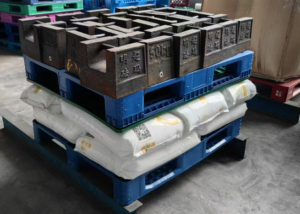
How Much Weight Can a Pallet Hold?
There is no single answer to how much weight a pallet can hold because the same pallet can have very different load ratings under different operating conditions.
| Load Type | What It Means | Typical Plastic Pallet Capacity |
| Static Load | Pallet remains stationary on a fully supported, level surface | 4,000–8,000 kg |
| Dynamic Load | Pallet is lifted or moved by forklift or pallet jack | 1,000–2,000 kg |
| Racking Load | Pallet is supported by rack beams or limited support points | 500–1,500 kg |
These ranges are useful for initial product selection, not as a universal rating for every pallet. The exact specification should come from the technical data for the model being used. Preface Plast states that its plastic pallets are evaluated according to ISO 8611, which defines test methods and performance requirements related to pallet load capacity, durability, and structural integrity.
The key point is simple: never use the static load rating as the maximum load for every application. A pallet that safely supports a heavy load on the warehouse floor may have a much lower allowable load when it is lifted or placed across rack beams.
What Is Static Load Capacity?
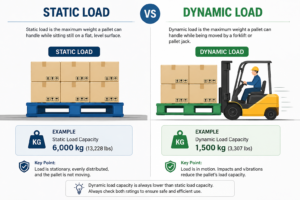
Static load capacity is the maximum weight a pallet can support while it is stationary on a flat, stable, fully supported surface.
This is usually the highest load rating because the entire underside of the pallet receives relatively even support. There is no forklift movement, acceleration, braking, or vibration adding extra stress to the pallet structure.
For example, Preface Plast lists 6,000 kg static load capacity for several heavy duty plastic pallet models. These include models with 1200×800 mm, 1200×1100 mm, 1200×1200 mm, and 1250×1000 mm dimensions.
Static capacity is most relevant when pallets are:
- Stored directly on the warehouse floor
- Used for stationary loads
- Stacked under approved conditions
- Holding heavy products that are not being moved during storage
However, a high static load rating does not automatically mean that the same pallet can carry the same weight during forklift handling or warehouse racking.
What Is Dynamic Load Capacity?
Dynamic load capacity is the maximum weight a pallet can carry while it is being moved by equipment such as a forklift, pallet truck, or hand pallet jack.
Movement creates additional forces that do not exist when the pallet is simply resting on the floor. Fork entry, acceleration, braking, uneven floors, vibration, and shifting loads can all change the stress placed on the pallet.
This is why dynamic load capacity is normally lower than static load capacity. (Enlightening Pallet)
For example, several Preface Plast heavy duty pallet models are listed at 1,500 kg dynamic load and 6,000 kg static load.
That difference matters in real operations. If a pallet is rated for 6,000 kg static but 1,500 kg dynamic, loading 2,000 kg and then moving it by forklift would exceed its stated dynamic rating even though the static number appears much higher.
For day-to-day logistics, the dynamic rating is often the more important number because the pallet is normally lifted and transported rather than left permanently on the floor.
What Is Racking Load Capacity?
Racking load capacity is the maximum weight a pallet can safely support when stored in a pallet racking system.
Unlike floor storage, a rackable pallet may be supported mainly by rack beams or specific contact areas rather than across its entire bottom surface. This creates a different load condition and can increase bending and deflection.
For this reason, racking load capacity is usually lower than static capacity. Typical plastic pallet specifications commonly show racking ratings around 500–1,500 kg, depending on design and support conditions. Preface Plast lists this same general range for its standard plastic pallet specifications.
When your warehouse uses high-bay storage, the rack system and pallet have to work together. A pallet advertised as “heavy duty” is not automatically suitable for every rack configuration.
For repeated warehouse storage, a purpose-designed rackable plastic pallet is a safer starting point because the pallet structure is designed around rack support conditions.
Static Load Vs Dynamic Load: What Is the Difference?
The easiest way to understand static load vs dynamic load is to think about whether the pallet is moving.
| Condition | Static Load | Dynamic Load |
| Pallet location | Stationary | Moving |
| Typical support | Flat warehouse floor | Forklift or pallet jack |
| Main concern | Long-term weight support | Movement, impact and handling stress |
| Typical capacity | Higher | Lower |
| Main use | Floor storage and stacking | Transportation and handling |
A pallet with a 6,000 kg static rating and a 1,500 kg dynamic rating should therefore be treated as a 1,500 kg pallet during movement, not as a 6,000 kg pallet.
This distinction also helps prevent a common specification mistake: comparing two pallets using only their highest advertised capacity. The useful comparison is always based on the load rating that matches your actual operating condition.
What Is Dynamic Pallet Racking?
The phrase dynamic pallet racking can refer to two different ideas, which can create confusion.
In pallet specifications, dynamic load means the pallet is being moved. In warehouse storage terminology, dynamic pallet racking can refer to a rack system designed for pallets to move through the rack, such as pallet flow or FIFO systems.
These are not the same thing.
A pallet can have a dynamic load rating for forklift handling and also be used in a rack system, but its racking suitability must be evaluated according to the actual support arrangement. The rack itself also has its own structural capacity.
For a warehouse using beam-supported storage, check:
- Pallet racking load capacity
- Beam spacing
- Pallet dimensions
- Load distribution
- Pallet deflection
- Total unit-load weight
- Whether reinforcement is required
This is especially important for heavy or concentrated loads. Two pallets carrying the same total weight can behave differently if one carries evenly distributed cartons while the other carries concentrated drums, bags, machinery, or containers.
How Many 50 Pound Bags Can a Pallet Hold?
The answer to how many 50-pound bags on a pallet depends on both the pallet’s load capacity and the physical loading pattern.
One 50-pound bag weighs approximately 22.68 kg. Theoretical bag quantities can therefore be estimated as:
Number of 50 lb bags = Applicable pallet load capacity ÷ 22.68 kg
For example:
| Pallet Rating | Theoretical 50 lb Bags |
| 500 kg | About 22 bags |
| 1,000 kg | About 44 bags |
| 1,500 kg | About 66 bags |
| 2,000 kg | About 88 bags |
| 4,000 kg | About 176 bags |
| 6,000 kg | About 264 bags |
These numbers are capacity calculations only. They do not mean that the pallet should actually be loaded with that many bags.

The physical footprint of each bag, pallet dimensions, stacking height, bag stability, packaging strength, and the applicable dynamic or racking rating can all limit the practical quantity. Retail packaging examples also show that the number of 50-pound bags per pallet varies by product and packaging configuration; for example, SAKRETE states that its 50 lb play sand is typically shipped as 54 bags per pallet.
For a moving pallet, use the dynamic load rating, not the static rating, to calculate the allowable product weight.
How Much Weight Can a Plastic Pallet Hold?
The plastic pallet weight capacity depends on pallet size, structural design, material, reinforcement, and the conditions used for testing.
As a general reference, Preface Plast currently lists the following standard plastic pallet ranges:
| Plastic Pallet Load Rating | Typical Range |
| Dynamic Load | 1,000–2,000 kg |
| Static Load | 4,000–8,000 kg |
| Racking Load | 500–1,500 kg |
Heavy-duty designs can offer substantially higher static capacity than lightweight export pallets. For example, Preface Plast’s heavy-duty range includes models rated at 1,500 kg dynamic load and 6,000 kg static load, with different dimensions, deck structures, and reinforcement configurations.
This is why two plastic pallets with the same outside dimensions can have very different load capabilities.
The plastic pallet itself is only one part of the equation. The structure underneath the deck, reinforcement, base design, and intended support condition all matter.
What Factors Affect Plastic Pallet Weight Capacity?
When comparing plastic pallets, the load rating should always be evaluated together with the application.
Pallet Dimensions And Structure
A larger pallet is not automatically stronger. Deck thickness, rib structure, feet or runners, bottom configuration, and the way the load is distributed all influence performance.
A pallet designed with a reinforced underside may perform very differently from a lightweight nestable pallet of similar dimensions.
For example, Preface Plast lists a 1200×800 mm nestable pallet at 500 kg dynamic and 1,500 kg static capacity, while a reinforced 1200×800 mm heavy duty model is listed at 1,500 kg dynamic and 6,000 kg static capacity.
Material And Reinforcement
Material selection affects stiffness, impact resistance, durability, and performance under different conditions.
For demanding applications, steel reinforcement can be used to improve structural performance. Preface Plast’s heavy duty models include reinforced designs with steel tubes and rackable configurations.
Load Distribution
Uniformly distributed loads are easier for a pallet to support than concentrated loads.
A pallet carrying evenly distributed cartons may perform very differently from the same pallet carrying a heavy machine positioned over a small area. This is one reason that load capacity should not be evaluated from total weight alone.
Storage And Handling Method
The same pallet may have separate ratings for floor storage, forklift handling, and racking because each condition places different stresses on the structure.
Before selecting a model, define whether the pallet will mainly be used for:
Floor storage → forklift transport → rack storage → automated handling
The more demanding the application, the more important the exact load test and support conditions become.
Temperature And Operating Environment
Plastic performance can change with temperature and environment. Cold storage, outdoor exposure, chemicals, moisture, and repeated handling can all affect long-term pallet performance.
For food, pharmaceutical, chemical, and industrial applications, material compatibility and operating conditions should therefore be considered together with the load rating.
What Is The Weight Capacity Of A Euro Pallet?
The standard Euro pallet size is commonly 1200×800 mm, but Euro-size plastic pallets are not all built to the same load specification.
Preface Plast’s 1200×800 mm Euro plastic pallet is listed with a 1,500 kg dynamic load, 6,000 kg static load, and 1,000 kg racking load, with a pallet weight of 15.6 kg.
That means the answer to Euro pallet weight capacity depends on the specific Euro pallet model rather than the 1200×800 mm dimensions alone.
For comparison, another Preface Plast 1200×800 mm hygiene-oriented Euro pallet model is listed with the same 1,500 kg dynamic and 6,000 kg static ratings.
This is an important purchasing point: pallet size tells you whether it fits your logistics system; the technical specification tells you how much weight it can safely carry.
You can also review the detailed differences between regional pallet dimensions in our guide to standard pallet sizes and dimensions.
How Do You Choose The Right Plastic Pallet Load Capacity?
Start with the heaviest real-world operating condition rather than the highest number on the specification sheet.
For example, a practical selection process looks like this:
- Determine the maximum product weight on one pallet.
- Decide whether the pallet will be moved by forklift or pallet jack.
- Confirm whether it will be stored on the floor, stacked, or placed in pallet racking.
- Check whether the load is evenly distributed or concentrated.
- Confirm the pallet dimensions required by your warehouse and transport system.
- Compare the applicable dynamic, static, and racking load ratings.
- Confirm the manufacturer’s test conditions before approving the specification.
When comparing quotations, it is useful to request all three values together instead of asking only for the pallet’s “maximum load.”
A quotation showing 1,500 kg dynamic / 6,000 kg static / 1,000 kg racking gives much more useful information than simply saying “6-ton capacity.”
For applications involving high rack storage or repeated heavy handling, a heavy duty plastic pallet may be more appropriate than a lightweight export model.
What Load Capacity Should You Use For Your Application?
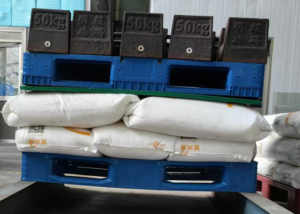
The correct rating depends on what happens after the pallet is loaded.
| Application | Rating To Prioritize |
| Stationary warehouse floor storage | Static Load |
| Forklift transportation | Dynamic Load |
| Pallet jack transportation | Dynamic Load |
| Beam-supported pallet racking | Racking Load |
| Automated warehouse handling | Dynamic + Racking conditions |
| Heavy industrial products | Dynamic + Static + application-specific testing |
One of the most common mistakes is selecting a pallet based on static capacity when the pallet will spend most of its life being moved.
A second mistake is assuming that a pallet with a suitable dynamic rating is automatically suitable for racking.
The safest approach is to match the load rating to the actual operating condition and then verify the exact pallet model.
Why Load Capacity Matters When Sourcing Plastic Pallets From China
When sourcing plastic pallets internationally, the load rating should be more than a marketing number. The specification needs to match the product structure, material, dimensions, reinforcement, and test method.
For example, Preface Plast’s plastic pallet range is evaluated according to ISO 8611, with quality control covering load capacity, dimensional tolerances, material safety, and structural performance.
This becomes especially important when different suppliers quote very different prices for pallets with seemingly similar dimensions. A lower price may come from a different weight, structure, material formulation, reinforcement configuration, or load rating.
For long-term logistics use, it is more useful to compare cost per usable service cycle than pallet price alone.
You can explore the full plastic pallet range to compare different pallet structures, sizes, and load requirements.
Frequently Asked Questions
How Much Weight Can A Standard Plastic Pallet Hold?
A standard plastic pallet can have widely different capacities, but Preface Plast’s general specifications list 1,000–2,000 kg dynamic, 4,000–8,000 kg static, and 500–1,500 kg racking load.
What Is The Difference Between Static Load And Dynamic Load?
Static load is the weight a pallet can support while stationary on a fully supported surface, while dynamic load applies when the pallet is being moved by handling equipment.
Can A Pallet Hold Its Static Capacity While Being Moved?
No. A pallet rated for a high static load should not automatically be loaded to that same weight during forklift or pallet-jack movement; the dynamic rating is the relevant value.
How Many 50 Pound Bags Can A 1,500 Kg Pallet Hold?
From a weight-only calculation, 1,500 kg ÷ 22.68 kg is about 66 bags, but actual loading must also account for bag dimensions, stacking pattern, stability, and the applicable handling rating.
What Is The Weight Capacity Of A Euro Pallet?
Euro-size plastic pallets are commonly 1200×800 mm, but their capacity varies by design. One Preface Plast 1200×800 mm model is rated at 1,500 kg dynamic, 6,000 kg static, and 1,000 kg racking.
Is Racking Load The Same As Dynamic Load?
No. Dynamic load describes a pallet while it is being moved, while racking load describes a pallet supported in a rack. They are different load conditions and should be evaluated separately.
Can A Heavy Duty Plastic Pallet Be Used For Pallet Racking?
Some heavy duty plastic pallets are designed for rack storage, but rack compatibility depends on the pallet structure, rack beam spacing, load distribution, and specified racking capacity.
Does A Heavier Plastic Pallet Always Have A Higher Load Capacity?
Not necessarily. Pallet weight can be an indicator of material and structure, but load capacity depends on the entire pallet design, including deck structure, runners, reinforcement, dimensions, and testing conditions.
Final Thoughts: Choose The Load Rating That Matches Your Real Application
The most important answer to how much weight can a pallet hold is not the highest number printed on a specification sheet. It is the rating that matches the way the pallet will actually be loaded, moved, stored, and supported.
For floor storage, static load is the key reference. For forklift handling, use dynamic load. For warehouse racking, check the racking load and the exact support conditions. When heavy loads, concentrated loads, or repeated handling are involved, pallet structure and reinforcement become just as important as the headline capacity.
At Preface Plast, plastic pallet specifications can be matched to your required dimensions, load conditions, warehouse handling method, and application. Whether you need standard, heavy duty, Euro-size, nestable, or rackable pallets, the right configuration can help reduce handling risk, avoid over-specification, and control long-term logistics costs.
Explore our plastic pallet solutions or review our heavy duty plastic pallets for higher-load applications. For a 1200×800 mm European logistics system, our Euro plastic pallets provide a practical starting point for specification and quotation. Send your pallet size, product weight, handling method, and racking requirements, and the specification can be matched to your actual operating conditions.