
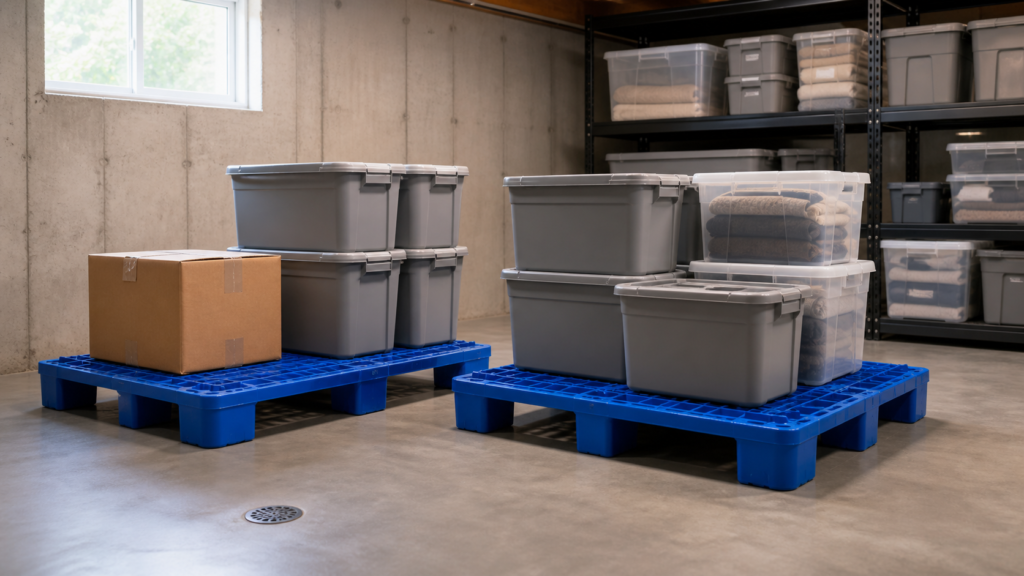
The last thing you want is to walk into your basement and find damp cartons, damaged supplies, or valuable stock sitting in water. Yet this can happen quickly when goods are stored directly on concrete or supported by the wrong pallet.
The right plastic pallets for basement storage give your goods a safer, cleaner place to sit. In this guide, we’ll walk you through the real benefits, common uses, and key deck, base, and load options—so you can choose a pallet that truly fits your space and protects what matters.
What Are Pallets Used For In Basement Storage?
If you are asking what are pallets used for, their basic job is to support goods as one stable unit for storage, handling, or transport. In a basement, the priority is usually floor storage: a pallet creates a raised barrier between stored goods and concrete that may be cold, dusty, damp, or exposed to minor leaks.
You use plastic pallets for storage under sealed bins, spare parts, tools, packaged inventory, maintenance supplies, and building materials. A forklift-ready pallet can also help move a complete load, while a low-profile modular plastic pallet is better suited to a fixed DIY storage platform.
Raised storage pallets reduce direct floor contact, but they do not make the contents floodproof. Water can rise above the deck, humid air can still reach the load, and condensation can form inside poorly sealed containers. Treat the pallet as one part of a basement moisture-control system, not as a substitute for repairing leaks or using a dehumidifier.
Why Choose Plastic Pallets For Basement Storage?
Yes, plastic pallets can be a practical solution for basement storage because they keep goods elevated above the floor while providing moisture resistance, easy cleaning, and stable support. Compared with unfinished wood, plastic does not absorb water into its structure in the same way, making it easier to inspect and maintain in a humid space.
Keep Goods Off The Basement Floor
A raised deck reduces contact with concrete dust, minor seepage, mop water, and small plumbing leaks. Choose the clearance from the actual water history of the room; a shallow storage pad may handle condensation or routine cleaning but offers little protection during a serious basement flood.
Resist Moisture And Humidity
Moisture-resistant plastic pallets do not swell, rot, or develop wooden splinters after absorbing water. The stored cartons or products may still be moisture-sensitive, so use sealed plastic totes and control the room’s humidity rather than relying on a pallet alone.
Improve Airflow Under Stored Goods
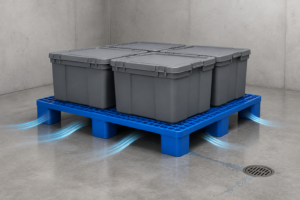
The space below the deck allows air to move under the load and makes damp areas easier to see. A ventilated deck plastic pallet or open deck plastic pallet adds drainage openings, although airflow still depends on leaving space around the load instead of packing every pallet tightly against a wall.
Make Cleaning And Reuse Easier
Reusable plastic pallets can be swept, wiped, or washed according to their material and design. Open grids drain quickly, while hollow ribs and deep cavities need enough drying time before the pallet goes back into a basement storage area.
Provide Stable Support For Heavy Items
Properly selected durable plastic storage pallets can support tools, machinery parts, packaged stock, or renovation materials. The relevant number for a pallet resting on a solid floor is its static capacity, but point loads and uneven feet can still overstress a deck even when the total weight appears acceptable.
Save Storage Space With Nestable Designs
Nestable plastic pallets fit partly inside one another when empty, reducing the space occupied by unused units. This is helpful in a small basement, but the open-bottom or nine-leg geometry must still support the intended containers and any pallet jack used in the room.
Plastic Pallets Vs. Wood Pallets For A Damp Basement
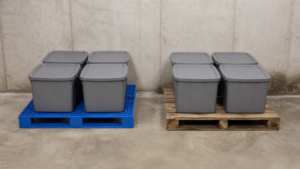
Plastic is usually the more predictable choice for repeated storage in a damp basement, while wood may have a lower purchase price. The decision should reflect moisture exposure, cleaning, load, room access, and how often the pallets will be reused.
| Decision Factor | Plastic Pallets | Wood Pallets | What It Means In A Basement |
|---|---|---|---|
| Moisture response | Does not absorb water like unfinished wood | Can absorb moisture, swell, stain, or support mold growth when it stays damp | Plastic is easier to manage near humid concrete or occasional seepage |
| Cleaning | Can usually be wiped or washed; cavities still require drying | Rough boards, gaps, and fasteners can retain dirt | Plastic supports routine cleaning and inspection |
| Surface safety | No nails or wooden splinters | Damaged boards can expose nails or splinters | Plastic reduces snag and package-damage risks in tight spaces |
| Shape and consistency | Molded dimensions are repeatable | Condition and board spacing vary, especially on reclaimed units | Plastic makes modular layouts and container placement easier to plan |
| Empty storage | Nestable models can reduce empty volume | Standard wood pallets normally stack at full height | Nesting helps where stairs and floor area are limited |
| Repair | Many one-piece pallets are removed after structural damage | Some wood pallets can be repaired | Plastic needs clear inspection and replacement criteria |
| Initial cost | Often higher | Often lower for common used pallets | Compare usable life and maintenance, not price alone |
Wooden pallets may carry unknown residues, insects, broken fasteners, or ownership markings. A used plastic pallet also needs an inspection, but it does not introduce absorbent deck boards into an already humid room.
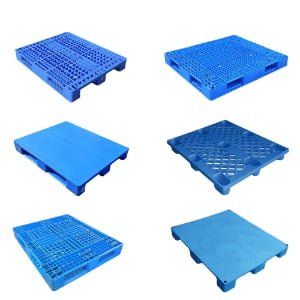
Which Plastic Pallet Design Is Best For Basement Storage?
The best pallet is the design that matches the containers, floor, load, and available access. For most basement storage, deck opening size, height, static capacity, and bottom structure matter more than whether the pallet is labeled “warehouse grade.”
| Pallet Design | Best Basement Use | Main Advantage | Check Before Choosing |
|---|---|---|---|
| Ventilated or open deck plastic pallet | Sealed bins, cartons with a continuous base, and general supplies | Promotes airflow and lets small amounts of water drain through | Narrow carton feet or loose parts must not fall into the grid; if the pallet sits on flow through decking, both grid layers need a clear drainage path |
| Solid deck plastic pallet | Small containers, bags, and items that need continuous support | Smooth support surface and straightforward wiping | Water can remain on top if the deck lacks drainage or slope |
| Nestable open bottom pallets | Light-to-medium floor storage and locations with limited empty-pallet space | Lower empty storage volume and easy manual positioning | Confirm foot layout, floor flatness, pallet-jack access, and point-load support |
| Three-runner or perimeter-base pallet | Heavy floor loads and repeated handling | Broader underside support and good unit-load stability | Usually occupies more space when empty and may be harder to carry downstairs |
| Heavy-duty reusable plastic pallet | Equipment, dense packaged goods, or repeated commercial use | Higher stiffness and durability when correctly rated | A high static rating does not prove rack, shelf, or moving capacity |
| Modular or interlocking plastic pallets | DIY coverage around columns, shelves, or irregular floor areas | Interlocking sections can create a custom raised footprint without cutting a structural pallet | Verify connector strength, supported edges, load per module, and finished-platform stability |
| Spill containment pallet | Drums, oils, cleaning chemicals, or other liquids | Captures leaks in a sump instead of only elevating the container | Use the required containment volume and chemical compatibility; an ordinary storage pallet is not a spill pallet |
A modular plastic pallet is the safer starting point for a DIY basement platform when the modules were designed to connect. Do not cut an industrial pallet to fit around a pipe or column; removing ribs or runners can change load distribution and invalidate its rating.
How Do You Choose The Right Plastic Pallet For Basement Storage?
Start with the room and load, then choose the pallet. A useful quotation or product comparison should state dimensions, deck and base design, material, pallet weight, and load ratings under the intended support condition.
- Measure the basement route and storage zone. Record stair width, door clearance, ceiling height, columns, drains, and the usable floor footprint. A pallet that fits the room may still be impossible to carry around a landing.
- Define the required elevation. Base it on cleaning water, past seepage, plumbing risk, and local flood history. Pallet height is a clearance dimension, not a flood guarantee.
- Calculate the complete load. Include containers, contents, shelving feet, and any concentrated equipment loads. Ask how the rating was tested instead of relying on a “heavy-duty” label.
- Match the deck to the package. Open decks improve drainage, but small feet, soft bags, and weak cardboard bases may need a solid surface or a compatible load-spreading sheet.
- Match the bottom to the floor and handling method. Nestable feet work well for fixed floor storage; runners provide broader support; pallet-jack use requires suitable fork openings and underside clearance.
- Choose a practical material and finish. HDPE and PP are common, but the exact formulation, recycled content, surface texture, temperature range, and cleaning method affect performance.
- Plan empty storage and replacement. If pallets are moved seasonally, compare nesting ratio, pallet weight, carrying points, inspection criteria, and availability of the same model.
Plastic pallet load capacity is support-specific. Static capacity applies on a flat, solid floor; dynamic capacity applies while a loaded pallet is lifted and moved; racking capacity applies across defined rack supports. Even heavy-duty plastic pallets need a rating that matches the actual load pattern and use. ISO 8611-1:2025 provides the relevant pallet test methods.
For a multi-site storage program, check the footprint against containers, doorways, handling equipment, and future warehouse use. The standard pallet size guide explains common regional footprints, while the plastic pallet types guide helps compare nestable, stackable, and rackable structures.
How Should Plastic Pallets Be Set Up In A Basement?
A good setup keeps goods elevated without hiding moisture, blocking drainage, or creating an unstable platform. Complete the room-level moisture work before loading the pallets.
- Fix active leaks first. Inspect walls, pipes, floor joints, drains, and the sump system. The US EPA recommends keeping indoor relative humidity below 60%, ideally between 30% and 50% where possible.
- Clean and inspect the floor. Remove debris that could create a high point under a pallet foot, then check for cracks, slopes, standing water, and soft floor coverings.
- Lay out access and drainage. Keep drains, shutoff valves, electrical panels, and walkways accessible. Leave inspection space where dampness or pests are likely to appear.
- Connect only compatible modules. For a DIY modular platform, engage every specified connector and support all outside edges. Mixed brands or improvised ties may create uneven joints.
- Load from the bottom up. Put dense items low, spread point loads, keep containers within the deck footprint, and use closed plastic totes for moisture-sensitive contents.
- Reinspect after loading. Look for deck bowing, rocking feet, cracked ribs, unstable stacks, trapped water, and blocked airflow. Repeat checks after a leak, flood, or major load change.
Never treat ordinary plastic pallets as a finished walking floor, work platform, or shelf unless that use is specifically engineered and approved. A pallet rated for uniformly distributed cartons can behave very differently under a person’s foot or the narrow legs of a storage rack.
What Can You Store On Plastic Pallets In A Basement?
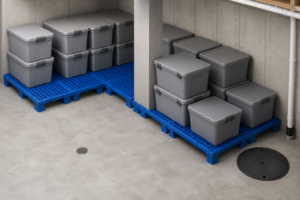
Plastic pallets work best under packaged goods that can tolerate the basement environment once elevated. The pallet protects the underside from floor contact; the container and room controls protect the contents from humid air.
- Sealed plastic totes: Seasonal stock, samples, spare parts, and maintenance items benefit from both elevation and a closed container.
- Tools and equipment: Use a durable pallet with a continuous bearing area or load-spreading panel under narrow feet.
- Packaged inventory: Cartons, retail goods, and consumables can be organized by lot while remaining accessible for inspection.
- Building and renovation materials: Tiles, fittings, hardware, and sealed bags need a pallet rated for the total weight and load pattern.
- Cleaning or facility supplies: Nonhazardous packaged products can be grouped by use; leaking or regulated liquids may require a containment pallet.
- Empty containers and returnable packaging: Nestable pallets help organize lightweight items while reducing the space needed when the area is cleared.
Irreplaceable documents, artwork, photographs, electronics, textiles, and temperature-sensitive products may require climate-controlled storage even when they sit on a pallet. Cardboard should not be the only moisture barrier in a basement with persistent humidity or seepage.
What Common Basement Pallet Mistakes Should You Avoid?
The most common mistake is choosing a pallet from one attractive feature—price, height, or headline capacity—without checking how the whole storage system behaves. Avoid these preventable problems:
- Assuming waterproof plastic pallets mean waterproof storage. Plastic resists water absorption, but the load remains exposed to humidity and water above deck height.
- Using the wrong load figure. A static rating does not establish safe performance while moving the pallet, spanning rack beams, or supporting narrow equipment feet.
- Blocking the open deck. A sheet placed over a grid can support small packages but may also restrict drainage; use a compatible, removable load spreader and inspect below it.
- Placing pallets tightly against walls. This reduces inspection access and can limit air movement near damp surfaces.
- Covering a floor drain or sump access. Keep water-management equipment visible and serviceable.
- Cutting, drilling, or heating a structural pallet for DIY use. Select interlocking modular sections or a custom footprint instead.
- Reusing a pallet with unknown chemical exposure. Odor, residue, cracks, distortion, or missing feet are reasons to quarantine the unit.
- Standing shelving on unsupported deck areas. Align legs with structural support or use a validated load-spreading base.
Frequently Asked Questions
Can Plastic Pallets Sit Directly On A Concrete Basement Floor?
Yes, if the floor is solid, reasonably level, and free of debris that creates concentrated pressure under the feet. Check that the pallet does not rock and that it leaves enough clearance to inspect damp areas.
How High Should A Basement Plastic Storage Pallet Be?
There is no universal height because seepage and flood risks differ by building. Choose clearance above the credible water level for minor incidents, and move valuable goods out of a basement with significant flood exposure.
Can A Plastic Pallet Support Metal Storage Shelving?
Only when the shelf-leg loads align with supported pallet areas or an approved load-spreading base. Total shelf weight alone is not enough because four narrow feet can create severe point loads.
Should You Buy New Or Used Plastic Pallets For Basement Storage?
Used pallets can work for low-risk storage when the model, capacity, ownership, previous use, and condition are known. Choose new pallets when cleanliness, consistent dimensions, documentation, or repeat availability matters.
Can Recycled Plastic Pallets Be Used In Damp Basements?
Yes, when the exact model meets the required load, stability, odor, cleanliness, and material specifications. Recycled content does not by itself determine whether a pallet is strong or suitable.
Can You Cut A Plastic Pallet To Fit A Small Basement?
Do not cut a load-bearing pallet because removing molded ribs, feet, or runners changes its structure. Use a purpose-built modular plastic pallet or request a suitable smaller footprint.
What Should You Do With Pallets After A Basement Flood?
Unload, clean, dry, and inspect each pallet for cracks, warpage, trapped contamination, and chemical or sewage exposure before reuse. Quarantine any unit whose condition or contamination cannot be verified.
Final Thoughts
The best plastic pallets for basement storage do more than raise goods a few inches. They match the floor, load, containers, access route, cleaning plan, water risk, and available space without creating hidden instability or a false sense of flood protection.
Preface Plast manufactures nestable, stackable, open-deck, heavy-duty, reusable, and custom plastic pallet solutions. Share the basement footprint, maximum load, desired clearance, floor conditions, handling method, quantity, and budget so our team can compare an existing mold with an OEM/ODM option and help reduce selection risk before production.