The best plastic pallets for food and beverage are not simply blue, washable, or described as “food-grade.” They must fit the product-contact risk, cleaning process, unit load, temperature, handling equipment, storage system, and documentation required at the receiving site.
This guide turns those requirements into practical selection criteria for food plants, beverage lines, cold stores, distribution centers, and export programs.
What Is The Food Pallet Meaning In A Food And Beverage Operation?
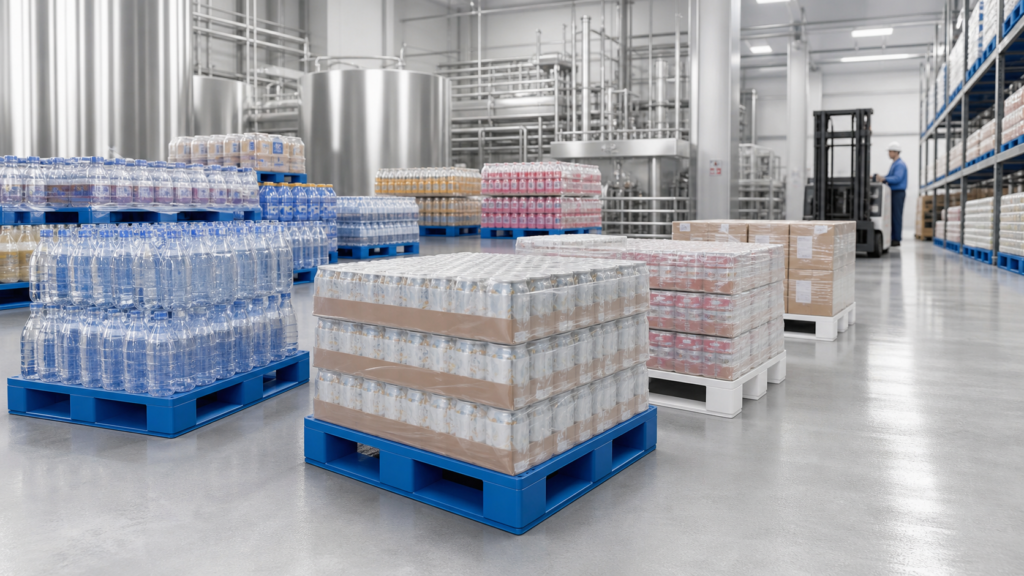
In procurement, the food pallet meaning is a pallet selected to move, store, or stage food products, ingredients, packaging, or containers under defined hygiene controls. The term describes an application; it is not a universal material grade, design standard, or regulatory certificate.
A food pallet can sit beneath sealed cartons in a dry warehouse, carry ingredient bags into a controlled area, or support containers near unpackaged food. These uses have different contamination risks. Before choosing a pallet for food, define what can touch the deck and where the pallet will travel.
| Use Condition | Typical Pallet Contact | Main Selection Priority |
| Unpackaged food or exposed ingredients | Direct or foreseeable contact | Verified food-contact suitability for the exact material and use, plus hygienic design |
| Open crates, sacks, or primary packs | Contact with product containers or packaging | Cleanability, material control, damage prevention, and site approval |
| Sealed cartons, bottles, or cans | Tertiary handling beneath complete packs | Load support, cleanliness, slip control, traceability, and route compatibility |
| Movement between raw and high-care zones | Pallet crosses hygiene boundaries | Segregation, color or asset identification, washing, drying, and release rules |
This distinction matters because a material declaration cannot make an inaccessible deck hygienic, while a smooth deck cannot prove that its resin and additives are suitable for direct food contact.
Why Are Plastic Pallets Used For Food And Beverage?
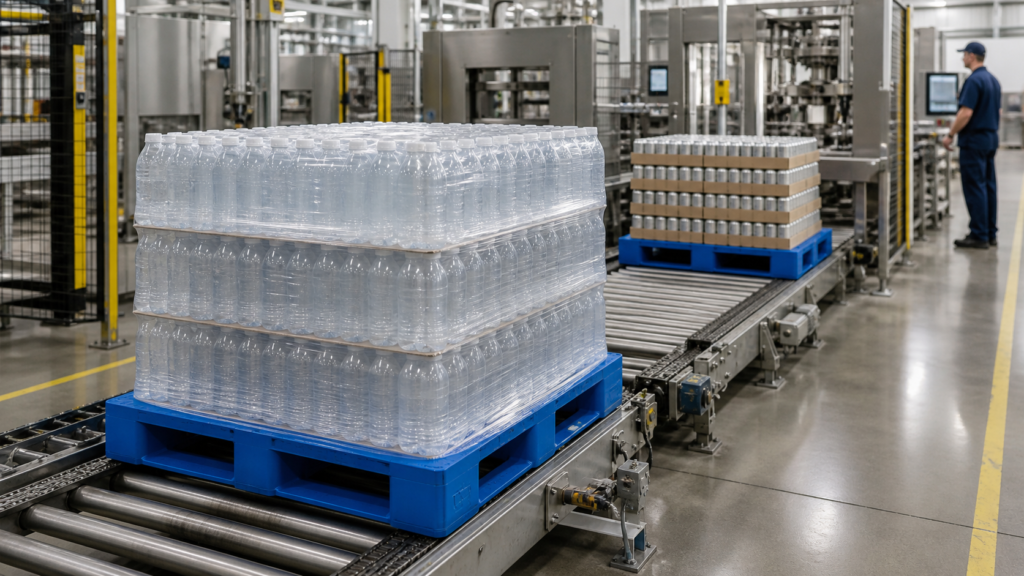
Plastic pallets are widely considered for food and beverage operations because their molded surfaces resist moisture, do not contain wooden nails or splinters, and can be cleaned repeatedly when the design and material suit the wash process. Consistent dimensions can also improve conveyor, palletizer, stretch-wrapper, and automated warehouse performance.
The operational advantages are practical:
- Moisture resistance: HDPE and PP do not absorb wash water in the same way as unfinished wood.
- Accessible cleaning: Smooth, closed surfaces can reduce areas where product residue and label fragments collect.
- Package protection: A consistent deck avoids protruding nails and damaged boards that can puncture bags or cartons.
- Automation fit: Controlled footprints, runners, fork openings, and deck flatness support repeatable transfers.
- Identification: Molded logos, color coding, barcodes, QR codes, and RFID can support ownership and hygiene zoning.
- Export simplicity: All-plastic pallets are outside the wood-treatment rules applied to regulated wood packaging.
These benefits are not automatic. Deep ribs, hollow cavities, damaged welds, rough repairs, or trapped water can undermine sanitation. Plastic may also deform under sustained load, become slippery when wet, or lose impact performance at low temperature if the wrong formulation is used.
What Makes A Plastic Pallet Suitable For Food Use?

A suitable food-industry pallet combines controlled material, cleanable geometry, process compatibility, and load performance. Approving only one of those four elements leaves a gap in the specification.
The hygienic plastic pallet range is a useful starting point for smooth, closed-deck and washable options. Final approval should still apply to the exact model, material formula, cleaning method, and operating route.
| Selection Factor | What A Useful Specification States | Warning Sign |
| Product contact | Whether food is unpackaged, primary-packed, or fully enclosed | “Food-grade” with no defined contact condition |
| Material | Polymer, virgin or recycled route, additives, color, and traceability | Only “HDPE” or “PP” appears on the quotation |
| Surface design | Deck openings, seams, cavities, corners, labels, drainage, and underside access | The top looks smooth but runners trap water or residue |
| Cleaning compatibility | Detergent, sanitizer, temperature, pressure, contact time, rinse, and drying limits | “Washable” without operating limits |
| Load performance | Static, dynamic, and racking data under stated test and support conditions | One large capacity number used for every condition |
| Equipment fit | Fork entry, conveyor contact, rack span, palletizer, wrapper, and sensor interface | The footprint matches but the base geometry is unverified |
| Traceability | Model, batch or serial identification and change-control records | No way to distinguish approved and unapproved batches |
“HACCP compliant pallet” also needs careful wording. HACCP is a hazard-control approach used by the food operation; it is not a generic pallet certificate. The pallet specification should support the hazards and controls identified by the site rather than replace that assessment.
Which Material Is Best For A Pallet For Food?
Virgin HDPE is often the practical starting point for cold, wet, impact-intensive, or tightly controlled applications. PP is generally stiffer and can suit warmer environments or dimensional requirements, while controlled recycled material may be appropriate for fully packaged goods and less sensitive logistics. The intended use decides the material—not the industry label alone.
Virgin HDPE
HDPE combines moisture resistance with useful impact behavior and is commonly selected for chilled distribution, repeated washdown, and closed-loop handling. If the pallet will enter a freezer, approve it using the lowest operating temperature and the real load; a room-temperature data sheet does not predict a loaded forklift strike in the cold.
Virgin PP
PP offers higher stiffness in many formulations and can help where deck flatness, conveyor interfaces, or warm cleaning conditions matter. Standard PP can be more brittle at low temperature than HDPE, so cold-chain use needs a suitable grade and production-intent testing.
Recycled Plastic
Recycled HDPE or PP can serve packaged food, beverage distribution, export, and external warehouse flows when feedstock, contamination, odor, batch consistency, and site policy are controlled. It should not be rejected or approved from recycled percentage alone.
If unpackaged food may touch the pallet, request evidence for the exact resin, additives, manufacturer, food type, contact time, and temperature. The U.S. FDA explains that food-contact authorization is tied to intended use, while the European Commission’s food-contact guidance covers safety, good manufacturing practice, documentation, and traceability in the EU.
Which Deck And Base Design Should You Choose?
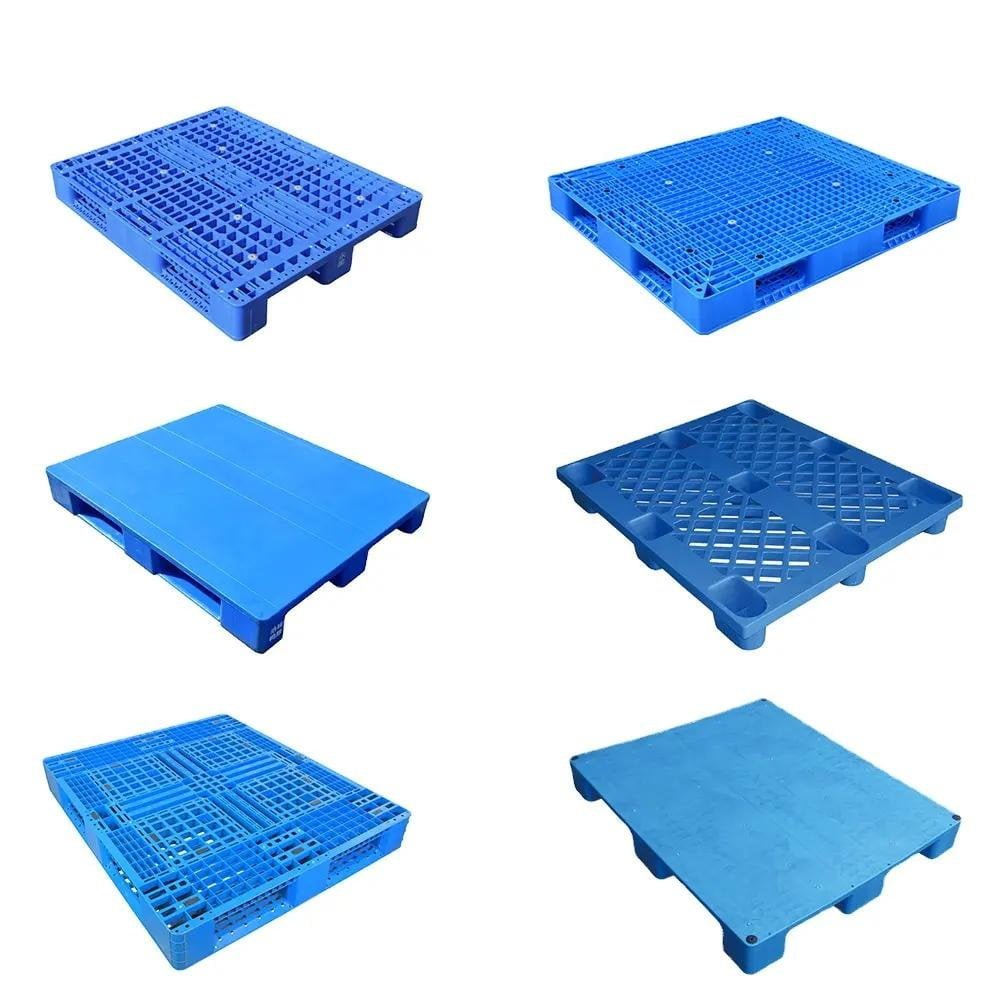
Choose the deck by contamination risk and package support, then choose the base by handling and storage. A closed top is not automatically better in every flow, and an open grid is not automatically less hygienic; the deciding question is whether the complete pallet can be cleaned, drained, dried, inspected, and used without damaging the load.
| Pallet Design | Best Starting Use | Main Advantage | What To Verify |
| Smooth closed deck | Exposed-product zones, ingredient bags, sanitary processing support | Accessible top surface and continuous package support | Underside cavities, seams, drainage, wash compatibility, and pallet weight |
| Open or ventilated deck | Sealed bottles, cans, crates, produce containers, and quick-drain flows | Lower weight, airflow, and drainage through the deck | Grid support, rib cleaning, label debris, and small-package stability |
| Three-runner base | Floor stacking, conveyors, and repeated forklift handling | Stable bottom support and broad contact paths | Runner direction, pallet-jack access, and conveyor geometry |
| Full-perimeter base | Heavy unit loads, block stacking, some racking and automation | Unit-load stability and structured underside support | Wash access, rack span, reinforcement, and nesting limitations |
| Nestable feet | One-way shipping and low-cost distribution | Reduced empty storage and return volume | Floor support, point loads, pallet-jack route, and hygiene-zone acceptance |
| Double-sided design | Dense bags, drums, or repeat-use industrial flows | Load spreading and reversible use | Cleaning access, pallet weight, and equipment compatibility |
For sealed packaged goods, stackable plastic pallets can provide runner support and stable loaded stacking. Where the pallet spans open beams, begin with a purpose-designed rackable plastic pallet rather than assuming any three-runner food pallet is rackable.
How Do Plastic Beverage Pallets Differ From General Pallets?
Plastic beverage pallets must manage dense loads, repeated line handling, and package stability. A pallet of filled bottles or cans can be heavy and relatively tall, while empty cans, preforms, trays, kegs, and five-gallon bottles create completely different support patterns.
The following details usually matter more than a generic “heavy-duty” description:
- Deck support pattern. Case corners, bottle trays, can layers, keg rings, and shrink-wrapped packs must sit on ribs that actually carry their weight.
- Slip control. Wet decks, smooth cartons, acceleration, and route-truck handling may require texture, anti-slip plugs, edge lips, tier sheets, or stretch-wrap validation.
- Flatness and stiffness. Palletizers, depalletizers, layer pads, and conveyors need a repeatable interface; excessive deck deflection can destabilize the layer above it.
- Base geometry. Runner positions must match roller pitch, chain centers, transfer plates, pallet dispensers, forks, and rack beams.
- Temperature. Filled beverages may move through hot-fill, ambient, chilled, or frozen-adjacent areas, but the pallet normally experiences a specific range that must be stated.
- Route ownership. Pooled beverage pallets need durable identification and a recovery plan; one-way loads need destination acceptance and an end-of-life route.
Do not copy a popular beverage footprint without checking the line. Some route systems use application-specific sizes, and even a familiar length and width can fail if the pallet height, fork opening, runner position, or deck pattern differs. For automated beverage lines, compare AS/RS plastic pallets using the actual conveyor and rack drawings.
For returnable five-gallon water jugs, a pallet is only part of the system. Purpose-built water bottle racks can organize individual bottles when horizontal support, inventory rotation, or retail-depot storage is more important than moving a full unit load.
How Do You Match Load Capacity To Food And Beverage Handling?
Match each capacity figure to its support condition. Static, dynamic, and racking loads describe different situations, and none of them alone proves performance on a conveyor, in an AS/RS, or beneath concentrated keg feet.
| Load Condition | What It Describes | Information Needed For Approval |
| Static load | A pallet supported on a flat, solid floor | Load distribution, stack height, duration, temperature, and floor condition |
| Dynamic load | A loaded pallet lifted and moved by suitable equipment | Fork position, handling speed, impacts, load restraint, and route |
| Racking load | A pallet spanning defined rack supports | Beam span, support direction, payload shape, storage time, temperature, and allowable deflection |
| Conveyor load | A pallet carried by rollers, chains, belts, or transfer points | Contact layout, roller pitch, chain centers, gaps, transitions, and start-stop forces |
A rating normally assumes a defined and often uniformly distributed load. Liquid drums, kegs, bag corners, crate feet, and rigid bottle trays can create point loads that stress only a few ribs. Long storage periods also matter because thermoplastics can continue to deflect under sustained load, especially at higher temperatures.
ISO 8611-1:2025 specifies test methods for new flat pallets and notes that load tests do not replace field trials on specific designs. Before volume approval, trial a production-intent pallet with the real payload, wrapping pattern, racks, forklifts, and line equipment.
How Should Food Pallets Be Cleaned, Inspected, And Segregated?
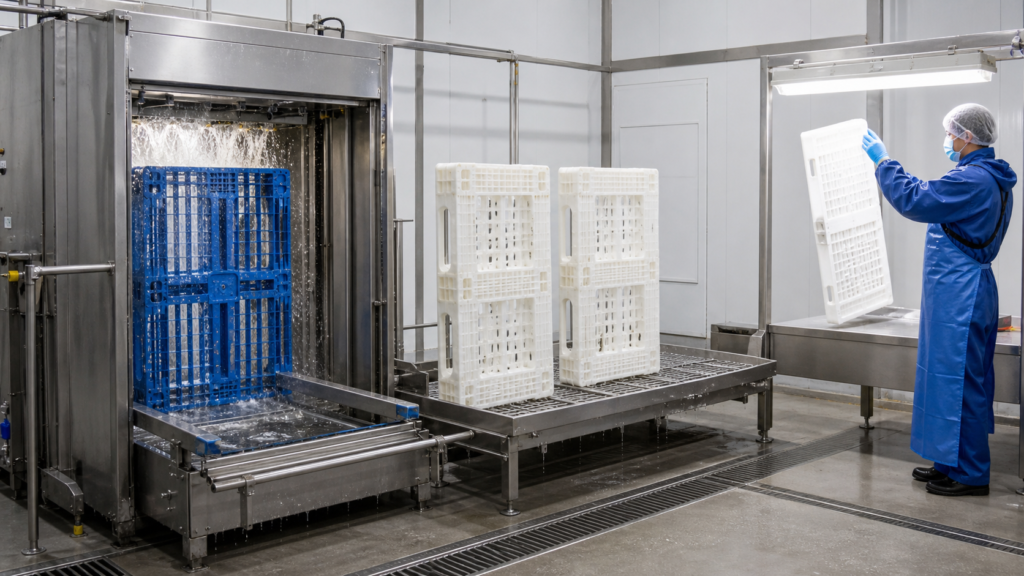
A washable pallet becomes hygienic in service only when the facility defines and verifies a repeatable process. The program should reflect the soil, allergen, microbiological, chemical, and cross-zone risks of the actual food or beverage flow.
A practical sanitation specification covers:
- what triggers cleaning and how frequently it occurs;
- pre-cleaning and removal of labels, film, soil, and product residue;
- approved detergent or sanitizer, concentration, water quality, temperature, pressure, and contact time;
- complete coverage of the deck, fork openings, feet, runners, recesses, identification features, and reinforcement areas;
- rinsing, drainage, drying, post-cleaning inspection, and release criteria;
- segregation of dirty, clean, quarantined, and damaged pallets;
- records that connect the pallet or batch to the wash and inspection result.
Cleaning limits must be checked against the exact material and construction. Excessive heat can warp a pallet, aggressive chemicals can attack the polymer or anti-slip parts, and high-pressure washing can drive residue into inaccessible cavities. A deep gouge or cracked runner is both a structural defect and a potential cleaning problem.
The FDA sanitary transportation guidance emphasizes sanitary transportation practices that prevent food from becoming unsafe. A clean pallet can still be recontaminated by a dirty trailer, mixed hygiene zones, standing wash water, or unprotected outdoor storage, so the complete route needs control.
What Food Pallet Compliance Documents Should You Request?
Request evidence that matches the market and intended use instead of collecting unrelated logos. “FDA approved,” “EU compliant,” or “food-safe” on a sales sheet is too broad to establish that an exact pallet formula is suitable for direct contact with a particular food under a particular time and temperature.
| Document Or Evidence | What It Should Identify |
| Product drawing and specification | Model, dimensions, tolerances, weight, deck, base, reinforcement, color, and identification |
| Material declaration | Polymer, virgin or recycled route, additives, masterbatch, anti-slip parts, and traceability scope |
| Food-contact evidence, when applicable | Exact material or article, applicable regulation, food type, contact conditions, restrictions, and issuer |
| EU Declaration of Compliance, when applicable | Article identity, regulations, migration basis, limitations, and supply-chain traceability |
| Load test report | Exact model, sample condition, test method, supports, temperature, load pattern, results, and date |
| Cleaning compatibility statement | Approved temperature, chemistry, concentration, pressure, exposure time, and exclusions |
| Production and batch controls | Weight and dimensional tolerances, inspection plan, lot identity, and approved material route |
| Change-control agreement | Which resin, additive, color, mold, reinforcement, or process changes require notice and revalidation |
The FDA’s regulatory-status guidance makes clear that compliance depends on the substances in the article and their intended use. In the EU, plastic food-contact materials are subject to composition, migration, documentation, and traceability requirements described in the European Commission’s legislation overview.
The approved sample and mass production also need to follow the same documented material route. A pallet can retain the same model number while a change in resin source, recycled content, filler, color masterbatch, or reinforcement alters odor, cleanability, impact behavior, or deflection.
How Should You Label And Trace A Shipping Mark Pallet?
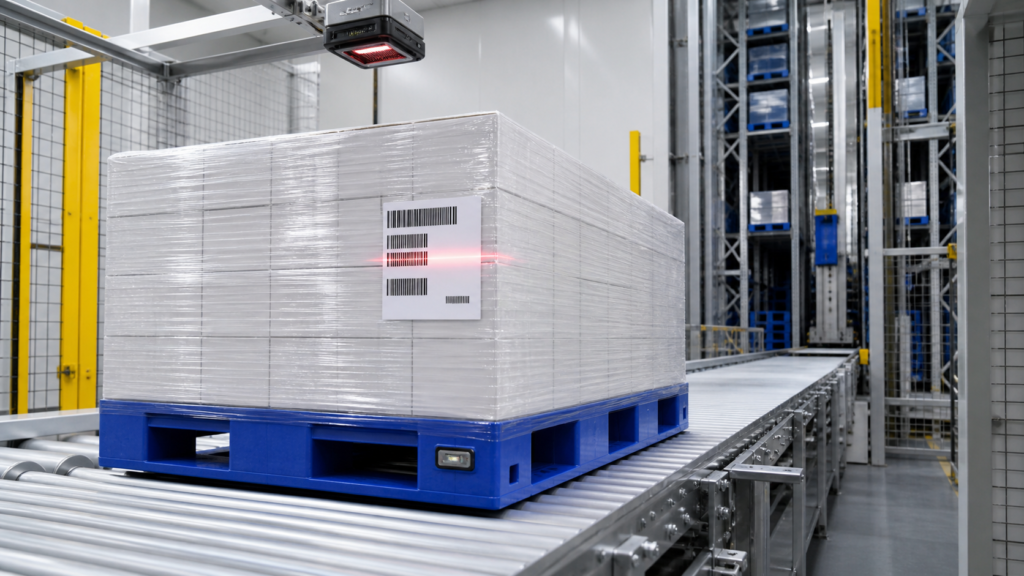
A shipping mark pallet is a palletized unit load identified with visible shipment information, such as the destination, order reference, product or lot, quantity, weight, and handling data required by the contract or carrier. The shipping mark identifies the load; it does not certify the hygiene or material of the pallet beneath it.
For GS1-based logistics, a Serial Shipping Container Code (SSCC) can uniquely identify each pallet or other logistics unit. The GS1 SSCC guidance explains how that identifier connects a physical unit to electronic information. Keep the barcode or label visible and scannable after stretch wrapping, and verify label adhesion through washing, condensation, cold storage, and transport if it will remain on the pallet.
Separate variable shipment data from permanent pallet identity:
- A logistics label or shipping mark changes with each load.
- A molded logo or asset number identifies the reusable pallet owner.
- A permanent barcode, QR code, or RFID tag can store the pallet’s serial identity and cycle history.
- A hygiene-zone color helps control movement but should not be the only traceability method.
Do not confuse a shipping mark with an IPPC treatment mark. The USDA APHIS wood-packaging guidance lists plastic pallets as an alternative not subject to its regulated wood-packaging requirements. Destination, carrier, food-safety, and cleanliness rules still apply to the shipment.
Where permanent identification needs to be molded into the product, custom plastic pallet services can evaluate logo areas, colors, barcodes, RFID protection, label recesses, and dedicated tooling without placing dirt-trapping features in critical cleaning areas.
How Do You Choose The Right Food Or Beverage Pallet?
Start with the route, not a catalog label. A complete RFQ allows several pallet models to be compared under the same conditions and exposes quotations that rely on vague capacity or compliance claims.
Provide these ten inputs:
- Product type, packaging, and whether any unpackaged food can touch the pallet.
- Maximum unit-load weight, center of gravity, footprint, overhang, and point-load locations.
- Pallet length, width, height, fork openings, and dimensional tolerances.
- Floor, block-stack, rack, conveyor, palletizer, depalletizer, AGV, or AS/RS use.
- Rack beam span, support direction, storage duration, and allowable deflection.
- Minimum and maximum operating temperatures, including loaded cold impacts.
- Cleaning chemistry, water temperature, pressure, cycle time, drying, and verification method.
- Required food-contact, material, load-test, quality, and traceability documents.
- One-way or closed-loop route, expected trips, loss rate, repair policy, and end-of-life plan.
- Quantity, delivery schedule, destination, branding, label, barcode, RFID, and color requirements.
| Operating Scenario | Practical Starting Point | Critical Validation |
| Exposed food, clean area, or strict washdown | Smooth hygienic plastic pallet | Contact documentation, full-surface cleanability, drainage, and release process |
| Sealed cartons or packaged ingredients | Runner-based stackable pallet | Deck support, package damage, stacking, and wash-zone acceptance |
| Filled bottles, cans, trays, or kegs | Stable beverage pallet with matched deck and slip control | Layer pattern, point loads, acceleration, wrapper, and route equipment |
| Beam racking or high-bay storage | Rackable or reinforced pallet | Span, temperature, load duration, deflection, and retrieval clearance |
| Automated line or warehouse | Application-validated AS/RS pallet | Dimensions, runner interface, sensors, transfer points, and batch consistency |
| One-way international shipment | Lightweight one-way export pallet | Destination acceptance, dynamic load, package support, and recovery route |
| Nonstandard footprint or proprietary beverage pool | Existing mold review or custom pallet | Tooling economics, production trial, ownership ID, and long-term supply |
Before a full order, approve the drawing, material, color, unit weight, physical sample, documentation, and trial result as one package. A sample made from premium resin or fitted with extra reinforcement is not a valid reference if the production quotation covers a different construction.
How Should You Compare Plastic Pallet Cost?
Compare cost per completed trip, not purchase price alone. Reusable food and beverage pallets create value only if the loop returns them, the wash process can release them efficiently, and breakage or loss stays within the planned range.
Include these costs in the model:
- pallet purchase, freight, duties, and any mold or identification tooling;
- washer labor, water, energy, chemicals, inspection, drying, and storage;
- empty return transport, nesting or stacking density, and pallet loss;
- product damage, line stops, rack incidents, rejected loads, and replacements;
- tracking, repairs where permitted, retirement, collection, and recycling.
A simple comparison is total program cost ÷ completed loaded trips. Run low-, expected-, and high-loss scenarios because recovery rate can change the result more than a small difference in pallet price. For one-way food exports, a lighter nestable pallet may win; for a controlled beverage pool, a heavier reusable pallet may deliver the lower cost per cycle.
Frequently Asked Questions
Does A Food Pallet Have To Be Blue?
No. Blue improves visibility and is widely used, but it does not prove hygiene, resin purity, or food-contact compliance; choose color for zoning, inspection, and brand needs, then verify the exact material separately.
Can Food Pallets Be Stored Outdoors?
Only when the formulation, load, exposure time, and hygiene program allow it. UV stabilization can slow sunlight damage, but outdoor storage also exposes cleaned pallets to dust, pests, water, and uncontrolled recontamination.
Can A Hygienic Pallet Go Into A Rack?
Only if the exact model has racking data for the real beam span, support direction, temperature, load pattern, and duration. A smooth closed deck describes cleanability, not unsupported-span performance.
Are Anti-Slip Plugs Suitable For Food And Beverage Pallets?
They can improve load stability, but the plug material, attachment, wear, chemical compatibility, and cleanability need approval. Loose or damaged plugs can become foreign-material and maintenance risks.
Do Beverage Pallets Need RFID?
Not always. RFID is most useful in a closed pool where serial-level tracking can reduce loss or connect each pallet to wash, inspection, load, and location records; a simple barcode may be more economical in other routes.
Can A Broken Plastic Food Pallet Be Repaired?
Only under an approved repair and requalification method for that model and hygiene zone. Cracks, heat repairs, rough welds, or exposed reinforcement can create structural and cleanability risks, so many operations quarantine and replace damaged units.
How Long Does A Plastic Beverage Pallet Last?
Service life depends on resin, design, load, impacts, temperature, washing, racking, route loss, and rejection rules. Ask for application evidence and model cost per completed cycle instead of accepting a universal number of years.
Final Thoughts
The correct food or beverage pallet is the one that keeps its load stable, passes the facility’s hygiene controls, fits every handling interface, and remains traceable throughout its intended route. Material, deck design, load evidence, cleaning limits, and documentation must be approved together rather than treated as separate sales features.
Preface Plast manufactures hygienic, stackable, rackable, export, AS/RS, and custom plastic pallet solutions for food and beverage operations. Share your product-contact condition, unit load, wash method, temperature, equipment drawings, documentation needs, quantity, and budget, and our team can compare existing molds or an OEM/ODM design to reduce trial risk and support stable long-term supply.