
Never put dry ice in an airtight box or an unventilated enclosed room. Released CO₂ can pressurize a sealed container and accumulate in the surrounding area, while direct contact can cause severe cold burns.
If your goal is to keep dry ice longer, do not start with a generic “thick insulated box.” Start with safe venting, low-temperature-compatible construction, fewer lid openings, and a loss test that reflects how you actually store and use the dry ice.
How Should You Store Dry Ice Safely?
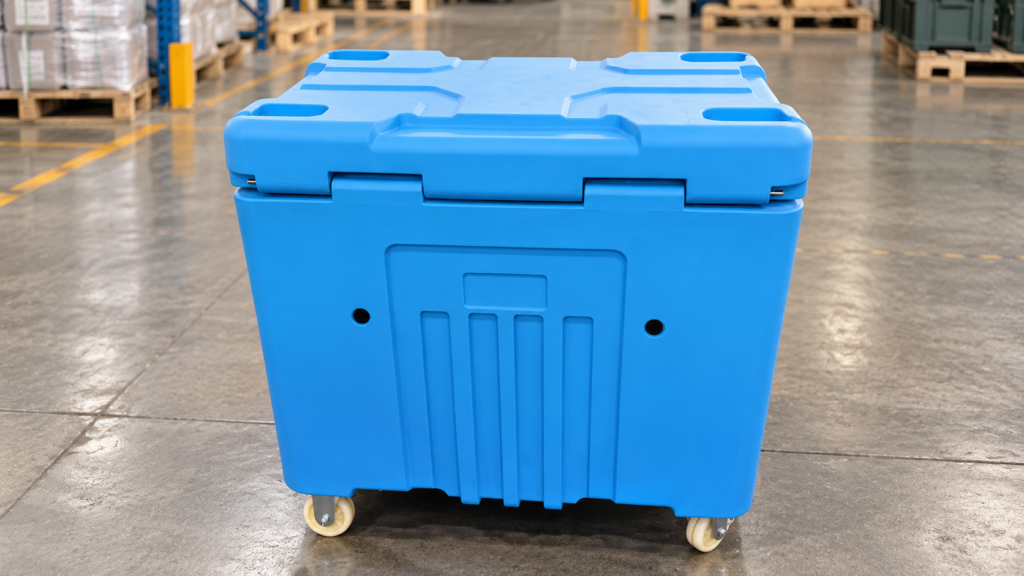
Use a purpose-built, vented insulated container in an adequately ventilated location. The container vent protects the package from pressure; room ventilation protects you from CO₂ buildup. You need both.
| Avoid This | Why It Creates a Problem | Use This Approach Instead |
|---|---|---|
| Airtight container or taped-over vent | CO₂ pressure can build as dry ice sublimates | Keep the designed gas-release path open |
| Small room or closed vehicle with no assessment | CO₂ can accumulate without a useful warning smell | Assess your dry ice quantity, room volume, airflow, occupancy, and monitoring needs |
| Bare-hand handling | Extreme cold can injure skin | Use suitable insulated gloves, eye protection, and handling tools |
| Ordinary freezer used without approval | It does not stop sublimation and may create equipment or CO₂ hazards | Follow the equipment manufacturer and your site safety procedure |
| Damaged or swollen package | It may fail suddenly | Isolate it and follow your emergency procedure; do not try to open it slowly |
The CDC dry ice safety guidance calls for cold-protective PPE, a well-ventilated area, and a container that allows gas release. OSHA also warns that oxygen monitoring alone may not identify every dangerous CO₂ condition.
Do not use a generic internet ventilation rate as your site rule. Your maximum inventory, expected loss, room layout, low areas, working time, and mechanical airflow all affect the control you need.
Why Is Your Dry Ice Disappearing Too Quickly?
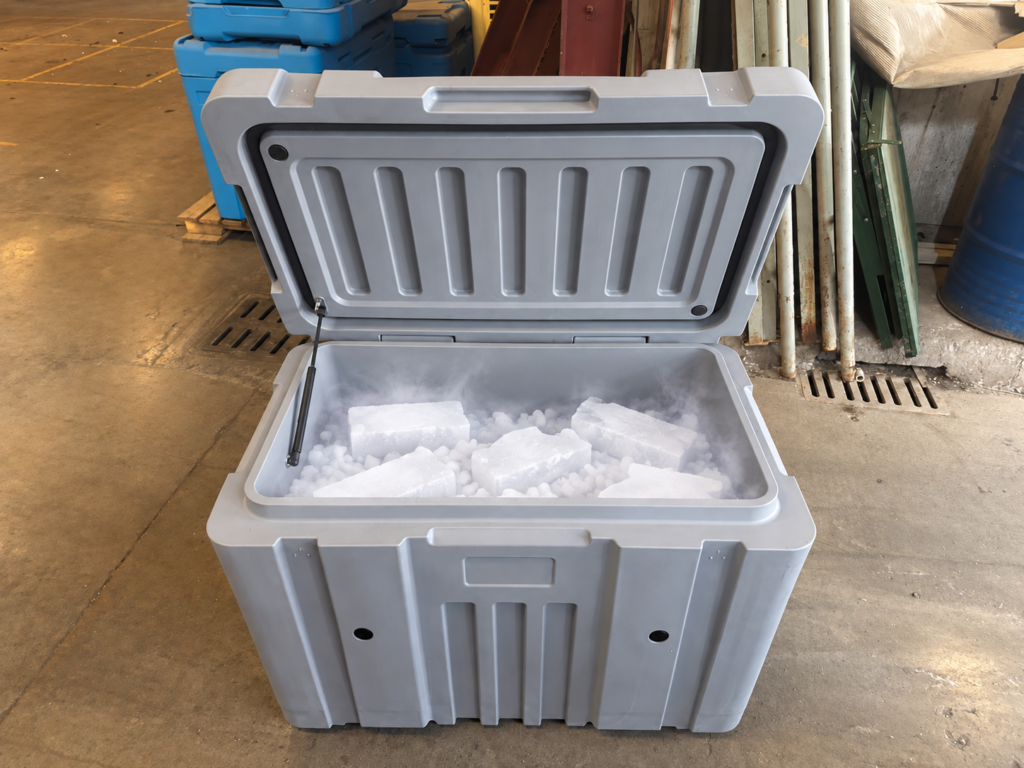
Fast dry ice loss usually points to heat entering through the container or the way it is being used. The table below helps you identify the likely cause before replacing every box.
| What You Notice | Likely Cause | What to Check First |
|---|---|---|
| High loss even when the lid stays closed | Weak insulation, thermal bridges, poor lid fit, or damaged walls | Compare a new unit with the current box under the same conditions |
| Loss rises after months of use | Crushed insulation, cracks, worn lid hardware, or liner damage | Inspect the lid, corners, hinges, drain area, and inner liner |
| Loss is high during picking shifts | The lid is opened too often or left open too long | Prepare picks before opening and use a smaller working box |
| The first few hours show heavy loss | The container or product starts warm | Pre-condition only where your product SOP permits it |
| Pellets disappear faster than expected | Small particles expose more surface area | Compare your actual pellet size with larger pellets or blocks |
| One location performs worse than another | Sunlight, hot floors, heaters, or warm airflow add heat | Review the exact storage position, not only room temperature |
| Delivered quantity seems low immediately | Loss occurred before receipt | Record dry ice production, dispatch, arrival, and first-use times |
An FAA study on dry ice sublimation found that pellet size, container design, and container degradation affected loss in its tested configurations. This is why a daily-loss claim has little value unless you also know the container, starting load, dry ice form, ambient conditions, test duration, and opening schedule.
What Can You Do to Slow Dry Ice Sublimation?
You can reduce sublimation by controlling heat input and daily handling. These changes are practical, inexpensive to test, and usually more useful than relying on one headline insulation figure.
- Use a dry-ice-rated container. Confirm that the complete box—not only the resin name—has suitable venting, insulation, low-temperature materials, and loaded handling features.
- Keep staging time short. Coordinate delivery, storage, and use so your dry ice does not sit on a warm dock or in an unsuitable temporary box.
- Reduce lid openings. Prepare each withdrawal first, open the lid once, and close it promptly. A smaller working box can keep your reserve stock closed.
- Choose the right dry ice form. Larger blocks often lose mass more slowly; pellets are easier to dispense and can surround a payload. Use the form that fits your process, then test it.
- Avoid warm product where possible. If dry ice must first cool the container and payload, less remains for the planned holding period. Follow your approved product procedure.
- Arrange the load without blocking the vent. Reduce unnecessary warm voids with an approved packout, but never wrap or seal dry ice in a way that traps gas.
- Keep the box away from avoidable heat. Direct sun, hot equipment, warm floors, and repeated movement through hot areas all increase loss.
- Inspect reusable boxes. Stop using a container when damage to the lid, vent, liner, insulation, hinges, or wheels could affect safety or thermal performance.
These steps can help you keep dry ice longer, but they cannot stop sublimation. Any promise of “no loss” under normal vented storage should be treated carefully.
Which Dry Ice Storage Container Should You Choose?
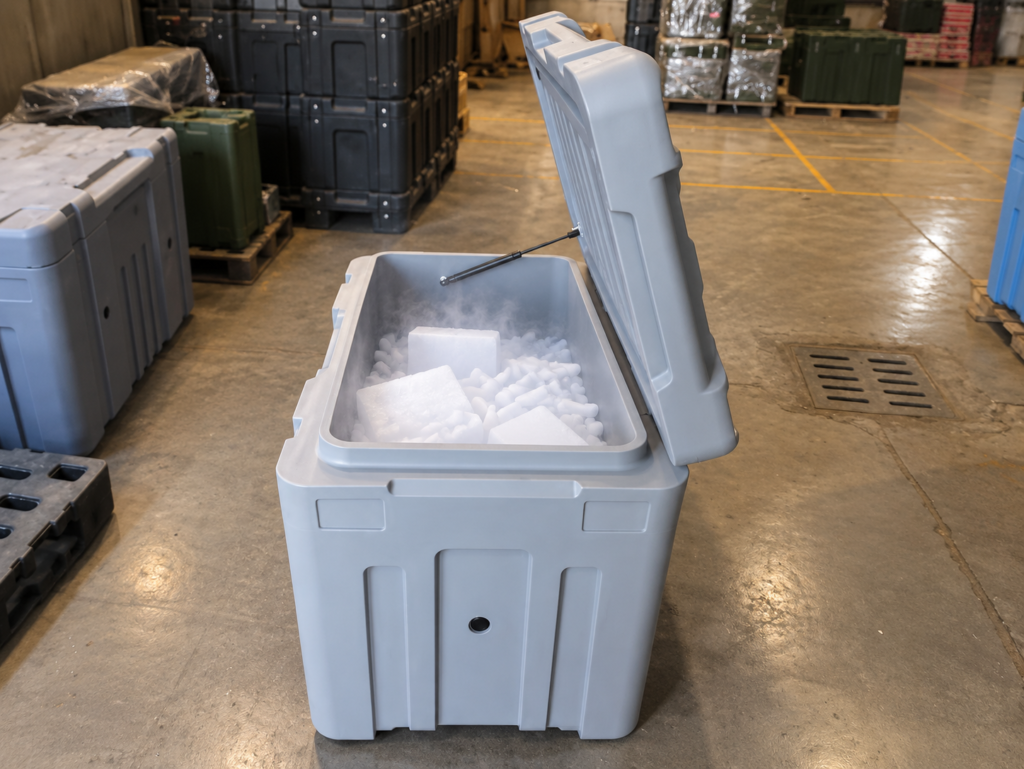
Choose around your actual route—not a product name. Your dry ice form, required hold time, working quantity, opening frequency, handling method, and external temperature matter more than whether a catalogue calls the product a box, bin, chest, or cooler.
| Container Option | Where It Can Make Sense | What You Need to Confirm |
|---|---|---|
| EPS foam shipper | Small quantities and one-way distribution | Outer protection, venting, damage resistance, and reuse limits |
| Reusable EPP insulated box | Light repeated distribution | Usable capacity, closures, cleaning, vent design, and loaded handling |
| PE shell with PU insulation | Commercial dry ice storage and larger working batches | Exact low-temperature compatibility, venting, thermal bridges, hardware, and test data |
| Qualified passive shipper | Food, laboratory, or pharmaceutical cold-chain routes | Complete packout, payload range, dry ice charge, route profile, and monitoring position |
| Standard crate or bulk box | Secondary handling around a qualified shipper | It does not automatically provide insulation or dry-ice-safe venting |
A ventilated bulk bin may improve airflow and material handling, but open walls do not provide thermal insulation. A solid-wall bulk box may protect goods, but solid walls do not prove pressure relief or suitability at dry ice temperature.
The same distinction applies to an insulated fish box for chilled seafood. Chilled seafood storage and dry ice storage involve different temperatures, venting needs, and validation conditions; the word “insulated” is not enough.
Our industrial bulk plastic boxes and stackable or ventilated plastic crates can be reviewed for secondary handling, unitization, or a model-specific development project. We would not describe an existing box as a dry ice container until its exact materials, structure, venting, and performance have been checked for that use.
What Should You Check for Food, Pharmaceutical, or Transport Use?
Dry ice controls temperature; it does not automatically make a container suitable for food, medicine, samples, or air freight. Confirm the requirements for your exact product and route.
| Your Use | What Needs Separate Confirmation |
|---|---|
| Food processing or distribution | Dry ice purity, direct-contact permission, inner packaging, sanitation, and exact material documents |
| Pharmaceutical cold chain | Approved product temperature, qualified packout, dry ice placement, payload limits, monitoring, and route profile |
| Laboratory samples | Sample classification, leakproof packaging, qualified coolant arrangement, and transport requirements |
| Dry ice blasting | Ventilated bulk storage, safe dispensing, PPE, and working inventory near the machine |
| Air or water transport | Current venting, marking, labelling, quantity, documents, and carrier rules |
For U.S. food applications, 21 CFR 184.1240 requires carbon dioxide purity suitable for the intended use and current good manufacturing practice. This does not make every dry ice grade or plastic box suitable for direct food contact.
For U.S. air or water transport, 49 CFR 173.217 includes gas-release and transport conditions for dry ice used as a refrigerant. Check the current rules for your route and carrier instead of copying a fixed limit from an older guide.
What Information Helps Us Recommend the Right Box?
Before we recommend an existing model for evaluation or discuss a purpose-built container, we need your dry ice form and maximum quantity, required holding time, ambient conditions, opening frequency, direct-contact requirements, transport mode, and handling method.
Also tell us whether you need hand carrying, casters, forklift movement, stacking, drainage, washing, an internal liner, or temperature monitoring. These details help us avoid offering a box that looks suitable in a catalogue but fails in your route.
If you do not yet know the required capacity, share your daily consumption and delivery interval. We can help you plan a practical test without turning the discussion into an unnecessary engineering exercise.
What Else Should You Know Before Ordering?
Can You Store Dry Ice in an Airtight Container?
No. Your container must allow sublimated CO₂ to escape continuously; an airtight vessel can build dangerous pressure and rupture.
Can You Store Dry Ice in a Freezer?
Do not assume an ordinary freezer is approved. It will not stop sublimation, and you still need to assess equipment compatibility and CO₂ release into the surrounding area.
How Long Does Dry Ice Last in an Insulated Container?
There is no reliable universal duration. Ask for test conditions that match your starting quantity, dry ice form, ambient exposure, container condition, and lid-opening pattern.
Do Blocks Last Longer Than Pellets?
Larger blocks usually expose less surface area per unit mass and may last longer. Pellets are easier to dispense, so the better choice depends on how you use the dry ice.
Where Should You Start?
Start with one problem you can measure: excessive overnight loss, frequent openings, container damage, or an upcoming cold-chain route. Confirm safe venting first, compare one candidate box with your current method, and review the result before scaling up.
Need a plastic box or insulated-container solution for dry ice, frozen food, laboratory, or pharmaceutical logistics? Share your required hold time, dry ice quantity, use conditions, transport mode, and handling requirements with Preface Plast. We can review our existing box range, identify the validation still needed, and advise whether a current model can be tested or a purpose-built solution is the better route.