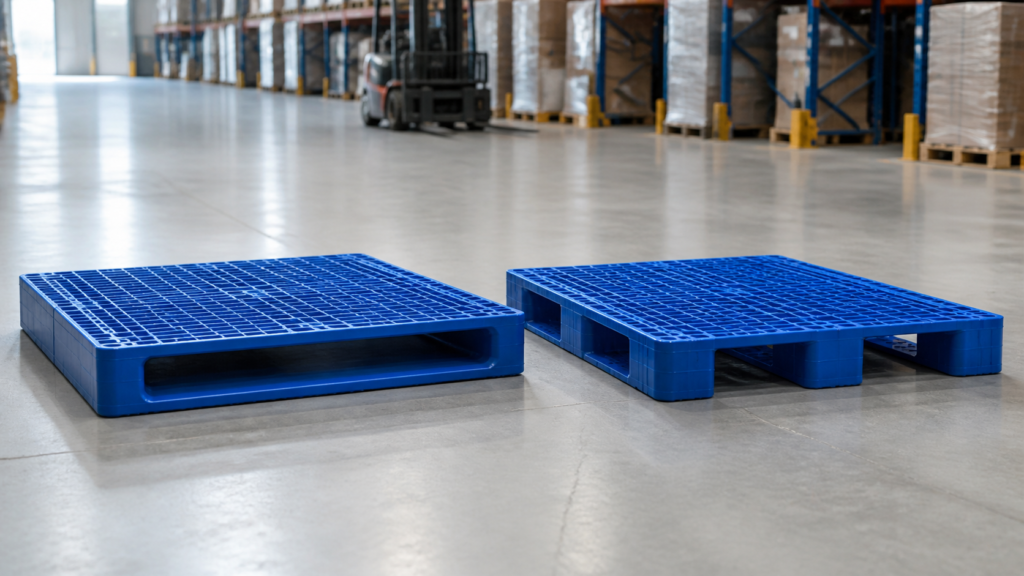
When comparing 2-way vs. 4-way pallets, a 4-way pallet gives a forklift more approach options, making it practical for tight, busy, or multi-stage handling. A 2-way pallet can be a better fit when every movement follows a fixed direction and you do not need extra entry points. The important catch is that four-way forklift entry does not always mean four-way pallet-jack access. This guide helps you match both pallet entry types to your equipment, racks, load, workflow, and budget.
What Is The Difference Between A 2-Way And A 4-Way Pallet?
The difference is the number of sides from which handling equipment can enter the pallet. A 2-way pallet has usable fork openings on two opposite sides. A 4-way pallet allows forklift forks to enter from all four sides, so the load can be approached from either its length or width.
Entry type does not tell you the material, deck style, size, or load capacity. Plastic pallets may use feet, runners, or a perimeter base, and each construction interacts differently with handling and storage equipment. This overview of the different types of plastic pallets explains the broader design choices.
| Comparison Point | 2-Way Pallet | 4-Way Pallet |
| Forklift entry | Two opposite sides | All four sides |
| Load orientation | Must face an accessible direction | More flexible at each handoff |
| Maneuvering space | More space may be needed to align the forklift | Easier to approach in tight or busy areas |
| Pallet-jack access | Usually through the two open sides | Must be verified; it may be full or limited |
| Typical fit | Fixed routes and controlled handling | High-throughput, multi-site, or space-constrained handling |
| Strength and load rating | Depends on the complete structure | Depends on the complete structure |
| Price | May be economical in a simple design | May cost more, but mold, material, weight, and reinforcement matter more than entry count alone |
You may also see the term partial 4-way entry. It means a forklift can use all four sides, but the side openings or underside path may not suit every pallet jack. Ask for the drawing rather than relying on the “4-way” label by itself.
When Should You Choose A 2-Way Pallet?
A 2-way pallet makes sense when orientation is controlled from loading to unloading. If the pallet always travels along a straight route, enters a truck from the same direction, and reaches a facility with generous turning space, two access sides may be all you need.
This pallet type is worth considering when:
- Forklifts or pallet jacks always approach from the same two sides.
- Loads move between dedicated stations with a fixed orientation.
- Trailer and warehouse layouts leave enough room to align equipment.
- The receiving site accepts the same entry direction.
- A simple runner arrangement supports the intended load and storage method.
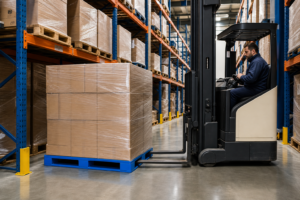
Two-way entry is sometimes described as stronger or cheaper, but neither result is automatic. Continuous runners can create a direct support path in some designs, yet deck ribbing, material grade, wall thickness, reinforcement, pallet weight, and molding complexity also affect performance and cost. Compare actual load data and quotations instead of treating the number of openings as a shortcut.
When Is A 4-Way Pallet The Better Choice?
A 4-way pallet is usually the better choice when handling flexibility prevents extra turns, repositioning, or blocked access. That advantage becomes valuable in narrow aisles, crowded loading areas, cross-docking operations, and routes where several facilities handle the same unit load.
Four-way entry is particularly useful when:
- A forklift may reach the load from different directions.
- Pallets are placed tightly inside trailers, containers, or staging lanes.
- High throughput makes every extra maneuver costly.
- The receiving warehouse cannot guarantee the original orientation.
- Conveyors, robots, or automated stations require defined access from more than one direction.
- Mixed warehouse layouts make a single approach direction impractical.
More access does not remove the need for a stable base. On a molded plastic pallet, every opening interacts with runners, ribs, feet, and optional steel reinforcement. The right plastic pallet balances fork clearance with deck stiffness and support under the real load rather than maximizing opening size alone.
Why Does Pallet Jack Compatibility Need A Separate Check?
A four-way pallet may accept forklift forks from all four sides without being usable by a pallet jack from all four sides. Forklift tines lift the pallet directly, while a pallet jack also needs room for its load wheels to roll through the underside and drop back to the floor.
A side opening can look wide enough but still fail in practice because a runner blocks the wheels, the vertical clearance is too low, or the fixed fork spacing does not align with the channels. This is why “4-way forklift entry” and “4-way pallet-jack entry” should appear as separate lines in a specification.
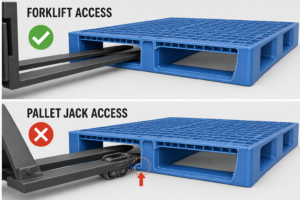
Before approving a model, compare the pallet drawing with:
- Fork width, thickness, length, and adjustable spacing
- Pallet-jack fork width, overall fork spacing, and lowered height
- Load-wheel position, diameter, and required travel path
- Clear opening width and height on every intended entry side
- Any center foot, runner, rib, or reinforcement beneath the deck
For nonstandard equipment, a loaded sample trial is much safer than checking nominal dimensions alone. The forks must enter without impact, lift the load evenly, clear the underside, and withdraw without catching the pallet.
How Do Racks, Conveyors, And Loads Affect Your Choice?
Entry type alone cannot confirm whether a pallet is rackable. A rack supports the pallet at specific edges or runners, leaving part of the deck suspended. That unsupported span, the direction of the rack beams, the load distribution, storage time, and temperature all affect deflection.
If the pallet will be stored above floor level, compare its stated racking load under the same support condition used at your facility. Static load applies on a level floor, dynamic load applies during handling, and racking load applies when the pallet bridges supports. These ratings are not interchangeable, even when the number printed for static loading is much higher.
Review the full system before deciding between 2-way and 4-way entry:
- Selective racks: Check runner direction, beam spacing, support width, safety stops, and maximum loaded storage time.
- Conveyors: Confirm that runners or feet maintain continuous contact with rollers, chains, or belts and do not catch at transfers.
- Automation: Match pallet dimensions, tolerances, sensor locations, fork pockets, deck deflection, and required orientation.
- Unit load: State whether cartons, bags, drums, or rigid containers create an even, concentrated, or shifting load.
- Environment: Include cold storage, heat, chemicals, washing, and outdoor exposure because plastic behavior changes with material and temperature.
For beam storage or automated high-bay systems, start with a purpose-designed rackable plastic pallet and validate it with the intended payload. ISO 8611 test data is useful, but a production-intent field trial still shows how your packaging, handling speed, rack, and environment work together.
How Can You Choose The Right Pallet Entry Type?
Choose the entry type by mapping every movement, not just the first forklift pickup. A pallet that works at your dispatch dock can still create delays at a distributor, retail warehouse, or return point.
Use these seven questions to reach a practical decision:
- Which equipment touches the pallet? List counterbalance forklifts, reach trucks, stackers, manual pallet jacks, powered pallet trucks, conveyors, and automated systems.
- From which direction does each handoff occur? Include production, storage, truck loading, unloading, order picking, and empty-pallet return.
- Is there room to turn or rotate the load? Tight aisles and closely packed trailers usually make 4-way entry more valuable.
- How is the pallet supported? Floor stacking, double stacking, racks, and conveyors impose different structural conditions.
- What does the actual load look like? Record maximum weight, footprint, center of gravity, load distribution, stacking height, and whether the load can shift.
- What does the receiving site require? Confirm pallet size, access direction, pallet-jack use, rack policy, and automation tolerances before ordering.
- What is the cost across the whole route? Compare purchase price with handling time, damage, storage space, return freight, and expected reuse.
Size belongs in the same decision. A 4-way pallet with the wrong footprint will not fix poor container utilization or rack fit, so confirm the destination’s standard pallet size at the same time.
If empty pallets return frequently, underside construction also affects reverse-logistics cost. A nestable plastic pallet can reduce empty storage volume, but its feet and wheel paths still need to match the equipment used along the route.
What Should You Include In A Pallet RFQ?
A useful RFQ describes performance and compatibility, not only “2-way” or “4-way.” When comparing quotations, send the same operating information to each source and ask for a production drawing with clearly marked entry sides.
Include:
- Required pallet length, width, height, and dimensional tolerances
- Forklift entry direction and pallet-jack entry direction as separate requirements
- Minimum clear opening width and height on every usable side
- Forklift and pallet-jack model or complete fork and wheel dimensions
- Maximum unit-load weight, load footprint, center of gravity, and distribution
- Required static, dynamic, and racking loads with their support conditions
- Rack-beam spacing, conveyor layout, stacking method, and automation interfaces
- Material preference, temperature range, hygiene, chemical, and anti-slip needs
- One-way or closed-loop use, expected trips, and empty-return constraints
- Order quantity, color, logo, RFID, reinforcement, and other customization needs
Before placing the production order, ask for the pallet weight and material, dimensioned drawing, load-test basis, stacking or racking limitations, and a representative sample. If the required opening conflicts with deck strength or runner placement, custom plastic pallet services can evaluate a revised base, reinforcement, material, or mold design around the real application.
Frequently Asked Questions
Are All Plastic Pallets 4-Way Entry?
No. Many plastic pallets provide four-way forklift entry, but some runner, double-sided, or application-specific designs have limited access. Check the underside drawing and confirm the entry direction for each type of equipment you use.
Can A 2-Way Pallet Be Used In Pallet Racking?
Yes, if that exact pallet has a verified racking load for your beam spacing, orientation, payload, and environment. The two-way label describes fork access, not automatic approval for or exclusion from rack storage.
Are 4-Way Pallets Always More Expensive?
Not necessarily. Material quantity, pallet weight, reinforcement, mold complexity, resin grade, order volume, and testing requirements can affect price more than entry count, so compare like-for-like specifications.
Is A 2-Way Or 4-Way Pallet Better For Export?
A 4-way pallet is often easier to handle across unfamiliar docks and warehouses, while a 2-way pallet can work well on a controlled one-way route. Confirm the destination’s equipment, pallet-size policy, and unloading direction before choosing.
Choose The Entry Type Around Your Complete Handling Route
The best choice when comparing 2-way vs. 4-way pallets is the one that works at every handoff. Choose two-way entry when orientation stays controlled and the structure fits the load; choose four-way entry when approach flexibility reduces turning, delays, and handling risk. In either case, verify pallet-jack access, support conditions, and load ratings separately.
Preface Plast has manufactured plastic material-handling products since 2003, with ISO 9001-certified production and more than 60 manufacturing machines. Share your load, equipment dimensions, rack or conveyor layout, destination, and budget with our team. We can recommend a standard model or develop an OEM/ODM pallet with suitable entry geometry, material, reinforcement, and testing—helping you reduce compatibility trials and secure stable long-term supply.