
Choosing the wrong shed-base material can shorten your shed’s life before you store the first tool. Put a thin pallet on soft soil, and the base may settle, the floor may bow, and the doors may stop closing. Can I use plastic pallets for a shed base? Yes—but only when the shed instructions permit it and the pallet system is suitable for the ground, load, outdoor exposure, connections, and anchoring. This guide shows you how to make that decision and build the base correctly.
Can I Use Plastic Pallets For A Shed Base?
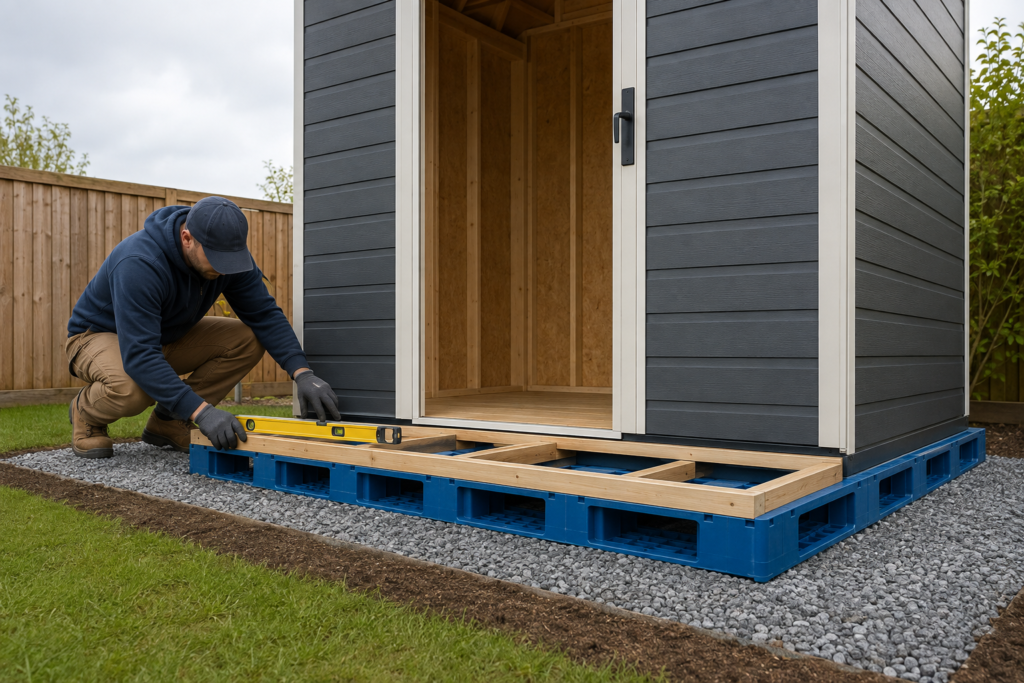
You can use plastic pallets for shed base projects when the structure is light, the site is well drained, every pallet is fully supported, and the complete assembly has been approved for the expected loads. A pallet that merely looks strong is not enough.
First identify what you actually have. A purpose-built plastic shed-base grid is designed to join, spread load into the sub-base, and often accept gravel infill. An industrial plastic pallet is designed primarily for materials handling. Its static capacity does not automatically certify it as a foundation, anchor point, or walking surface.
| Your Project Condition | Practical Decision |
|---|---|
| The shed manual allows a modular or alternative base, and the pallet configuration is documented | A plastic pallet shed base may be considered |
| The manual requires wood or concrete to preserve stability or warranty | Follow the manual; do not substitute shipping pallets |
| Pallet material, condition, capacity, or connector design is unknown | Do not use it as a shed base |
| The shed is occupied, permanent, elevated, or subject to permit rules | Use a code-compliant engineered foundation |
| The soil is soft, sloped, flood-prone, or affected by frost movement | Design the sub-base first; pallets alone will not solve it |
| The shed needs anchoring but the pallet has no approved fixing points | Choose another base or an independently anchored structural frame |
This distinction protects more than the shed floor. Some shed manufacturers specify a particular foundation; for example, Suncast requires a sturdy, level wood or concrete foundation for its sheds. Check the instructions for your exact model and local requirements before purchasing the base.
What Makes A Plastic Pallet Suitable For A Shed Base?
A suitable pallet must support the complete load path, not just the shed’s total weight. Shed walls, floor ribs, shelving legs, stored equipment, and people may place force on small parts of the deck. Those concentrated forces can matter more than a large uniformly distributed static rating.
| Specification To Check | Why It Matters | What To Request |
|---|---|---|
| Static capacity | Indicates performance while supported in the stated floor condition | Test method, support arrangement, load distribution, and safety factor |
| Point-load support | Shed corners, joists, and equipment feet can press between ribs | Deck drawing and approved bearing zones |
| Bottom geometry | Nine feet, runners, or a perimeter base transfer load differently | Foot or runner layout matched to the prepared sub-base |
| Long-term stiffness | Plastic can deflect under sustained load even without sudden failure | Allowable deflection and duration for the project temperature |
| Outdoor material | Sunlight, heat, cold, and chemicals can change long-term performance | Resin, UV-stabilization statement, and service-temperature approval |
| Module connection | Joints must remain aligned under movement and installation loads | Connector drawing, installation method, and joint limitations |
| Top-surface compatibility | Open grids may not support every shed floor or finish board | Required load-spreading sheet or frame and approved fixing zones |
| Condition and traceability | Cracks, distortion, repairs, and unknown previous use add uncertainty | New or inspected units with model identification and consistent dimensions |
Pallet capacity is also support-specific. Static, dynamic, and racking capacities describe different conditions under pallet test methods such as ISO 8611-1; none is a general building-foundation rating. For a shed, ask for an application review that includes wall bearing lines, floor contact points, storage load, temperature, and anchoring.
How To Build A Plastic Pallet Shed Base Step By Step
The reliable sequence is to approve the design first, prepare a stable sub-base second, and assemble the pallets third. Making a flat pallet array on unprepared soil only hides the ground problem until the shed begins to move.
1. Check The Shed Instructions And Local Rules
Confirm the permitted foundation type, finished base dimensions, floor support pattern, anchoring points, and clearance around the shed. Also check planning, setback, drainage, wind, and permit requirements. If the manual calls for concrete or a timber platform, obtain written approval before substituting a pallet system.
2. Draw The Complete Base Layout
Measure the external shed-floor footprint rather than relying on its marketed size. Map each pallet, joint, wall line, doorway, anchor point, and any overhang. Avoid narrow cut pieces: cutting a molded pallet can remove ribs and change its load path.
For a simple rectangular layout, divide each shed dimension by the usable module dimension and round up to the next whole module. Then check whether the extra edge area interferes with access, runoff, or anchoring. A custom modular footprint is often cleaner than forcing standard pallets into an awkward shape.
3. Choose A Firm, Well-Drained Location
Keep the shed away from low spots, roof discharge, blocked drains, and large roots. Plan for water to move away from the building without eroding the sub-base. A plastic pallet will resist water absorption, but it will not stop soil settlement or standing water.
4. Prepare The Sub-Base
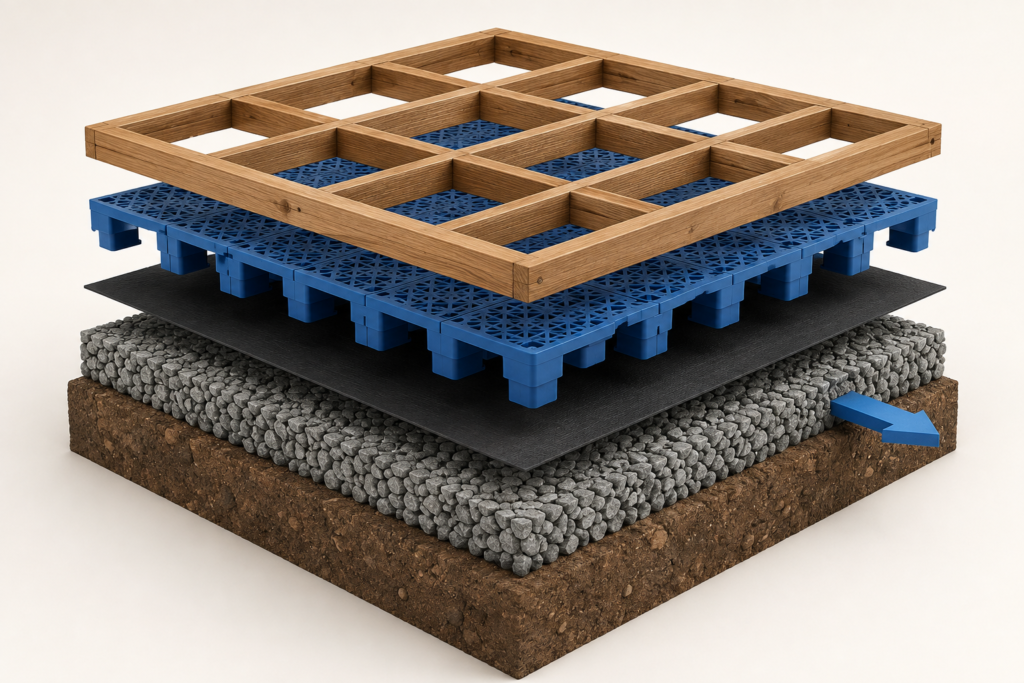
Remove vegetation, organic topsoil, sharp debris, and soft pockets. Install edging, geotextile, compacted aggregate, leveling material, or frost protection as required by the soil and local climate. The finished area must be firm, level, and large enough to support every foot, runner, joint, and perimeter edge.
Do not choose a universal gravel depth from a generic tutorial. Clay, sand, filled ground, rainfall, frost depth, and shed weight create different requirements. A local installer or engineer should size the sub-base when settlement would damage the structure.
5. Dry-Lay And Inspect Every Pallet
Place the unloaded pallets in their final orientation. Check model numbers, dimensions, cracks, missing feet, bowed decks, contamination, and damaged connector pockets. Reject any unit that rocks or creates a step at the joint; a top sheet will not correct inconsistent support below it.
6. Connect The Pallets With The Designed System
Engage the manufacturer’s clips, locks, or module connectors in the specified sequence. Keep the joints flush, verify the overall dimensions, and measure both diagonals to confirm the array is square. The detailed connection procedure appears in the next section.
7. Add The Approved Load-Spreading Layer
An open pallet deck may need a structural sheet, shed-floor frame, or compatible grid infill to carry wall and floor loads across the ribs. Select its thickness, edge support, fasteners, moisture resistance, and expansion clearance as one system. Ordinary thin plywood laid loosely over openings is not a structural design.
8. Anchor The Shed Through An Approved Load Path
Wind uplift must transfer from the shed into a recognized foundation or independent ground anchors. Do not assume screws driven into a thin plastic deck will hold. Use only documented molded fixing points, an independently anchored perimeter frame, or the shed manufacturer’s approved detail.
9. Level, Load, And Reinspect
Before assembling the walls, check level across both directions and across every joint. After loading the shed, inspect door gaps, floor deflection, connector movement, and perimeter settlement. Recheck after heavy rain, a freeze-thaw cycle, high winds, or a major change in stored weight.
How To Connect Plastic Pallets Together
The safest answer to how to connect plastic pallets together is to use the connector designed for that exact modular pallet. The joint should maintain alignment without puncturing structural ribs or leaving hardware where it can snag the shed floor.
| Connection Method | Appropriate Use | Important Limit |
|---|---|---|
| Integral clips or locking pins | Purpose-built shed-base grids | Use every specified connector and follow the grid installation guide |
| Manufacturer-specified module connectors | Modular industrial pallet systems | Capacity and joint behavior depend on the approved configuration |
| Independent perimeter frame | Holds a pallet array in position and provides an edge detail | Restraint is not the same as connecting every pallet or anchoring the shed |
| Through-bolts and plates | Only through identified molded bosses with written approval | Random holes can cut ribs, start cracks, and invalidate the rating |
| Cable ties | Temporary alignment during layout | Not a structural connector, anchor, or long-term outdoor fixing |
| Adhesive | Rarely suitable beyond nonstructural trim | Dirt, moisture, resin type, and thermal movement make performance uncertain |
| Screws driven into the deck | Not recommended without designed inserts or fixing zones | Thin plastic ribs provide unreliable withdrawal resistance |
A practical connection sequence is:
- Use identical compatible modules. Mixed pallet heights, foot patterns, or connector geometries create steps and uneven load sharing.
- Set every unit on its final support. Never pull two rocking pallets together with the connector and expect the joint to level them.
- Align the molded connector zones. Clean out gravel and flashing so the parts seat fully without forced bending.
- Install the specified connectors. Use the correct orientation, count, tools, and locking method from the supplier’s drawing.
- Check the joint. The decks should be flush, the gap consistent, and the assembly square without visible connector damage.
- Support the perimeter and finish layer. Prevent edge roll, trip points, and unsupported sheet joints.
- Complete a loaded mock-up. Check deflection, separation, noise, and fastener movement before repeating the design across multiple sites.
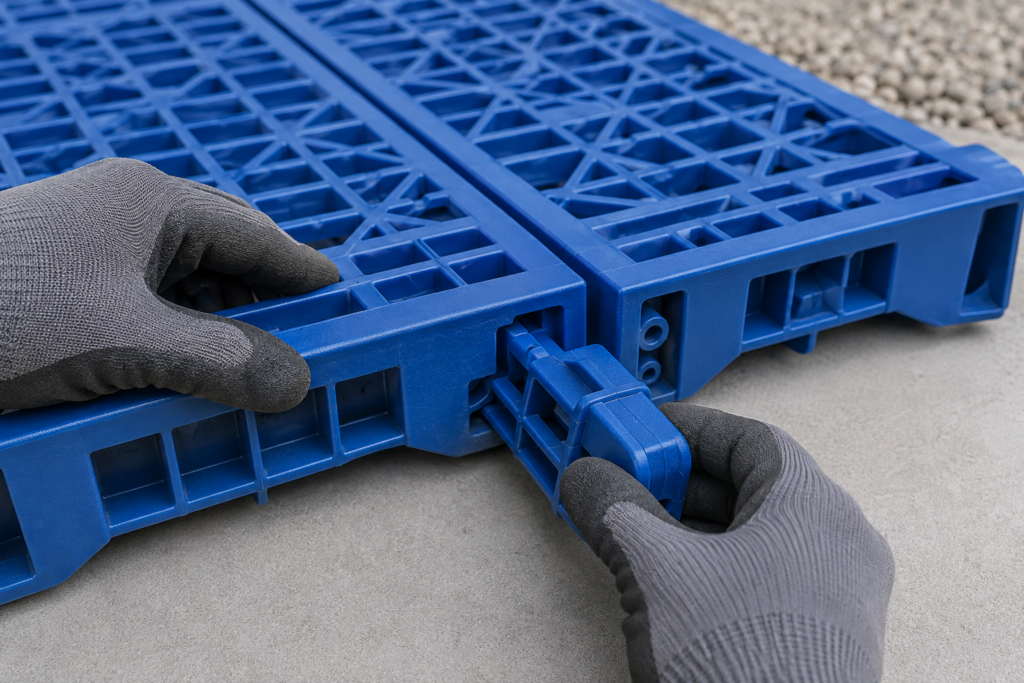
For applications that need a nonstandard footprint, the 1100 × 1100 mm modular plastic pallet uses reinforced PP module connectors without exposed metal fasteners at the panel joints. Its 4-, 6-, or 9-module structures can be adjusted in approximately 20 mm increments, and a damaged module can be replaced separately.
The product page lists capacities up to 6,000 kg static, 2,000 kg dynamic, or 1,000 kg in racking with the correct approved configuration. These values are useful for pallet selection, but they do not by themselves approve a shed foundation, pedestrian deck, or anchoring detail. Send the complete application for review.
How Is A Plastic Pallet Deck Different From A Shed Base?
A shed base primarily supports fixed wall, floor, and storage loads. A plastic pallet deck or plastic pallet patio also receives repeated footsteps, chair legs, impact near edges, and possibly stairs or guards. That change in use requires a different review.
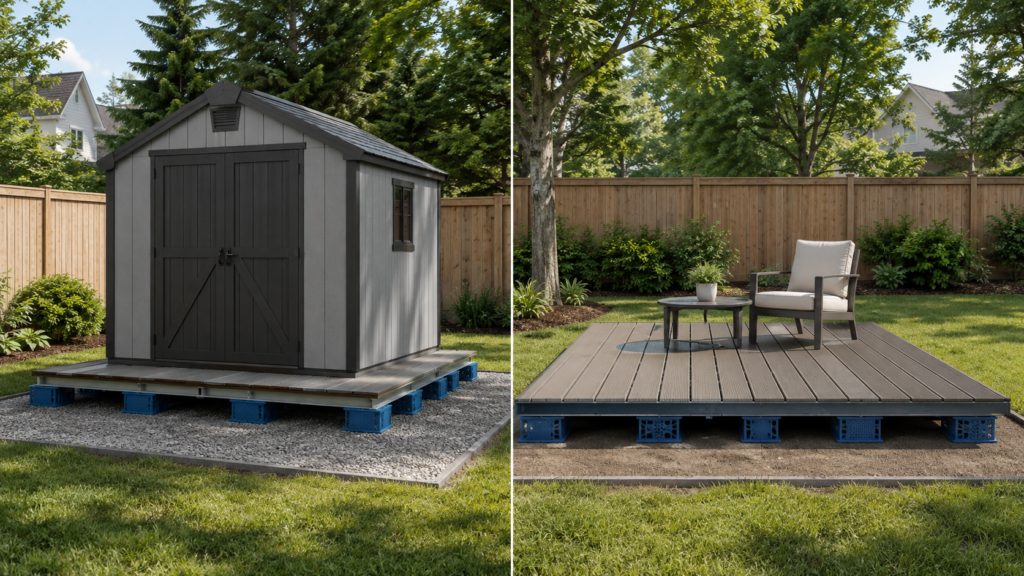
| Design Question | Shed Base | Pallet Deck Or Patio |
|---|---|---|
| Main load | Shed walls, floor, contents, wind uplift | People, furniture, impact, edge loads, finishes |
| Surface | Shed floor or load-spreading platform | Slip-resistant, drainable, walkable finished surface |
| Connection priority | Alignment, wall-load transfer, anchoring | Joint stiffness, surface fastening, edge and trip control |
| Movement | Long-term settlement and thermal change | Settlement plus repeated vibration and footfall |
| Safety review | Shed manual, warranty, anchors, local rules | Deck height, stairs, guards, public use, local code |
If you searched for a “plastic pallets deck,” first decide whether you mean a low removable platform or a regulated deck. Making a deck out of pallets may look simple, but a shipping-pallet static rating does not show how the deck responds when a heel, chair leg, or board fastener lands between molded ribs.
The most workable plastic pallet deck ideas are normally low to the ground, fully supported, easy to inspect, and finished with a compatible surface that preserves drainage. Any elevated deck, public-use platform, attached structure, stair, or guard system needs an appropriate structural design rather than an improvised pallet base.
Which Plastic Pallet Ideas Are Practical For Repurposing?
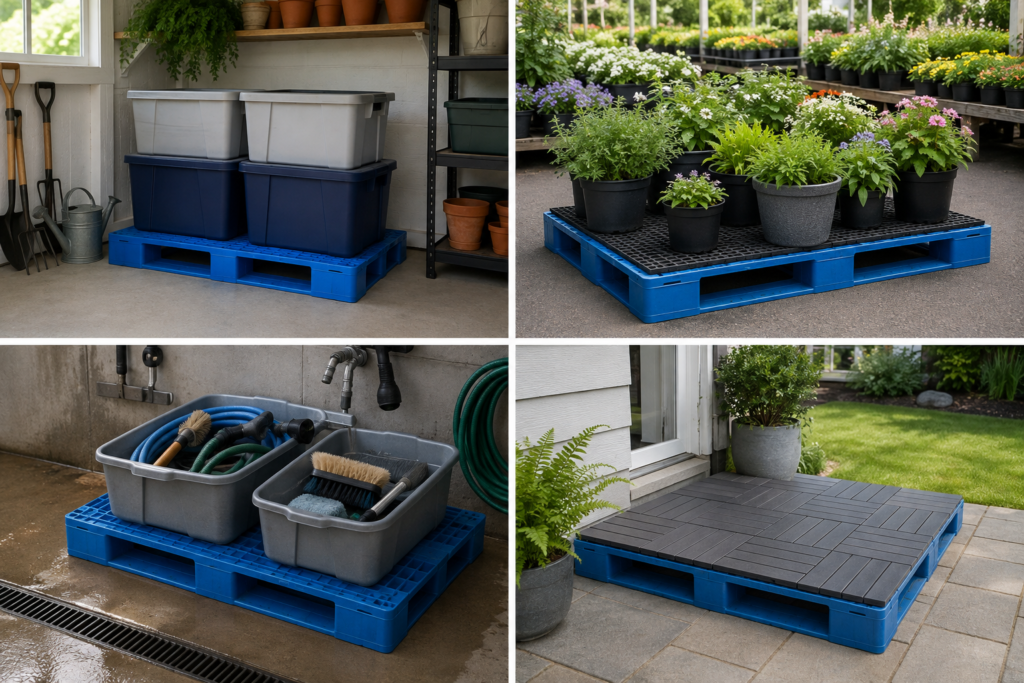
Among common plastic pallet ideas, the lower-risk projects keep the pallet close to its original job: supporting distributed loads above a floor. Before you repurpose plastic pallets, confirm ownership, previous cargo, chemical exposure, material, capacity, damage, and outdoor suitability.
- Raised shed or workshop storage: Keep sealed bins, spare parts, bagged materials, and equipment off a damp floor.
- Washdown-area staging: Use an open deck to elevate compatible containers while preserving drainage and inspection access.
- Seasonal equipment platform: Create a removable base for lightweight tools or garden equipment after checking point loads.
- Planter and nursery staging: Keep pots organized and off wet ground, with a barrier where small feet could enter the grid.
- Temporary event or maintenance platform: Use only a system approved for pedestrian loading, edges, and the intended finish.
- Low removable patio concept: Treat a plastic pallet patio as a walking structure, not as cargo storage, and validate the whole surface assembly.
Reclaimed pallets are not automatically a bargain. A missing foot, cracked weld line, distorted module, or unknown chemical history can erase the savings. For repeat projects, consistent new modules and replaceable parts are usually easier to specify, install, inspect, and reorder.
What Common Plastic Pallet Base Mistakes Should You Avoid?
Most failures begin with a plausible shortcut: a high capacity number, a surface that looks level, or a connector that seems tight. Avoid these mistakes before the shed hides the base from view:
- Placing pallets directly on grass or topsoil. Organic material compresses and holds moisture, causing differential settlement.
- Leveling only the pallet tops. Shims can create concentrated pressure and leave other feet unsupported.
- Using static capacity as a universal safety rating. Shed walls, anchors, people, and shelving create different loads.
- Joining pallets with zip ties alone. Ties may hold alignment temporarily but do not create a structural platform.
- Drilling wherever a bolt fits. A hole through a rib, hollow wall, or stressed corner can initiate cracking.
- Blocking drainage with a solid cover. Plan outlets and inspection access below any sheet or finished deck.
- Ignoring edge support. Perimeter modules and top-sheet seams are often where rocking and local deflection start.
- Assuming all plastic is weatherproof. Confirm UV stabilization and the expected service temperature for the exact resin and color.
- Anchoring only to the pallet skin. Wind can pull fasteners out even when gravity loads appear modest.
- Mixing used pallet models. Small differences in height and bottom geometry prevent even load sharing.
- Skipping the loaded trial. A one-bay mock-up can reveal deflection and connection problems before a full installation.
What Should You Send A Supplier Before Ordering Modular Pallets?
A useful quotation needs more than length, width, and quantity. Send enough information to match the module layout, support, connectors, and reinforcement to the real application.
- Shed brand, model, manual, floor plan, and warranty requirements
- Finished base length, width, height, and allowable overhang
- Empty shed weight, maximum stored load, and likely point loads
- Wall bearing lines, floor ribs or joists, shelving feet, and doorway loads
- Soil, sub-base, drainage, slope, frost, and outdoor temperature conditions
- Required UV exposure period and expected service life
- Top sheet, floor frame, finish board, and fastening concept
- Wind anchoring method and proposed ground or foundation anchors
- Required module connection, replaceability, color, and identification
- Project quantity, delivery schedule, sample need, and installation location
Ask for a module drawing, support layout, connector detail, approved capacity under that support condition, material statement, and installation limits. For a multi-site program, approve a full-size sample or loaded mock-up before releasing the volume order.
Frequently Asked Questions
Can Plastic Pallets Sit Directly On Soil?
Not reliably, because topsoil and vegetation compress unevenly and allow feet to sink. Use a properly designed, compacted, and drained sub-base that supports every pallet bearing point.
How Many Plastic Pallets Do You Need For A Shed?
Divide the shed’s actual floor length and width by the usable pallet or module dimensions, round each direction up, and multiply the results. Then revise the layout for wall bearing lines, joints, edge support, and any prohibited overhang.
Can You Fix Plywood Directly To A Plastic Pallet?
Only when the pallet maker identifies approved fixing zones or inserts and the sheet is specified for the span, moisture, and loads. Random screws into thin deck ribs can loosen or split the plastic.
Can Zip Ties Connect Plastic Pallets For A Shed Base?
Zip ties can hold modules in position during layout, but they should not be treated as structural joints or wind anchors. Use the designed connector or an approved independent frame.
Should You Fill Plastic Pallets With Gravel?
Fill only a purpose-built cellular shed-base grid whose instructions require or allow aggregate. Do not pour gravel into a hollow industrial pallet unless its drainage, cleaning, mass, and structural effects have been approved.
Can Used Plastic Pallets Become A Shed Base?
Used units may suit a low-risk project only when their ownership, model, capacity, previous cargo, outdoor suitability, and condition are known. Reject mixed, cracked, bowed, repaired, stained, or unidentified pallets.
How Long Do Plastic Pallets Last Outdoors?
There is no reliable universal lifespan because resin, UV stabilization, color, temperature, stress, chemicals, and inspection all matter. Request outdoor-service information for the exact model instead of applying a generic plastic-pallet lifespan.
Final Thoughts
A successful plastic pallet shed base begins with one decision: can the complete system carry the shed, contents, movement, and anchors into stable ground without violating the shed instructions? Once that is confirmed, modular construction can simplify unusual footprints, wet-site maintenance, and replacement—but the ground, connector, support, and top layer must still work together.
Preface Plast manufactures standard and modular plastic pallets for commercial projects, including configurable footprints, replaceable modules, optional reinforcement, and OEM/ODM requirements. Share your shed drawing, base size, load distribution, ground support, outdoor conditions, anchoring concept, quantity, and budget, and our team can help compare a standard module layout with a custom solution before you invest in the wrong base.