One warped pallet or blocked fork opening can turn automated pallet handling from a productivity upgrade into a line stop—and make manual recovery unsafe. The safest starting point is simple: treat the robot, dispenser, conveyor, wrapper, storage equipment, controls and pallet as one connected system.
What can you gain when those interfaces work together? Automated pallet management can improve flow consistency, reduce repetitive handling, use storage space more effectively and give you better control of pallet movement. This guide shows where those benefits come from—and how to choose automated palletizer systems and plastic pallets without creating new bottlenecks.
What Is Palletization, And What Is Palletizing?
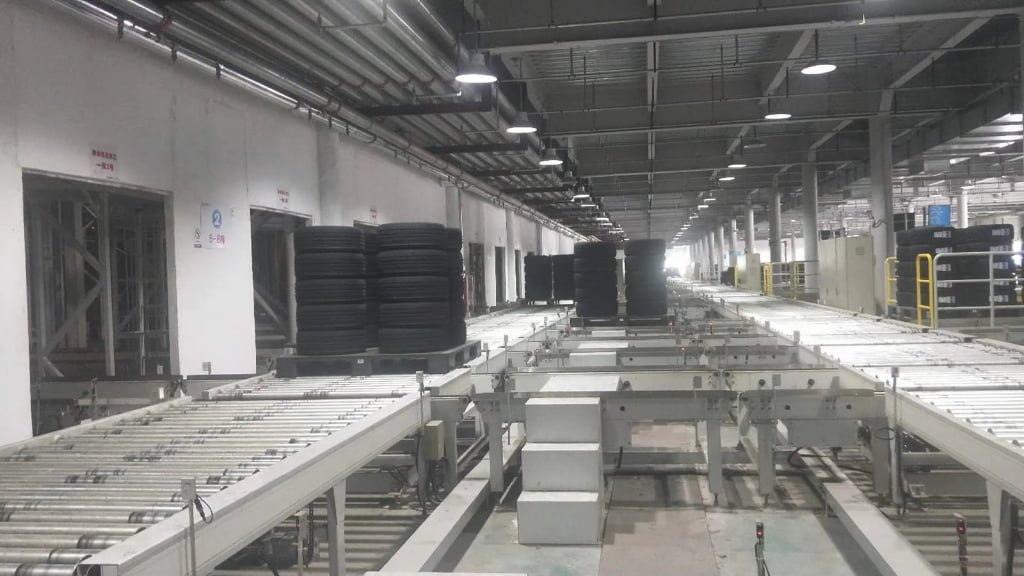
Here is the simple difference. Palletization is the process of arranging and securing products on a pallet to create a stable unit load; palletizing is the act of building that load. In your project meetings, the terms may be used interchangeably.
When you compare automated palletizer systems, remember that the palletizer performs only part of the journey. Your wider automated pallet handling flow may also include empty-pallet supply, conveying, inspection, wrapping, labeling, AGV transport and automated pallet storage.
This is where your project can get caught. A fast palletizer cannot fix an empty-pallet misfeed, a transfer that does not support the runners, or an outbound wrapper that keeps blocking your line.
Where Does Automated Pallet Handling Begin And End?
Map your automated pallet handling flow by following one pallet from the empty stack to storage or shipping. Review both your product flow and empty-pallet flow; either one can stop the line.
| Process Stage | Typical Equipment | What The Pallet Must Match | Common Failure |
|---|---|---|---|
| Empty pallet supply | Automatic pallet dispenser or magazine | Stack geometry, nesting behavior and separation points | Two pallets release together or none releases |
| Product preparation | Infeed conveyor, orienter and identification | Pallet position and approved load pattern | Wrong recipe or case orientation |
| Palletizing | Layer-forming machine, robot or gantry | Deck flatness, location reference and surface grip | Off-center or unstable unit load |
| Load stabilization | Tier-sheet unit, wrapper, strapper and labeler | Deck edge, load footprint and identification area | Loose film, damaged label or shifted load |
| Pallet transfer | Roller, chain or transfer pallet conveyor | Runner position, support spacing and transfer gap | Pallet stalls, rocks or rotates |
| Storage and retrieval | Pallet storage racks, shuttle, stacker crane or AGV | Support span, underside geometry and loaded deflection | Fork, rail or rack interference |
If you are comparing plastic material handling systems, note that the phrase often means resin or powder conveying. Here, it means equipment handling products on plastic pallets; every model in a wider plastic pallet product range still needs automation approval.
Which Palletizer Types Fit Different Production Lines?
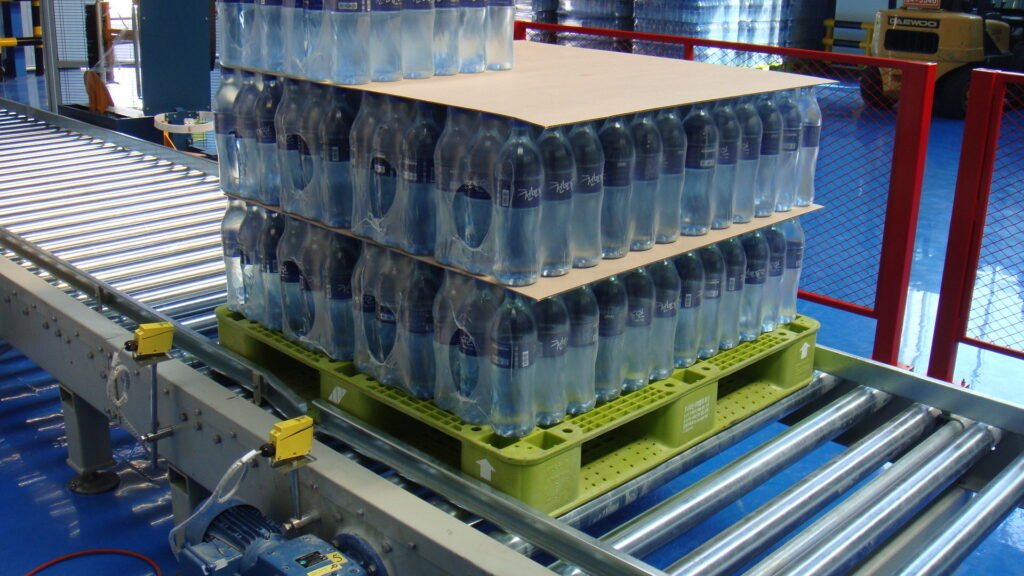
When you compare different palletizing systems, do not start with a robot brand or headline speed. Start with your product flow: sustained output, product behavior, SKU changes, available space and downstream capacity decide which option fits.
| Palletizer Type | Best Starting Fit | Main Strength | Main Limitation |
|---|---|---|---|
| Low-level conventional palletizer | Stable cartons or bags at medium to high volume | Ground-level access and proven layer handling | Longer product path and less recipe flexibility |
| High-level conventional palletizer | High-volume, repeat production | Efficient layer transfer | More height, access and guarding complexity |
| Industrial robotic palletizer | Multiple SKUs, patterns or infeed lines | Flexible recipes and end-of-arm tooling | Output depends on picks, travel, tooling and pallet exchange |
| Collaborative palletizer | Lighter products and limited-space lines | Compact deployment and easier relocation | Lower payload, reach or rate in many applications |
| Gantry or Cartesian palletizer | Large work envelope, several positions or heavy products | Controlled paths and broad coverage | Larger structure and application-specific integration |
If your line handles heavy cases, bags, pails, drums or building materials, heavy duty palletizing systems need application-specific engineering. Check product weight, tooling, center of gravity, inertia and every downstream device; a heavy-duty plastic pallet label alone proves nothing.
If you need mixed-load palletizing, treat it as a capability rather than a machine type. Your result depends on product data, sequencing, vision or identification, pattern logic and load stability—not simply on selecting an articulated robot.
If you are considering a collaborative robot, do not assume it creates a fence-free cell. Include the gripper, product edges, payload, speed, human tasks and foreseeable contact in your application risk assessment.
How Do Pallet Conveyors And Automatic Pallet Dispensers Affect Reliability?
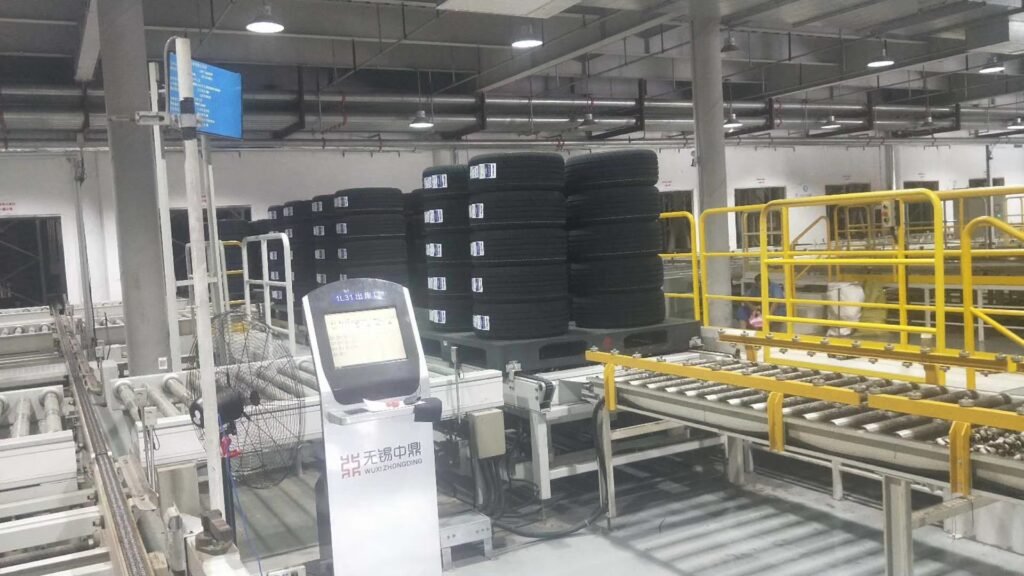
This is where many otherwise good projects get caught. If you are loading pallets automatically, your pallet conveyor system and automatic pallet dispenser may run well with one pallet and misfeed the next when stack behavior, runner contact or transfer clearance changes.
| Component | Interface To Verify | Typical Problem When Missed |
|---|---|---|
| Automatic pallet dispenser | Stack lean, pallet pitch, separation feature, grip point and allowable damage | Double feed, dropped pallet or failure to separate |
| Roller pallet conveyor | Roller pitch, transfer gap, runner direction and local point loading | Runner drops between supports or pallet bounces |
| Chain pallet conveyor | Chain centerlines, runner contact and underside clearance | Chain misses the load path or damages the base |
| Chain-to-roller transfer | Lift stroke, support transition and pallet orientation | Pallet catches or rotates during a 90-degree transfer |
| Stop, centering or turntable | Squareness, locating face, friction and load stability | Robot datum shifts or load leans after release |
| Photoeye or profile sensor | Target position, surface, color, holes and detection angle | Black, glossy or grid surfaces are missed |
If you plan to use nestable plastic pallets, test the dispenser against their nesting depth and release geometry. A magazine designed for block pallets may not reliably denest your nine-leg export pallet.
Even if you choose stackable plastic pallets for automated handling, do not treat them as automatic approvals. Your plastic pallets for pallet conveyors still need runner, stack, support and production-condition trials.
How Do You Choose An Automated Palletizing System?
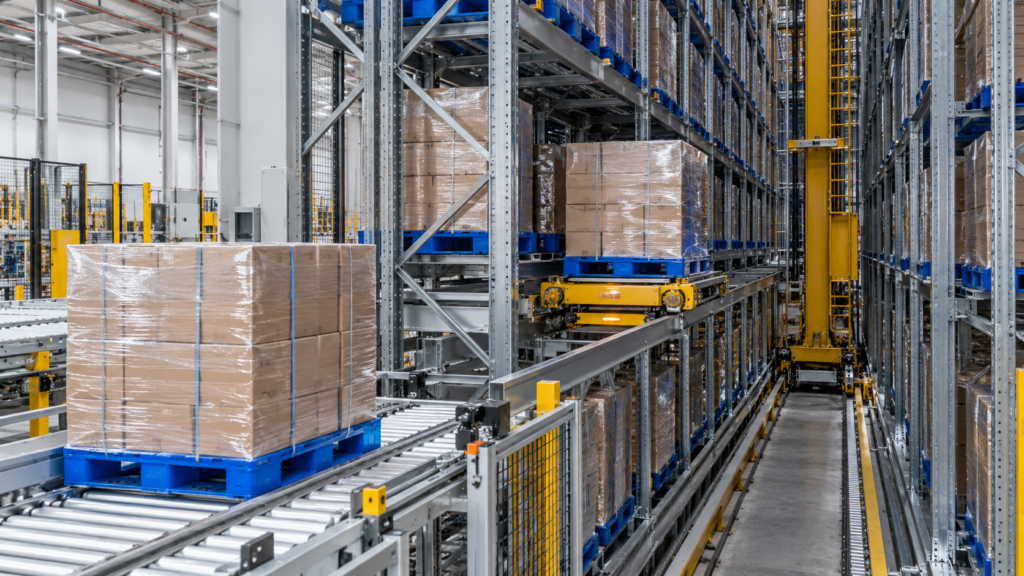
If you are asking how to choose a palletizing system, start with what your line really does on its hardest day. Your measured production conditions matter more than robot payload or a short demonstration at headline speed.
| Selection Input | Why It Changes The System Choice |
|---|---|
| Average, peak and sustained product rate | Defines required picks, layers and completed pallets per hour |
| Product dimensions, weight and rigidity | Determines tooling, orientation and safe acceleration |
| SKU count and changeover frequency | Changes the value of flexible recipes versus fixed high-speed mechanics |
| Pallet pattern, height and gross load | Sets reach, payload, stability and wrapper requirements |
| Single-, multi-case or full-layer pick | Changes robot cycles and end-of-arm tooling |
| Available floor area and clear height | Separates low-level, high-level, robotic and gantry options |
| Upstream and downstream capacity | Reveals starvation, blocking and buffer requirements |
| Dust, washdown, cold or corrosive exposure | Changes materials, sensors, lubrication and enclosure needs |
| PLC, WCS, WMS, barcode or RFID interface | Defines recipe, identity, tracking and exception logic |
| Pallet drawing and permitted condition | Fixes the dispenser, conveyor, locating and storage interfaces |
If your project handles food or beverages, include the cleaning method and wet-surface behavior when comparing plastic pallets for automated food and beverage lines. Keep hygiene, automation fit and food-contact documentation as separate checks.
Before you request a quotation, define measurable acceptance criteria: representative SKUs, approved pallet samples, sustained good pallets per hour, changeover time, reject logic, fault recovery and safe restart. That gives the project a testable target instead of “run fast with no jams.”
What Makes A Plastic Pallet Automation-Ready?
Here is the practical truth: you need to validate one exact pallet model at every contact point. A high static-load figure, steel tubes or a three-runner base does not prove compatibility with your dispenser, conveyor, shuttle, rack or palletizer.
| Pallet Requirement | Data To Approve | What It Protects |
|---|---|---|
| Overall geometry | Length, width, height, squareness and critical tolerances | Stops, guides, rack clearances and load position |
| Empty flatness | Deck and base warpage limits | Stable conveying and accurate pallet location |
| Loaded deflection | Load, distribution, support lines, time and temperature | Fork clearance, conveyor contact and rack safety |
| Underside structure | Legs, runners, perimeter base and support direction | Roller, chain, shuttle and rack compatibility |
| Entry openings | Clear height, width, lead-in and load-wheel path | Fork, AGV and pallet-jack access |
| Deck surface | Usable area, grid openings, friction and anti-slip parts | Product placement and load stability |
| Identification | Barcode or RFID position, orientation and loaded read test | Traceability and routing |
| Sensor target | Surface, color, geometry and viewing angle | Reliable presence and profile detection |
| Material and environment | Resin grade, temperature, UV, chemicals and wash cycle | Impact, stiffness, creep and surface behavior |
| Condition limits | Crack, broken foot, bent runner, protrusion and repair rules | Damaged-pallet isolation before a jam |
You can manage this with an approved pallet envelope: the minimum and maximum geometry, loaded behavior and condition your system will accept. That is far more useful than approving one nominal catalog size.
Do not approve a footprint without its drawing. Compare standard plastic pallet dimensions, 1200 × 1000 mm plastic pallets and 1200 × 800 mm plastic pallets by model; 1200 × 1000 mm is not a true 48 × 40 inch pallet.
Choose material around your temperature, impact, hygiene and load needs, but remember that HDPE, PP and recycled plastic pallet materials are not automation ratings. Molding, cooling, welding, reinforcement and batch control also affect your flatness and repeatability; see the plastic pallet manufacturing process.
Use ISO 8611-1:2025 as a pallet-test reference, not as proof of compatibility with your line. Compare static, dynamic and racking load conditions and run production-intent trials at your actual support, load and temperature.
How Do Automated Pallet Storage And Shuttle Systems Change Pallet Requirements?
Once your full pallet leaves the wrapper, automated pallet storage can make support and clearance more demanding. Your pallet storage systems may include pallet storage racks, shuttle pallet racking or stacker-crane AS/RS; none is a palletizer type.
| Storage Approach | Best Starting Fit | Pallet Interface That Matters Most |
|---|---|---|
| Selective pallet racks | Direct access to many SKUs | Beam span, orientation and loaded deflection |
| Semi-automated radio shuttle | Deep lanes and multiple pallets per SKU | Runner or bottom-board contact with shuttle rails |
| Automated pallet shuttle with lifts | High-density, sequenced storage | Lift points, rail clearance, profile and identification |
| Stacker-crane AS/RS | High-bay standardized unit loads | Rack support, fork or telescope clearance and repeatability |
| AGV or AMR buffer flow | Flexible routes between fixed stations | Entry geometry, load stability and pickup position |
Compare pallet racking systems for plastic pallets before you choose the storage architecture. For beam storage, verify an exact rackable plastic pallet at your required span rather than inferring capacity from its base name.
An automated pallet shuttle moves completed loads inside storage; it does not build the load. The pallet requirements for AS/RS should be checked across conveyors, cranes, shuttles and AGVs using the exact AS/RS plastic pallet interface.
At your storage entry, verify pallet direction, gross weight, loaded profile, overhang, loose stretch film, runner condition and barcode or RFID. This keeps one rejected load from becoming a difficult recovery task inside a deep lane.
Why Do Pallets Jam On Conveyors Or Lose Throughput?
When your line stops, do not blame “automation” in general. Most pallet-related stops occur at a specific interface where your pallet changes support, direction, identity or load state.
| Symptom | First Checks |
|---|---|
| Pallet will not separate | Warpage, nesting depth, stack tolerance, friction and dispenser grip setting |
| Two pallets discharge together | Separation feature, pallet pitch, damaged feet and release timing |
| Pallet stalls at a transfer | Runner position, roller pitch, chain centers, gap and orientation |
| Robot places cases off-center | Pallet stop, centering device, datum and dimensional variation |
| Sensor misses the pallet | Target location, color, reflectance, grid openings and setup |
| Fork or shuttle cannot enter | Opening clearance, load-wheel path, runner damage and loaded deflection |
| Load leans after discharge | Pattern, product rigidity, deck friction, acceleration and wrapping |
| Rated machine speed is never reached | Starvation, blocking, pallet exchange, changeovers and microstops |
If you widen every guide or disable a sensor, you may only move the failure downstream. To prevent recurring palletizer downtime, record your pallet model, batch, condition, SKU, recipe and exact transfer point so you can reproduce the cause.
Which Safety Controls Must Cover The Whole System?
Plan your safety controls around the moment someone must replenish pallets, clear a jam or enter for maintenance—not only around steady production. ISO 10218-2:2025 addresses industrial robot applications and cells, not every conveyor or storage hazard.
- Guard robot, tooling, products, pallet lifts and conveyor nip points as one hazard zone;
- Validate interlocks, scanners, light curtains, safe stops and restart behavior;
- Prevent an automatic restart merely because a guard closes or a device resets;
- Control electrical, pneumatic, hydraulic, mechanical and gravity energy;
- Provide a safe route and method for clearing pallets or products;
- Test faults such as a missing pallet, skewed case, sensor failure and power loss.
If your workplace is in the US, OSHA 29 CFR 1910.212 covers machine guarding, while 29 CFR 1910.147 addresses hazardous-energy control during servicing and maintenance. An emergency stop is not energy isolation; also confirm your local rules.
If your flow uses AGVs or AMRs, ISO 3691-4:2023 is relevant to those driverless industrial trucks. Do not apply it as the governing standard for your fixed-rail shuttle or stacker crane.
How Can You Optimize Palletizing Efficiency?
A faster robot is rarely the first answer. To optimize palletizing efficiency, remove delays across the complete flow and make sure every connected station can sustain the required output.
- Stabilize product infeed. Keep case spacing, orientation and quality consistent so the robot is not waiting for products or correcting avoidable misalignment.
- Balance the connected equipment. Match the capacity of conveying, orientation, picking, pallet exchange, slip-sheet placement, wrapping and outfeed. The slowest recurring step will limit the line.
- Reduce pallet-change delays. Keep approved empty pallets ready, tune the automatic pallet dispenser and confirm that each pallet separates cleanly without double-feeding.
- Improve the pick and pallet pattern. Where the product and tooling allow it, pick multiple cases or complete layers. Use a stable pattern that minimizes unnecessary robot travel without sacrificing load stability.
- Shorten SKU and pattern changeovers. Save validated recipes, use clear product identification and make tooling adjustments easy to repeat. This helps prevent the wrong pattern from reaching the line.
- Control pallet quality before entry. Reject pallets with cracks, excessive deflection, blocked fork openings, damaged runners or dimensions outside the approved tolerance.
- Prevent downstream blocking. Make sure the wrapper, labeler, pallet conveyor, AGV pickup and storage interface can accept finished loads as quickly as the palletizer releases them.
- Make recovery simple and safe. Give operators clear procedures for misfeeds, fallen products and damaged pallets. Easy access for maintenance matters, but it must not bypass guarding or isolation controls.
Start with the small delays that return every shift. A well-balanced line that runs steadily will usually release more good pallets than a faster robot interrupted by pallet misfeeds, blocked outfeed or complicated recovery.
What Else Should You Know Before Automating Pallet Handling?
Do Automated Pallet Systems Require RFID?
No. Barcode, vision, location tracking or PLC logic may be sufficient; if RFID is selected, validate the tag, antenna, direction and loaded read performance around metal or liquid products.
Can A Nestable Pallet Work In An Automatic Pallet Dispenser?
Yes, when the dispenser is designed for that exact nesting depth, leg geometry and separation method. Test new and serviceable used pallets because friction, damage and stack lean can change release behavior.
Can One Robotic Palletizer Serve Several Production Lines?
Yes, if combined peak demand, product arrival sequence, reach, tooling, buffers and changeovers fit the design. Also assess the operational impact when one shared robot stops.
Is Four-Way Entry Enough For AGV Compatibility?
No. Fork opening, lead-in, runner position, load-wheel route, pickup height, loaded deflection and positioning tolerance still need approval for the actual vehicle.
Can Existing Pallets Be Used In A New Automated Line?
Possibly, but approve a representative sample population rather than one undamaged pallet. Include dimensional extremes, normal wear, temperature and the heaviest permitted load in FAT and SAT.
Are Plastic Pallets Always Better Than Wood For Automation?
No material is automatically suitable. A validated plastic design can offer controlled geometry without loose nails or boards, while any warped, cracked or poorly supported pallet can still stop an automated line.
What Should You Decide Before Approving The Project?
Before you approve the project, ask one practical question: can your product, pallet, dispenser, conveyor, wrapper and storage system sustain the required flow when normal variation and recoverable faults appear? That matters more than a perfect demonstration cycle.
Planning an automated palletizer, conveyor, shuttle or AS/RS project? Share the pallet underside, unit-load weight, target rate, conveyor contact, storage support, temperature and identification needs with Preface Plast. We can compare existing molds, prepare production-intent samples and support OEM/ODM validation so the pallet does not become a costly source of downtime.