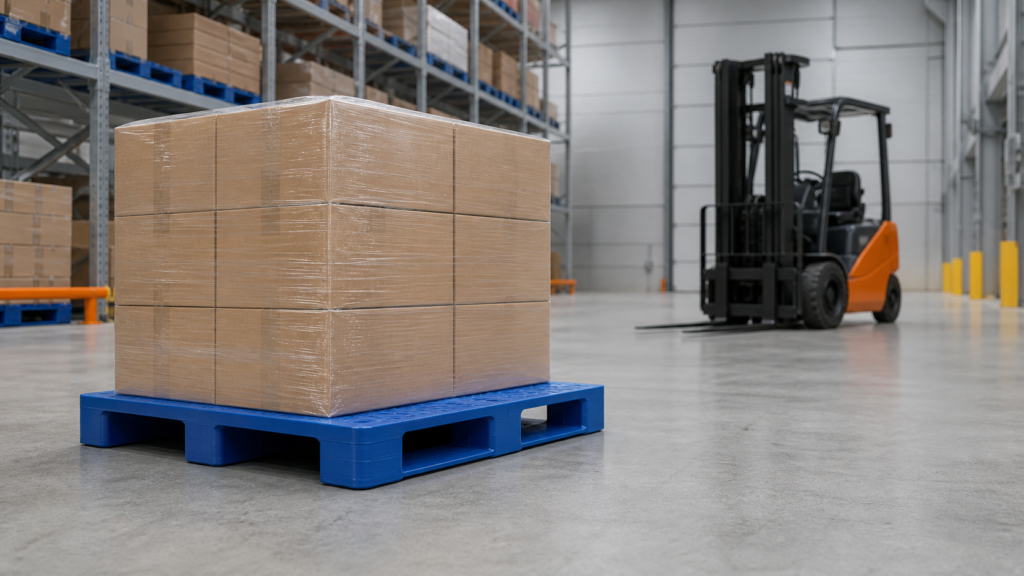
A plastic pallet is a reusable or one-way load platform molded from plastic, usually HDPE or PP, so goods can be stored, lifted, and transported as one unit. Its deck supports the load while feet or runners create entry space for forklifts and pallet jacks.
The right pallet is not defined by material alone. Size, deck and base design, static, dynamic, and racking capacity, handling equipment, temperature, hygiene, and return logistics all affect whether a model is suitable for your operation.
What Is A Plastic Pallet And How Does It Work?
The simplest plastic pallet definition is a molded platform that turns cartons, bags, drums, crates, or other packages into a unit load. Fork openings below the deck allow the complete load to move through production, warehousing, transport, and distribution without handling every package separately.
A plastic pallet normally includes four functional areas:
- Top deck: Supports the product or packaging; it may be open, ventilated, closed, or textured.
- Ribs and internal structure: Distribute the load and control stiffness without making the pallet unnecessarily heavy.
- Feet or runners: Support the deck on the floor, in a stack, on conveyors, or across rack beams.
- Entry openings: Provide two-way or four-way access for forklifts, pallet trucks, and other handling equipment.
The pallet, packaging, restraint, and product must be evaluated as one unit load. A strong deck cannot correct unstable cartons, and a high load rating does not guarantee compatibility with your rack, conveyor, or pallet jack.
What Are Plastic Pallets Made Of?
Most industrial plastic pallets are made from high-density polyethylene (HDPE) or polypropylene (PP). Material selection affects impact behavior, stiffness, temperature performance, chemical resistance, processing stability, service life, and price.
| Plastic Pallet Material | Typical Strengths | Important Procurement Checks |
| HDPE Plastic Pallet | Good impact behavior, moisture resistance, and suitability for many cold or frequently handled applications | Resin grade, recycled content, temperature range, chemical exposure, and test conditions |
| PP Plastic Pallet | Higher stiffness and useful performance in many warm or heavily loaded environments | Low-temperature impact requirements, load duration, additives, and actual operating temperature |
| Recycled Plastic Pallet | Can reduce virgin-resin use and suit cost-sensitive or one-way programs | Resin identification, contamination control, batch consistency, odor, color variation, and application restrictions |
“Virgin plastic” does not automatically mean the pallet is suitable for food, pharmaceutical, cold-chain, or cleanroom use. The finished design, material declarations, additives, molding controls, surface condition, and cleaning process must match the application.
An injection-molded plastic pallet can combine complex ribs with repeatable dimensions at production scale. Blow molding and rotational molding are also used for selected heavy-duty or specialized designs. The manufacturing process should be chosen around performance and volume rather than treated as a quality label by itself.
What Types Of Plastic Pallets Are Available?
The main types of plastic pallets are nestable, stackable, rackable, one-way export, hygienic, and application-specific pallets. These names describe how the pallet stores, handles, or performs; they do not establish one universal capacity.
| Plastic Pallet Type | Best Starting Use | Main Design Feature | Limitation To Check |
| Nestable Plastic Pallet | One-way distribution, retail, and routes with frequent empty returns | Feet fit inside the pallet below to reduce empty storage volume | Base geometry may limit pallet-jack or beam-rack use |
| Stackable Plastic Pallet | Floor storage, block stacking, transport, and repeat-use handling | Runners or a stable bottom deck allow secure pallet-on-pallet stacking | “Stackable” does not automatically mean rackable |
| Rackable Plastic Pallet | Selective racking and unsupported beam spans | Runner structure and optional reinforcement control bending and deflection | Capacity depends on beam span, load pattern, time, and temperature |
| One-Way Export Pallet | Cost-controlled export where the pallet will not return | Lightweight construction and efficient empty-pallet shipping | Usually not intended for demanding long-term reuse or open-span racking |
| Hygienic Plastic Pallet | Food, beverage, pharmaceutical, and clean production areas | Closed or easy-to-clean surfaces with reduced dirt traps | Material and design still need application-specific hygiene approval |
| AS/RS Plastic Pallet | Conveyors, robotics, and automated storage | Controlled dimensions, runner contact, stiffness, and sensor interfaces | Requires equipment data and a production-intent trial |
The broader plastic pallet types guide compares these designs in more detail. For empty-return efficiency, review nestable plastic pallets; for loaded stacking, compare stackable plastic pallets.
What Are The Advantages And Limitations Of Plastic Pallets?
The main advantages of plastic pallets are consistent molded dimensions, resistance to moisture, freedom from nails and splinters, and the ability to design surfaces for cleaning, automation, tracking, and repeat use. Their value is strongest when these features solve a measurable operational problem.
Plastic is not automatically better than wood in every route. The main disadvantages of plastic pallets can include higher upfront cost, limited repair options, fire requirements, racking deflection, and dependence on return and recycling systems. These trade-offs must be assessed for the complete route.
The following plastic pallets vs wood pallets comparison focuses on operating differences rather than claiming one material wins in every application.
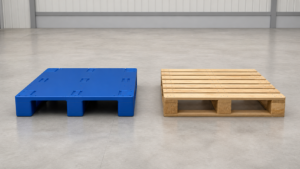
| Decision Factor | Plastic Pallet | Wood Pallet | What The Difference Means |
| Dimensional Consistency | Molded geometry can support repeatable interfaces | Dimensions and condition can vary with construction, repair, and moisture | Plastic may be easier to validate for conveyors and automation |
| Moisture And Cleanability | Does not absorb water like untreated wood; design affects drainability and drying | Can absorb moisture and may retain dirt or odor | Plastic can support controlled wash programs when the model is designed for them |
| Nails And Splinters | No wooden splinters or exposed nails | Damage can create splinters or protruding fasteners | Plastic can reduce selected package-damage and handling risks |
| Export Treatment | Not regulated as solid-wood packaging under ISPM 15 | Regulated wood packaging may require treatment and marking | Plastic can simplify phytosanitary preparation, but destination rules still apply |
| Repair | Many molded designs are not practically repairable after structural damage | Many wood pallets can be repaired through an approved system | Inspection and end-of-life planning matter for plastic fleets |
| Racking Stiffness | Requires design-specific span and creep validation; reinforcement may be used | Stiffness depends on lumber, construction, condition, and span | Neither material should be approved for racks from a static rating alone |
| Initial Cost | Often higher and sensitive to resin, structure, and order volume | Often lower for common one-way designs | Compare cost per completed trip, not purchase price alone |
How Does Plastic Pallet Load Capacity Work?
Plastic pallet load capacity must always be tied to a support condition. Static, dynamic, and racking ratings describe different uses, so one number cannot represent every stage of the route.
| Capacity Rating | How The Pallet Is Supported | Approval Question |
| Static Load Capacity | Stationary on a flat, solid floor | Can the pallet and lower packages carry the stated load without unacceptable damage or deformation? |
| Dynamic Load Capacity | Lifted and moved by a forklift or pallet truck | Does the model support the load pattern during real handling and travel? |
| Racking Load Capacity | Supported only by rack beams or another partial-support system | Is capacity validated for the beam span, support direction, load distribution, temperature, and storage time? |
Load performance also depends on plastic pallet weight, rib pattern, runner design, resin, reinforcement, molding consistency, payload shape, point loads, temperature, handling impacts, and long-term creep. A uniformly distributed carton load can behave differently from drums, bags, coils, or a rigid bulk container of the same total weight.
ISO 8611-1:2025 specifies test methods for evaluating new flat pallets and notes that testing does not replace field trials on specific designs. For open-span storage, start with a purpose-designed rackable plastic pallet and test it with the actual payload and rack layout.
Which Plastic Pallet Size Do You Need?
There is no single global standard plastic pallet size. Common footprints include 1219 × 1016 mm (48 × 40 in) in North America, 1200 × 800 mm in Europe, 1200 × 1000 mm in many industrial networks, and 1100 × 1100 mm in parts of Asia.
The required plastic pallet dimensions must account for more than length and width:
- Product or package pattern, overhang, and weight distribution
- Pallet height and total loaded height
- Forklift and pallet-jack openings
- Rack beam span and runner direction
- Conveyor contact points and AS/RS tolerances
- Truck or container orientation, door clearance, and payload
- Receiving-site and pallet-pool requirements
The standard plastic pallet sizes and dimensions guide provides a regional comparison and RFQ checklist. Use the loaded unit’s external dimensions for transport planning; an empty pallet footprint alone cannot determine how many loads fit in a container.
Where Are Plastic Pallets Used?
Plastic pallets are used in warehouses, manufacturing plants, food and beverage operations, pharmaceutical logistics, chemicals, retail distribution, cold storage, export shipping, and automated systems. A warehouse plastic pallet must still be matched to the individual load, rack, conveyor, and handling route.
Food, Beverage, And Pharmaceutical Operations
Washable surfaces, consistent dimensions, and the absence of wooden splinters can be useful in controlled hygiene environments. However, not every blue or solid-deck pallet is a food-grade plastic pallet. Define product contact, material declarations, cleaning method, drainage, drying, inspection, and traceability requirements.
Warehouse Racking And Automated Handling
Repeatable geometry can support conveyors, robots, wrappers, and AS/RS, but automation needs more than nominal size. Runner straightness, underside contact, deflection, sensor surfaces, fork pockets, stops, and dimensional tolerance belong in the approval drawing.
Export And One-Way Distribution
Plastic pallets do not require ISPM 15 wood treatment, which can simplify international routes. A lightweight export plastic pallet still needs sufficient dynamic capacity, package support, fork access, destination acceptance, and a realistic end-of-life route.
Chemicals, Drums, Bags, And Heavy Goods
Chemical compatibility, point loads, bag deformation, drum feet, slip resistance, and spill-control requirements can change the design. A “heavy-duty plastic pallet” label is not a specification; require load data for the actual support and payload pattern.
How Do You Choose The Right Plastic Pallet?
Start with the operating route, then select a model. Choosing by color, headline load, or lowest unit price can hide equipment incompatibility and create more cost after delivery.
If your team is deciding how to choose a plastic pallet, ask each plastic pallet manufacturer to work from the same application data. Comparable inputs make technical differences and quotation gaps much easier to identify.
Use this sequence before requesting a quote:
- Define the unit load: Product, packaging, dimensions, total weight, weight distribution, center of gravity, and stacking pattern.
- Map every support condition: Floor, stacked load, rack beams, conveyor, forklift, pallet jack, and vehicle floor.
- Confirm the footprint: Receiving standard, package fit, loaded overhang, and transport layout.
- Select the base design: Nine-leg, three-runner, six-runner, perimeter base, reversible, or application-specific underside.
- Choose the material: HDPE, PP, virgin, or controlled recycled resin based on environment and required consistency.
- Specify operating conditions: Temperature, chemicals, cleaning, UV exposure, storage time, hygiene, and fire rules.
- Review commercial conditions: Quantity, existing mold availability, tooling, color, logo, RFID, lead time, and return cycle.
- Approve evidence and a sample: Dimensioned drawing, material data, load-test basis, inspection criteria, and a production-intent field trial.
Manufacturing decisions are connected. Removing material can reduce pallet weight but also change stiffness and impact behavior. Adding runners or steel can improve selected support conditions but increase weight, cleaning complexity, recycling steps, and cost.
When no existing mold fits the load or equipment, custom plastic pallet services can evaluate footprint, ribs, runners, material, reinforcement, color, logo, and tooling. Customization is most valuable when the operational savings are large enough to justify mold development and validation.
What Determines Plastic Pallet Price And Total Cost?
Plastic pallet price varies with resin, pallet weight, dimensions, mold complexity, production process, base structure, reinforcement, features, order volume, testing, and shipping. A fixed online price range is rarely useful for a commercial project because it may describe a different model, load condition, resin, or destination.
Compare alternatives with a total-cost model:
Cost Per Completed Trip = Purchase + Freight + Storage + Cleaning + Handling + Loss + Repair Or Replacement + End-Of-Life Cost − Recoverable Value, Divided By Completed Trips
A reusable pallet creates value only when it stays in a controlled loop long enough to complete the expected trips. The total cost of ownership of plastic pallets therefore depends on completed cycles, losses, cleaning, handling, and recovery—not the purchase price alone.
For a one-way route, a lightweight nestable design may cost less overall even if it has a shorter intended service. For racking or automation, a heavier design can be the economical choice when it prevents deflection, stoppages, or load damage.
Ask every quotation to state the model, material, dimensions, pallet weight, ratings, test conditions, options, quantity, lead time, packing method, and freight basis. This prevents a low specification from appearing cheaper than a configuration designed for the real application.
Are Plastic Pallets Recyclable?
Many HDPE and PP pallets can be mechanically recycled, but plastic pallet recycling is not automatic. Acceptance depends on resin identification, contamination, embedded steel, rubber or RFID components, color, quantity, ownership, and the capabilities of the available processor.
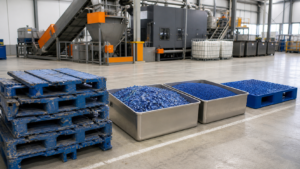
Design the recovery route before purchase:
- Record the resin and any recycled-content or additive requirements.
- Define how damaged pallets are inspected and removed from service.
- Separate detachable runners, steel reinforcement, rubber plugs, and electronic tags when required.
- Keep incompatible chemicals, dirt, and other contamination out of the recycling stream.
- Confirm take-back, collection quantity, preparation, and commercial terms in writing.
A recyclable material does not prove a lower environmental impact. Compare the same logistics service—defined load, route, trips, cleaning, losses, return distance, and end-of-life treatment—rather than relying on material labels alone.
Frequently Asked Questions
Do Plastic Pallets Need ISPM 15 Treatment?
No. The USDA APHIS guidance lists plastic pallets as an alternative not subject to its wood-packaging regulation; receiving, cleanliness, material, and fire requirements still apply.
Are Plastic Pallets Waterproof?
Plastic does not absorb moisture like untreated wood, but dirt and water can remain in ribs, cavities, joints, or damaged areas. Drainage, washing, drying, and inspection must match the pallet design.
How Long Do Plastic Pallets Last?
There is no universal service-life number. Trips depend on load, impacts, rack use, temperature, UV exposure, cleaning, material, loss rate, and removal criteria, so validate life with fleet data from the actual route.
Can Plastic Pallets Be Repaired?
Some assembled or specially designed pallets allow component replacement, while many one-piece molded pallets are removed from structural service after critical damage. Agree on inspection, repair authorization, and end-of-life handling before deployment.
Are Plastic Pallets Safe For Food Use?
They can be suitable when the resin, additives, finished construction, product-contact situation, cleaning process, and documentation meet the application. A color or “hygienic” product name is not proof by itself.
Can A Nestable Plastic Pallet Be Used In Racking?
Only when the specific model is rated for the exact rack support condition or the rack provides an approved supporting deck. Do not infer racking capacity from static or dynamic load figures.
Are Plastic Pallets Fireproof?
No. Plastic pallets are combustible unless a specific formulation and tested classification says otherwise, and facility fire rules may restrict their quantity, storage arrangement, or location.
Final Thoughts
A plastic pallet is a molded material-handling platform, but the procurement decision is about the complete operating system. The correct model must support the load, fit the equipment and destination, perform in the stated environment, and deliver an acceptable cost per completed trip.
Share your unit-load drawing, size, static/dynamic/racking conditions, rack or conveyor details, temperature, hygiene requirements, destination, annual volume, and return plan through the Preface Plast inquiry page. Our team can compare existing molds with an OEM/ODM design and prepare a production-intent specification before order approval.