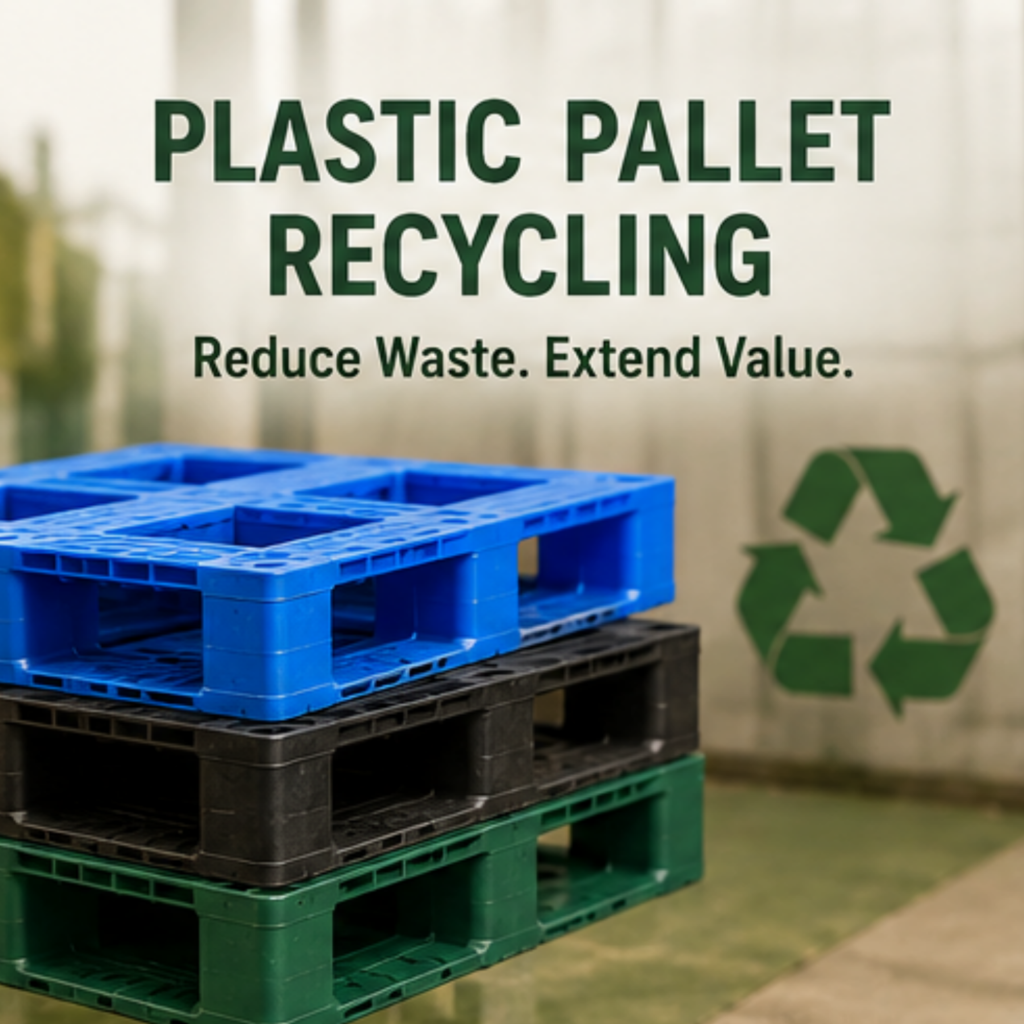
Plastic pallets may seem like just an ordinary tool for logistics and transportation, but when they become damaged, worn out, or no longer needed, how you handle them can directly affect your logistics costs and environmental efficiency.
This article will show you where to recycle plastic pallets, how to prepare them for recycling, when disposal is necessary, where to source used plastic pallets, and how to determine whether a plastic pallet is truly sustainable based on its material, service life, and recyclability, rather than simply relying on a “recyclable” label.
Are Plastic Pallets Recyclable?
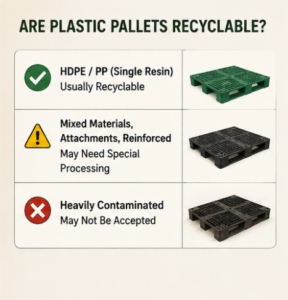
If you are asking, “Are plastic pallets recyclable?” the short answer is yes for many HDPE or PP units. What matters is whether a processor can identify and accept your specific pallet, then turn it into usable feedstock—not simply whether the base polymer can be remelted.
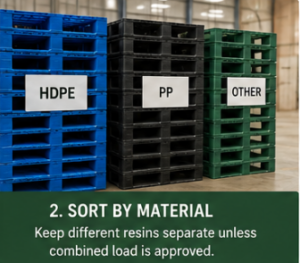
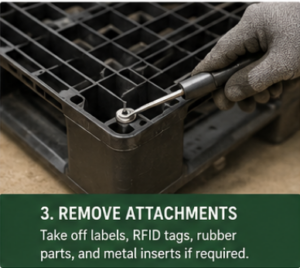
Start by sorting your pallets by resin. Combine HDPE and PP only when the downstream processor approves it in writing. Metal bars, glass fiber, rubber parts, RFID tags, labels, pigments, flame retardants, absorbed chemicals, and unknown blends can all affect acceptance.
| What To Check | Why It Changes The Recycling Route | Useful Evidence |
| Ownership | A pooled pallet may have to be returned, not sold or recycled | Owner mark, rental agreement, asset ID, and ownership example |
| Service Condition | An intact unit may retain more value through reuse | Photos of the top, bottom, runners, and damage |
| Base Resin | HDPE and PP may follow separate specifications or an approved combined load | Molded resin mark or material declaration |
| Reinforcement And Attachments | Metal or incompatible polymers may require removal or a specialist outlet | Drawing, bill of materials, close-up photos |
| Contamination | Oil, chemicals, food residue, odor, or labels can reduce acceptance | Previous-use record and residue description |
| Quantity And Location | Freight and handling can determine whether pickup is viable | Unit count, total weight, stack size, postcode |
How To Recycle Plastic Pallets Step By Step
If you are learning how to recycle plastic pallets, follow this sequence: protect reuse value first, then prepare unusable units to the recycler’s written specification.
- Verify ownership. Separate your pallets from rented, pooled, or supplier-controlled assets and arrange returns where required.
- Triage by condition. Keep serviceable units for reuse. Quarantine cracked, warped, punctured, heat-damaged, or chemically affected units so they cannot re-enter operations by mistake.

- Identify the material. Record the resin mark, model, color, reinforcement, anti-slip parts, labels, and other attachments. Keep resins segregated unless the downstream processor has approved a combined load.
- Describe contamination. Tell the recycler what the pallets carried and whether they have oil, adhesive, odor, powders, food residue, or regulated substances. Do not wash an unknown residue into the drain.
- Confirm preparation. Ask whether labels, RFID devices, rubber inserts, steel bars, or loose components must be removed. Do not shred, bale, or compact units until the receiving specification is approved.
- Sort and stage safely. Build stable, labeled stacks by resin, model, and condition. Keep them dry and accessible for a forklift or loading crew.
- Close the record. Keep the collection weight, destination, rejected quantity, fees or rebate, and recycling or destruction certificate required by your reporting system.
Once your pallets reach a mechanical recycler, they are typically inspected, sorted, cleaned when required, shredded, separated from foreign material, and reprocessed into pellets or regrind. The recovered material may become another pallet or a different durable product; only claim pallet-to-pallet recycling when the processor can document it.
Where To Recycle Plastic Pallets And Who Handles Them
If your team is deciding where to recycle plastic pallets, start with the original supplier or asset owner, then move to a resin-specific industrial recycler or pallet recovery network. Household curbside programs rarely provide the right route for bulky commercial units.
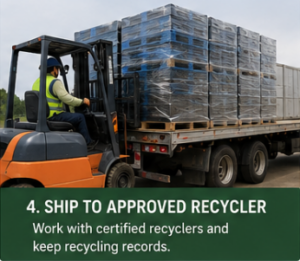
To find who recycles plastic pallets, look for an organization whose input specification matches your resin, construction, condition, quantity, and collection area—not simply the nearest business with “plastic recycling” in its name.
| Recovery Channel | Best Fit | What To Confirm |
| Original Supplier Or Take-Back Partner | Known models and planned fleet replacement | Ownership, accepted models, freight, credit, and evidence |
| Pallet Pool Operator | Rented or marked pool assets | Return point, pickup process, asset count, and charges |
| Industrial Rigid-Plastics Recycler | Broken, clean, sorted HDPE or PP | Resin, additives, contamination limit, minimum load, and destination |
| Pallet Broker Or Reuse Network | Owned, serviceable, repeatable models | Inspection grade, quantity, dimensions, collection, and resale terms |
| Commercial Waste Contractor | Mixed sites or material requiring several outlets | Actual downstream route, sorting fee, rejected-load policy, and records |
Search your city or region with “industrial rigid-plastic recycler,” “HDPE reprocessor,” “PP reprocessor,” “plastic pallet take-back,” or “pallet recovery.” Give each candidate the same data so you can compare collection offers and environmental claims fairly.
How To Arrange Pallet Removal Or Responsible Disposal
A pallet removal quote should clearly separate reuse, resale, material recycling, and disposal. If you need to know how to dispose of pallets, avoid placing intact industrial units in a mixed or curbside bin unless your collection provider confirms that material and format.
| Pallet Status | Preferred Route | Key Control |
| Pooled Or Marked Asset | Return to the owner | Record the asset count and handover |
| Owned And Serviceable | Internal reuse or verified resale | Confirm rating, condition, and legal title |
| Repairable By An Approved Method | Qualified repair and reinspection | Do not improvise repairs on load-bearing parts |
| Broken, Clean, And Identifiable | Resin-specific material recycling | Sort by resin and follow the processor’s specifications |
| Unknown Or Contaminated | Site EHS and waste-characterization review | Classify the residue and material before choosing a route |
When Scheduled Collection Makes Commercial Sense
Scheduled collection works best when you can consolidate enough material into safe transport stacks. Uniform, reusable models may have resale value, while mixed, broken, dirty, or low-volume loads may attract sorting, collection, or disposal fees. There is no universal free-pickup threshold.
Before you accept an offer, confirm who loads the vehicle, stack limits, collection window, rejected units, insurance, downstream destination, and whether the quoted amount is a rebate or a net price after freight and handling.
Where to Get Rid of Pallets That Cannot Be Reused
If you are unsure where to get rid of pallets, check the original supplier or pool owner first, followed by a pallet reuse network, a resin-specific recycler, and finally a licensed waste operator. Separate plastic, wood, and metal units because they need different processing routes.
When deciding how to get rid of plastic pallets, evaluate safe reuse and recycling where applicable. If no outlet accepts your pallet, classify and manage it under local waste rules.
For non-hazardous materials, the EPA waste-management hierarchy places source reduction and reuse ahead of recycling, energy recovery, treatment, and disposal.
If your pallets were exposed to pesticides, solvents, oils, hazardous powders, or unknown chemicals, ask your site EHS team to characterize the waste. Never burn, dump, or wash them to appear recyclable. If local rules classify the load as regulated waste, use the required authorized carrier or facility.
Where To Find Used Pallets And Reuse Them Safely
If you are researching where to find used pallets, start with the original manufacturer, authorized dealers, approved rental or pooling programs, recovery firms, warehouse networks, and verified industrial marketplaces. Never buy, resell, or dispose of ownership-marked pool assets outside the owner’s terms.
Before you approve them, check:
- Legal ownership and permission to resell or transfer the pallet
- Manufacturer, model, resin, dimensions, entry type, and readable markings
- Static, dynamic, and racking ratings for the intended support condition
- Cracks, punctures, missing feet, welds, warpage, chemical attack, and heat damage
- Odor, residue, hygiene history, and any industry-specific restrictions
- Fit with forklifts, pallet jacks, racks, conveyors, loads, and stacking patterns
- Quantity consistency and future availability of the same model
Use standard plastic pallet sizes to shortlist compatible footprints, then confirm how each pallet fits your complete unit load. A familiar footprint does not prove capacity, rack safety, cleanliness, or ownership, so never infer an unknown load rating from appearance.
What Makes Sustainable Pallets A Better Procurement Choice?
When you compare sustainable pallets, look beyond plastic content or a recycling symbol. Choose a pallet that performs through controlled cycles, protects your products, limits empty transport, and has a funded return or end-of-life route wherever you use it. For your next fleet, compare:
- Right-sized performance: enough capacity and durability without unnecessary material or weight
- Verified recycled content: traceable source and a specification that still meets performance needs
- Material simplicity: clearly marked resin and removable or compatible attachments
- Service-life control: inspection criteria, loss tracking, cleaning method, and approved repair limits
- Logistics efficiency: load fit, nesting or stacking ratio, vehicle utilization, and return distance
- End-of-life access: a named take-back or recycling outlet with written acceptance conditions
As you compare plastic pallet types, weigh each trade-off. Steel reinforcement can improve racking but adds a disassembly step; lightweight construction can reduce freight mass but still needs deflection and impact validation. Recycled content can reduce virgin-resin demand, yet its source, consistency, additives, and test results still matter.
Before you approve the order, ask for a material declaration, resin marking, recycled-content basis, attachment list, repair policy, expected use conditions, and end-of-life instructions. These details make future pallet recycling practical instead of aspirational.
How Does Plastic Pallet Design Affect Environmental Performance?
What are the environmental impacts of plastic pallets? Your potential impacts include polymer production, molding energy, freight mass, washing, empty returns, losses, and end-of-life treatment. Which stage matters most depends on your pallet system. Reuse can spread manufacturing impacts across more trips when your pallet survives, returns, and carries loads efficiently.
| Life-Cycle Stage | Potential Impact | Better Decision Metric |
| Raw Material | Fossil feedstock, recycled-resin processing, and additives | Pallet mass, verified recycled content, and material yield |
| Manufacturing | Molding energy, cooling, rejects, and scrap handling | Energy per accepted pallet and documented scrap recovery |
| Use And Cleaning | Freight mass, product damage, water, chemicals, and drying | Completed trips, damage rate, load efficiency, and wash resources |
| Return Logistics | Empty transport, lost assets, and storage | Return rate, nesting ratio, loss rate, and empty kilometers |
| End Of Life | Collection, sorting, reprocessing energy, rejects, or disposal | Reuse rate, material-recovery rate, and verified destination |
Life-cycle research does not support a universal material-only answer. A review of wooden and plastic pallet LCA studies shows that results shift with resin source, pallet weight, number of trips, transport, and end-of-life. Compare the same service: one defined load moved safely over a defined number of trips.

Your environmental case weakens when pallets are lost after a few uses, shipped long distances empty, poorly loaded, or landfilled despite being designed for reuse. Track completed cycles, loss and rejection rates, product damage, empty-return distance, cleaning inputs, recycled content, and verified recovery—not just units purchased.
What Information Should You Send For A Recycling Quote?
For a reliable quote, give every recovery outlet enough information to identify material value and collection cost:
- Confirmation that the business owns the pallets or has authority to release them
- Collection address, loading access, deadline, and preferred collection frequency
- Pallet manufacturer, model, dimensions, color, unit count, and estimated total weight
- Clear photos of the top, bottom, sides, damage, labels, and molded markings
- Base resin and any steel, rubber, fiberglass, RFID, label, or anti-slip components
- Condition split: reusable, repairable, broken, warped, contaminated, or unknown
- Previous application and an honest description of residue, odor, or chemical exposure
- Required route: resale, take-back, recycling, secure destruction, or regulated disposal
- Required weight ticket, destination record, recycling certificate, or destruction certificate
Do not ask only whether a facility takes plastic pallets. Request written acceptance conditions, preparation steps, minimum quantity, pickup or drop-off terms, fees or rebates, rejected-load charges, material destination, and reporting evidence. This gives you an auditable pallet recycling process.
Frequently Asked Questions
Can Black Plastic Pallets Be Recycled?
Sometimes. Black pallets may be accepted by a specialist industrial recycler, but some automated near-infrared sorting systems cannot identify certain dark pigments, so confirm the actual sorting method before collection.
Can Recycled Plastic Pallets Be Used In Automated Warehouses?
Yes, when the exact pallet model meets the dimensional, deflection, load-rating, conveyor, and sensor requirements of the system. Recycled content alone neither proves nor prevents compatibility with automation.
Does Recycled Content Affect Plastic Pallet Load Capacity?
It can affect material behavior if the formulation or process changes, but the recycled-content percentage alone does not determine capacity. Confirm the tested rating for the exact model, material specification, load pattern, temperature, and support condition.
Will A Recycler Accept Mixed Pallet Models Made From The Same Resin?
Not automatically. Models labeled with the same resin can contain different colors, fillers, inserts, or attachments, so list each model and obtain written approval before combining them.
How Should RFID Tags Or Custom Logos Be Handled For Secure Recycling?
Check whether identifiers will be removed, destroyed, or processed with the pallet before shipment. If brand or asset security matters, request a documented chain of custody and destruction evidence rather than relying on pickup alone.
Final Thoughts
You make the best end-of-life decisions before a pallet enters service. Clear ownership, a known resin, compatible attachments, realistic reuse controls, efficient return logistics, and a confirmed recovery outlet help you preserve more value than an unsupported “fully recyclable” claim.
For a new or replacement fleet, contact Preface Plast with your pallet dimensions, load and racking conditions, handling equipment, route, annual volume, and return plan. We’ll help you define a plastic pallet specification that balances service life, recycled-content options, handling performance, and design for disassembly and recycling with clear next steps.
Preface Plast can provide material, component, and disassembly information to support your local recovery planning. Your recovery outlet still needs to confirm final acceptance, pickup, and recycling evidence for your location.