
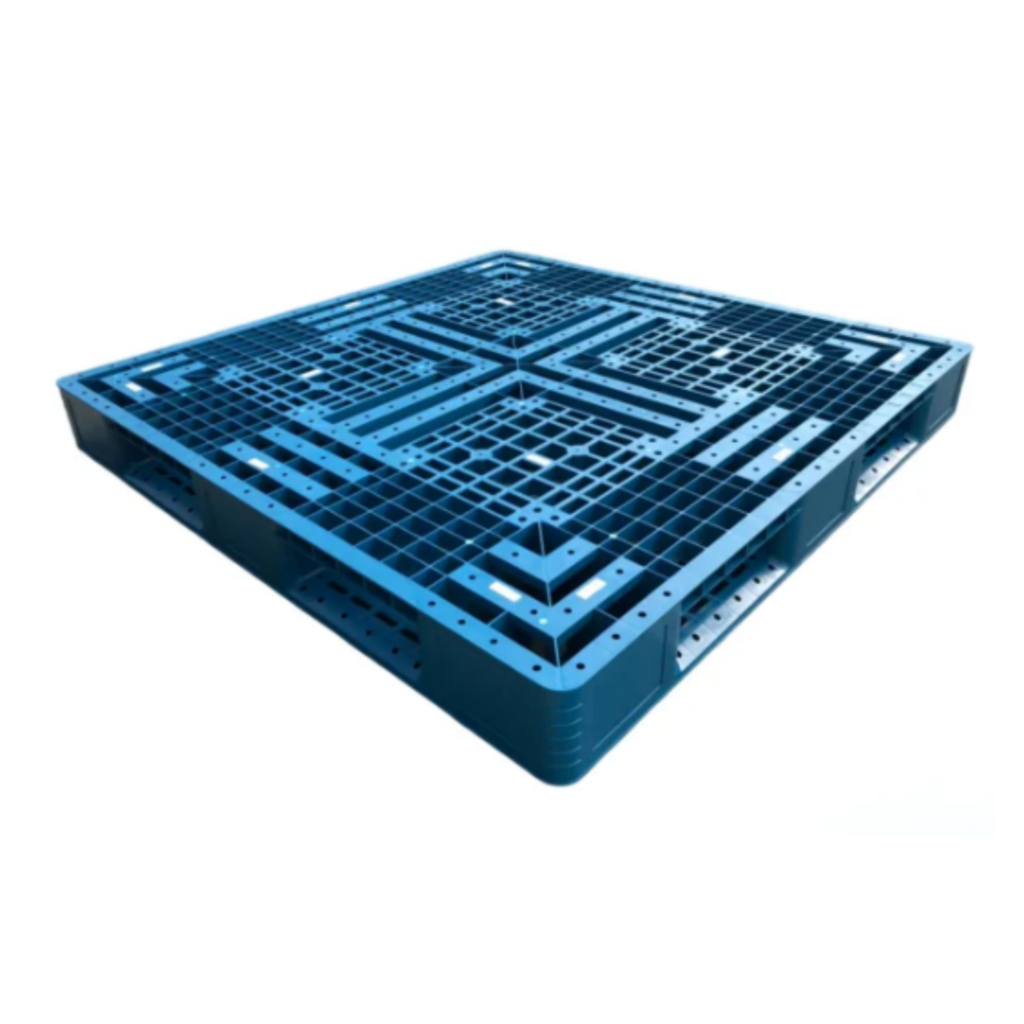
Product Specifications
| Specification | Published Configuration |
|---|---|
| Product Type | Full perimeter rackable plastic pallet |
| Dimensions | 1400 × 1400 × 150 mm |
| Deck | Vented grid deck |
| Base | Full perimeter base |
| Manufacturing | One-piece injection molding |
| Material | HDPE or PP, by confirmed configuration |
| Pallet Weight | 21.5 kg |
| Static Load | Up to 4,000 kg* |
| Dynamic Load | Up to 1,000 kg* |
| Rack Load | Up to 1,000 kg* |
| Forklift Entry | 4-way entry |
| Steel Reinforcement | Optional, configuration-specific |
| Color | Blue, black, orange, grey, or custom |
Is This 1400 × 1400 Plastic Pallet Right for Your Load?
This large-format pallet is a practical starting point when a standard footprint leaves cartons, components, bagged materials, or assembled units overhanging the deck. The 1400 × 1400 mm surface can also make it easier to keep a wide load centered and supported during forklift movement.
It is most relevant when the unit load is large rather than merely heavy. A smaller pallet with a higher published floor-load rating is not automatically a better choice if it creates carton overhang, unsupported edges, or an unstable center of gravity.
Use this model for a project where the larger footprint is needed for the product and handling route. If your operation uses standard 1200 × 1000 mm or 48 × 40 in rack locations, check the rack opening, conveyor interface, truck loading plan, and receiving-site requirements before selecting a 1400 × 1400 mm pallet.
Large Footprint for Oversized Unit Loads
The deck size matters before the load rating. A pallet should support the full carton or unit-load footprint without relying on edge overhang to reach the required count per layer.
For large cartons, bulky industrial components, wide bagged loads, and assembled goods, this footprint can reduce the need to place goods beyond the pallet edge. That improves load protection during handling and gives stretch wrap or strapping a more stable base to work from.
The vented grid deck is suited to loads that do not need a fully closed support surface. If your goods have small feet, narrow contact points, flexible bags, or sensitive packaging, provide the contact footprint and load distribution for review. A wide pallet does not remove the need to check how the load bears on the deck.
Rack Performance Depends on the Actual Rack Condition
The published rack-load value is up to 1,000 kg under specified conditions. It should not be used as a general claim for every beam rack, temperature, support span, or load arrangement.
For beam-rack storage, the pallet spans between defined support points. Beam spacing, support width, pallet orientation, unit-load distribution, storage duration, temperature, and allowable deflection can all change the result. A static floor-load rating does not establish rack performance.
Before using this pallet in racking, send the following information with your inquiry:
- Clear rack-beam span and support width
- Pallet orientation on the beams
- Gross loaded pallet weight
- Load type and whether weight is evenly distributed
- Storage duration and operating temperature
- Required maximum deflection, if your rack or automation provider specifies one
- Whether the pallet will also run on conveyors, shuttles, or stacker-crane forks
For a broader explanation of the three load conditions, see Static Load vs Dynamic Load: Plastic Pallet Capacity Explained. If the project includes a new rack layout, the plastic pallet racking guide helps identify the support details that need to be checked before purchase.
Full Perimeter Base and Handling Compatibility
A full-perimeter base gives the pallet a continuous lower support path around the edge. This can be useful for stable floor contact, compatible loaded stacking, and selected industrial storage conditions.
Forklift entry is four-way for this configuration. Pallet-jack compatibility must be confirmed with the exact pallet-jack wheel clearance and the final bottom geometry. Four-way forklift entry does not, by itself, mean that every standard hand pallet truck can travel under a full-perimeter base.
This check is especially important if your operation uses manual pallet jacks at loading docks, in container loading, or at the receiving site. Send a photo or drawing of the pallet-jack fork and load-wheel area when the equipment interface is critical.
Standard and Steel-Reinforced Configurations
Steel reinforcement is an option for projects that need additional stiffness under defined conditions. It is not a generic upgrade that allows the same load rating to be used in every rack or automation system.
If reinforcement is needed, confirm the number and location of the steel tubes, the selected material, the intended rack orientation, and the actual unit load. These details should be reflected in the technical approval and quotation for the exact configuration.
For projects with a different footprint, unusual support path, or special equipment interface, compare this model with the wider rackable plastic pallet range. A different runner layout or a custom configuration may be a better fit than adding reinforcement to a pallet that does not match the operation.
Typical Applications
This 1400 × 1400 mm full perimeter plastic pallet can be considered for:
- Large industrial cartons and assembled units
- Wide machinery components and production parts
- Distribution loads that need more deck area than standard pallets provide
- Defined beam-rack storage after support-condition review
- Reusable warehouse flows using forklifts and compatible equipment
It is not the automatic choice for every large load. Select another deck, base, or pallet type when the load requires a closed surface, hand-pallet-truck access, a different rack span, or compact empty-pallet return logistics.
What to Confirm Before Ordering
The fastest way to receive a useful quote is to provide the unit-load requirement instead of asking only for a pallet price. Include the final cargo dimensions, gross load weight, intended number of layers, and the route from loading to receiving.
For this model, the key approval points are the final material configuration, rack condition, pallet-jack requirement, steel reinforcement option, color, logo requirement, order quantity, and destination. These inputs keep the quotation aligned with the equipment and load you actually use.
Do not use generic container quantities as a buying decision for this pallet. Empty-pallet loading depends on the container type, the pallet’s actual stacking or nesting method, height limits, and loading plan. Loaded-pallet quantities depend on the complete unit-load envelope and permitted payload.
If container space is part of the decision, review how pallet size affects container utilization and landed cost. That comparison begins with the pallet and load dimensions, then checks the container and transport limits instead of relying on a fixed pallet-count claim.
Frequently Asked Questions
Is the 1400 × 1400 Plastic Pallet Rackable?
Yes, this is a rackable configuration with a published rack capacity of up to 1,000 kg under specified conditions. Confirm beam span, orientation, support width, load distribution, temperature, and duration before using it in a rack.
What Is the Difference Between Static, Dynamic, and Rack Load?
Static load applies when the pallet rests on a flat, rigid floor. Dynamic load applies while it is moved by approved handling equipment, while rack load applies when the pallet spans defined rack beams.
Can This Full Perimeter Pallet Be Used With a Hand Pallet Jack?
Do not assume compatibility from four-way forklift entry alone. Confirm the exact pallet-jack fork and load-wheel clearance against the selected full-perimeter bottom structure before ordering.
Does Steel Reinforcement Increase the Rack Capacity?
Reinforcement can increase stiffness in a defined configuration, but the resulting performance must be confirmed for the actual beam span, orientation, load pattern, and support condition. Request technical confirmation for the reinforced version rather than applying the standard-model rating.
Is HDPE or PP Better for This Pallet?
The correct material depends on the load, operating temperature, impact exposure, hygiene needs, and selected configuration. Confirm the required material in the quotation instead of assuming HDPE and PP perform the same way in every application.
Request a Technical Recommendation
Preface Plast manufactures plastic pallets for industrial storage, export, racking, and reusable logistics. Send your unit-load dimensions, gross weight, rack drawing or support span, handling equipment, destination, and expected quantity.
We will help you confirm whether this 1400 × 1400 full perimeter rackable plastic pallet is the right configuration, compare the standard and reinforced options, and prepare a quotation around your actual handling route rather than a generic load claim.