
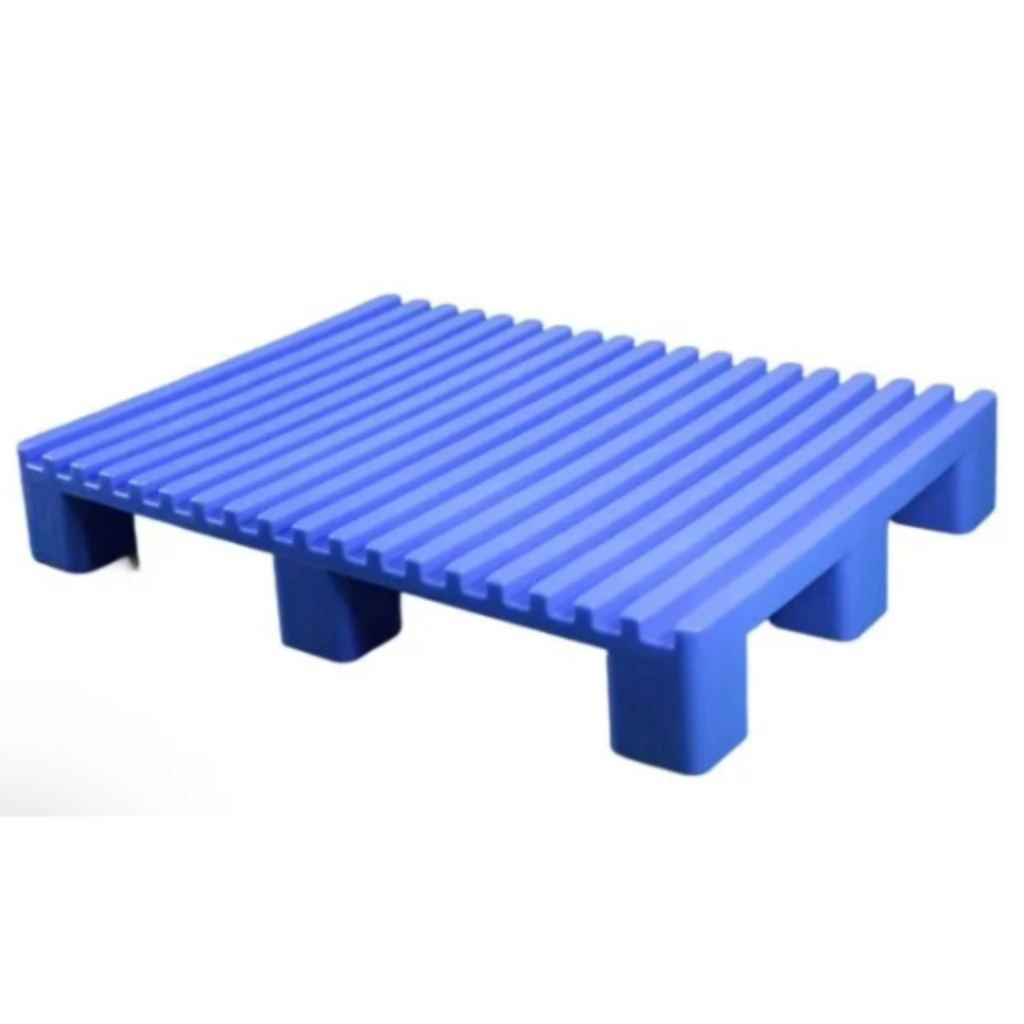
Basic Product Specifications
| Specifications | Details |
|---|---|
| Material | PP / HDPE |
| Dimensions (L×W×H mm) | 960 x 720 x 150 |
| Structure | 9 Legs |
| Top Deck | Ribbed / Slatted Deck |
| Process | Injection Molding |
| Dynamic Capacity | 1000 kg |
| Static Capacity | 1500 kg |
| Forklift Entry | 4-Way Entry |
| Pallet Jack Entry | 4-Way Entry |
| Long-Side Entry | Available |
| Application | Printing, Paper Handling, Packaging |
| Printing Industry Use | Yes |
| Reusable | Yes |
| Moisture Resistant | Yes |
| Easy to Clean | Yes |
| Logo / Printing | Available |
| Color | Blue, Black, Grey, Custom |
| Customization | Size, Color, Logo, Deck Structure |
Main Features of 960 x 720 9 Legs Plastic Pallet
1. Compact Format for Printing Areas
The 960 x 720 mm footprint is smaller than many general-purpose industrial pallets, making this pallet easier to position around printing presses, paper preparation areas, and production workstations where floor space is limited.
Its compact format can help operators organize paper loads closer to the working area without using more floor space than necessary. It is particularly suitable for plants that handle smaller paper formats or require more flexible pallet positioning around production equipment.
2. Stable 9-Leg Support Structure
The 9-leg configuration creates multiple support points beneath the deck, helping distribute the load during storage and internal movement. The structure is suitable for routine handling of paper stacks, printed products, and packaging materials.
With a 1,000 kg dynamic capacity and 1,500 kg static capacity, the pallet provides a practical load range for common printing-floor and warehouse handling requirements.
3. Multiple Entry Options
This pallet is designed around flexible handling rather than a single forklift approach. The structure supports 4-way entry, while the product specification also allows handling from the long side with suitable equipment.
The multiple entry configuration gives printing facilities more freedom when positioning pallets in production areas, especially where forklift travel direction is restricted by machinery, aisles, or workstations.
4. Lower Profile for Easier Material Transfer
At only 150 mm high, the pallet maintains a relatively low profile that can be useful when transferring paper or printed materials between pallet storage areas and production equipment.
The reduced height also helps keep the load closer to floor level during internal movement, while the open underside provides access for material-handling equipment.
5. Ribbed Deck for Load Distribution
The structured top deck uses repeated ribs to provide distributed contact points beneath paper and packaged goods. The ribbed surface combines load support with an open deck structure, helping keep the pallet practical for daily cleaning and handling.
For printing applications, the plastic deck also eliminates exposed nails, splinters, and broken wood components that can occur with aging wooden pallets.
6. Easy-Clean Plastic Construction
The molded plastic body has a smooth, non-porous material surface that is easier to clean than unfinished wood. This is particularly useful in printing and packaging environments where paper dust, ink residue, and general production debris can accumulate around material-handling equipment.
Regular cleaning helps maintain a more controlled handling environment for paper, packaging, and finished printed products.
7. Moisture Protection for Paper Handling
Paper products can be sensitive to moisture during storage and internal transportation. Unlike untreated wooden pallets, the plastic structure does not absorb water into the pallet body in the same manner.
The PP / HDPE construction is therefore well suited to printing plants, paper warehouses, and other environments where pallets may be exposed to humidity or routine washing.
8. Designed for Printing and Paper Logistics
Rather than serving only as a general warehouse pallet, the 960 x 720 mm format is suitable for material flows connected with the printing process, including:
- Paper storage
- Printing press feeding
- Printed sheet handling
- Packaging production
- Finished product movement
- Internal warehouse transfer
Its compact footprint and flexible handling structure make it practical for production environments where pallets are frequently moved between different work areas.
Applications of 960 x 720 9 Legs Plastic Pallet
Printing Press Operations:
The pallet can be used to move paper and printed materials between storage zones and printing equipment. Its compact dimensions help operators position loads efficiently around production machinery.
Paper Warehousing:
The pallet is suitable for storing paper stacks and related raw materials. The plastic structure provides moisture resistance and avoids the splinters and loose debris associated with damaged wooden pallets.
Packaging Production:
Printed cartons, packaging materials, labels, and other finished or semi-finished products can be handled on the pallet during production and storage.
Internal Material Handling:
The 4-way entry design allows forklifts and pallet jacks to approach the pallet from different directions, which is useful in production areas with changing traffic patterns.
Distribution & Storage:
The pallet can also be used in warehouses and distribution centers for temporary storage and movement of printing-related goods.
Return Logistics:
As a reusable plastic pallet, it can be incorporated into closed-loop material flows between printing plants, warehouses, packaging facilities, and distribution locations.
Customization Options
The 960 x 720 Plastic Printing Pallet can be customized to match specific printing and material-handling requirements.
Available customization:
- Custom pallet dimensions
- Alternative deck designs
- Different leg configurations
- Color customization
- Logo printing
- Identification markings
- Material selection
- Packaging solutions
For printing equipment applications, customers can provide paper dimensions, equipment requirements, or pallet drawings so the pallet structure can be matched to the actual handling process.
FAQs
1. Why choose a 960 x 720 mm pallet for printing applications?
The 960 x 720 mm format provides a compact handling footprint for printing areas, smaller paper formats, and workstations where available floor space is limited. It can help operators position pallets closer to equipment while maintaining sufficient load capacity for paper and printed products.
2. What is the load capacity of this printing pallet?
The pallet supports up to 1,000 kg in dynamic applications and 1,500 kg under static loading. Actual performance depends on load distribution, handling equipment, support conditions, and operating environment.
3. Does the pallet allow four-way forklift entry?
Yes. The pallet is designed for 4-way entry, allowing forklifts and pallet jacks to approach from multiple directions. Long-side entry is also available depending on the handling equipment and pallet configuration.
4. Is the pallet suitable for paper products?
Yes. The pallet is intended for paper handling and printing-related applications. Its plastic structure eliminates common wooden-pallet problems such as splinters, exposed nails, and wood fragments that may damage paper products.
5. Can this pallet be used around printing presses?
Yes. The compact 960 x 720 mm format can be used for paper staging, material transfer, and printed-product handling around printing equipment. Equipment compatibility should be checked according to the actual press layout and material-transfer method.
6. How is this pallet different from a larger printing pallet?
The main difference is its compact 960 x 720 mm footprint. It is designed for applications where a smaller pallet format can improve positioning flexibility and make more efficient use of production-floor space.
7. Can the pallet be customized with a company logo?
Yes. Logo marking, colors, and identification requirements can be customized. Different colors can also be used to distinguish materials, production zones, or pallet ownership.
8. Can I request a sample before a bulk order?
Yes. Samples can be provided for customers who need to verify the pallet dimensions, deck structure, handling compatibility, and overall product performance before placing a larger order. Sample freight is generally paid by the customer.