
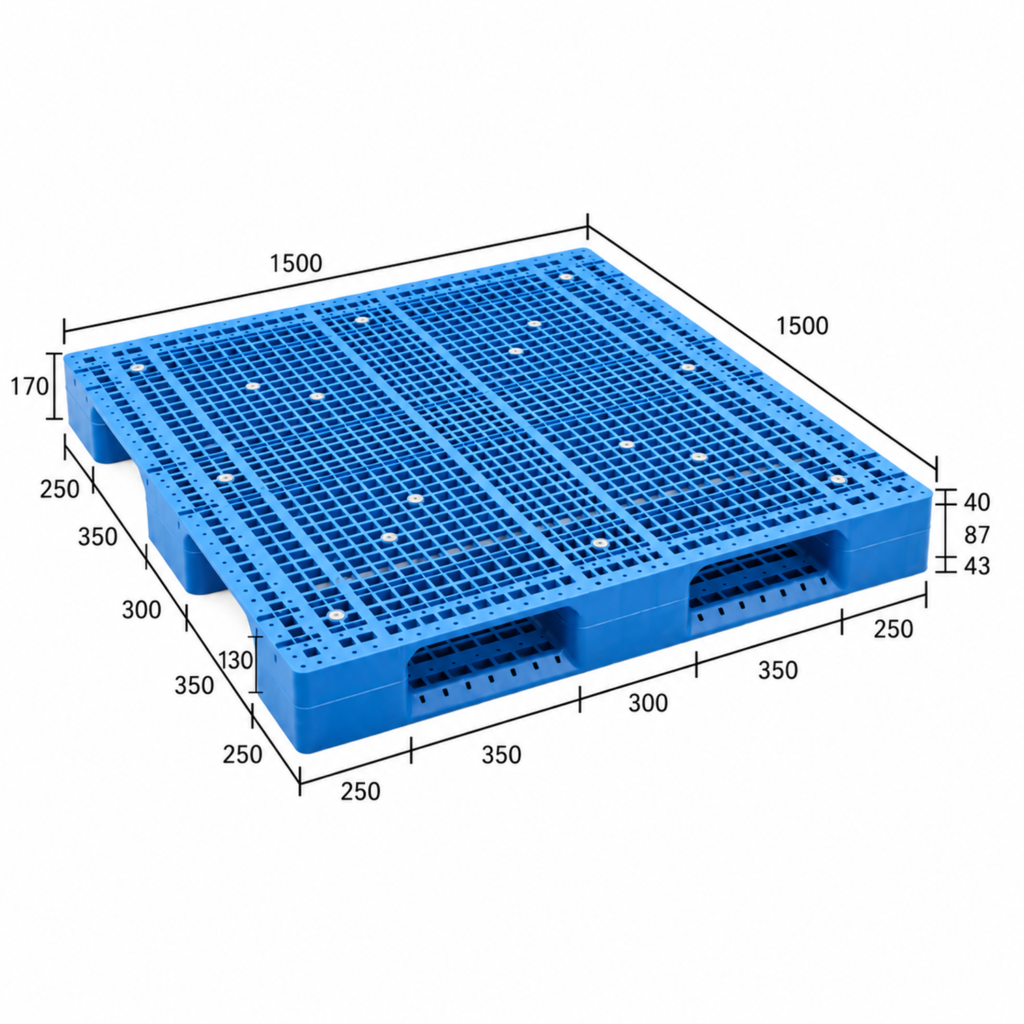
Technical Specifications
| Specification | Details |
|---|---|
| Product Model | H1515 |
| Footprint | 1500 × 1500 mm |
| Deck Area | 2.25 m² |
| Deck Type | Vented / Open Grid Deck |
| Base Structure | 3 Skids / 3 Runners |
| Construction | Welded |
| Plastic Body Weight | 31.5 kg, excluding steel |
| Steel Reinforcement | 18 steel tubes |
| Deck Reinforcement | 12 steel tubes |
| Base Reinforcement | 6 steel tubes |
| Reinforced Dynamic Load | 2,000 kg |
| Reinforced Static Load | 6,000 kg |
| Reinforced Rack Load | 2,000 kg |
Weight note: The published 31.5 kg figure refers to the plastic body only. It does not include the weight of the 18 steel tubes.
Load note: Dynamic, static and rack loads describe three separate support conditions and must not be added together.
1. 2.25 m² Square Deck for Oversized Unit Loads
The 1500 × 1500 mm footprint provides 2.25 m² of loading area. This is 1.05 m², or 87.5%, more deck area than a conventional 1200 × 1000 mm pallet.
Its square footprint also remains unchanged after a 90-degree rotation. This simplifies orientation when wide cartons, industrial containers, bagged materials or large components do not fit efficiently on a rectangular pallet.
2. 18 Steel Tubes Reinforce Both the Deck and Base
The reinforced configuration contains 18 steel tubes: 12 inside the upper deck and 6 in the lower structure. Two-thirds of the steel tubes reinforce the loading surface, while the remaining one-third supports the base and three skids.
This two-level arrangement is different from pallets that reinforce only the deck. It helps control bending across the oversized 1500 mm span while strengthening the lower structure that transfers the load to the floor, forks or approved rack supports.
3. Published 2,000 kg Rack Capacity
The reinforced pallet provides a published rack load of 2,000 kg under the stated support condition. Its rack rating is equal to its 2,000 kg dynamic capacity, making it suitable for heavy unit loads that must move between forklift handling and configured rack storage.
Rack use must still be approved against the actual beam spacing, pallet orientation, load distribution, storage time, temperature and allowable deflection. The 6,000 kg static figure must not be used as a rack-load rating.
4. 6,000 kg Static and 2,000 kg Dynamic Performance
The reinforced configuration carries up to 6,000 kg while fully supported on a flat, rigid floor and up to 2,000 kg while lifted and moved by suitable handling equipment. The published static capacity is three times the dynamic capacity.
This distinction allows you to match the pallet to floor storage, block stacking and loaded forklift transport without treating one load figure as a universal rating. Point loads and uneven cargo still require separate review.
5. Vented Deck with Three Continuous Skids
The open-grid deck promotes airflow and drainage while making the supporting structure easier to inspect. It is suitable for packaged goods that do not require a completely closed loading surface.
Underneath, three continuous longitudinal skids create defined support paths for floor stacking and compatible handling systems. Compared with a 9-leg pallet, the runners provide more continuous bottom contact. Compared with a full-perimeter base, the underside remains more open for inspection and drainage.
The welded construction joins the separately formed vented deck and reinforced three-skid base into one assembled pallet.
Typical Applications
- Oversized cartons and industrial containers
- Large bags and packaged raw materials
- Machinery and automotive components
- Chemical and manufacturing supplies
- Loaded floor and block stacking
- Defined beam-rack storage
- Factory-to-warehouse transfers
- Closed-loop industrial logistics
- Projects requiring a 1500 × 1500 mm square footprint
Frequently Asked Questions
1. How much weight can this 1500 × 1500 mm plastic pallet carry?
With all 18 steel tubes installed, the published capacities are 2,000 kg dynamic, 6,000 kg static and 2,000 kg rack load. These figures apply to different support conditions and cannot be combined.
2. Is 31.5 kg the total weight of the reinforced pallet?
No. The 31.5 kg figure is the plastic-body weight. The specification does not state the weight of the 18 steel tubes or the final assembled weight, so these values should be confirmed separately.
3. How are the 18 steel tubes arranged?
The pallet uses 12 steel tubes in the upper deck and 6 steel tubes in the lower structure. This reinforces both the 2.25 m² loading surface and the three-skid base instead of concentrating all reinforcement in one area.
4. Can this pallet be used on warehouse racks?
It has a published rack capacity of 2,000 kg in its reinforced configuration. Final approval must consider the rack type, clear beam span, support direction, pallet orientation, cargo contact pattern, temperature, storage duration and permitted deflection.
5. What does welded construction mean?
The vented upper deck and three-skid lower structure are produced as separate components and then welded together. This construction allows reinforcement to be distributed across both sections. The welded joints should be included in routine pallet inspections.