
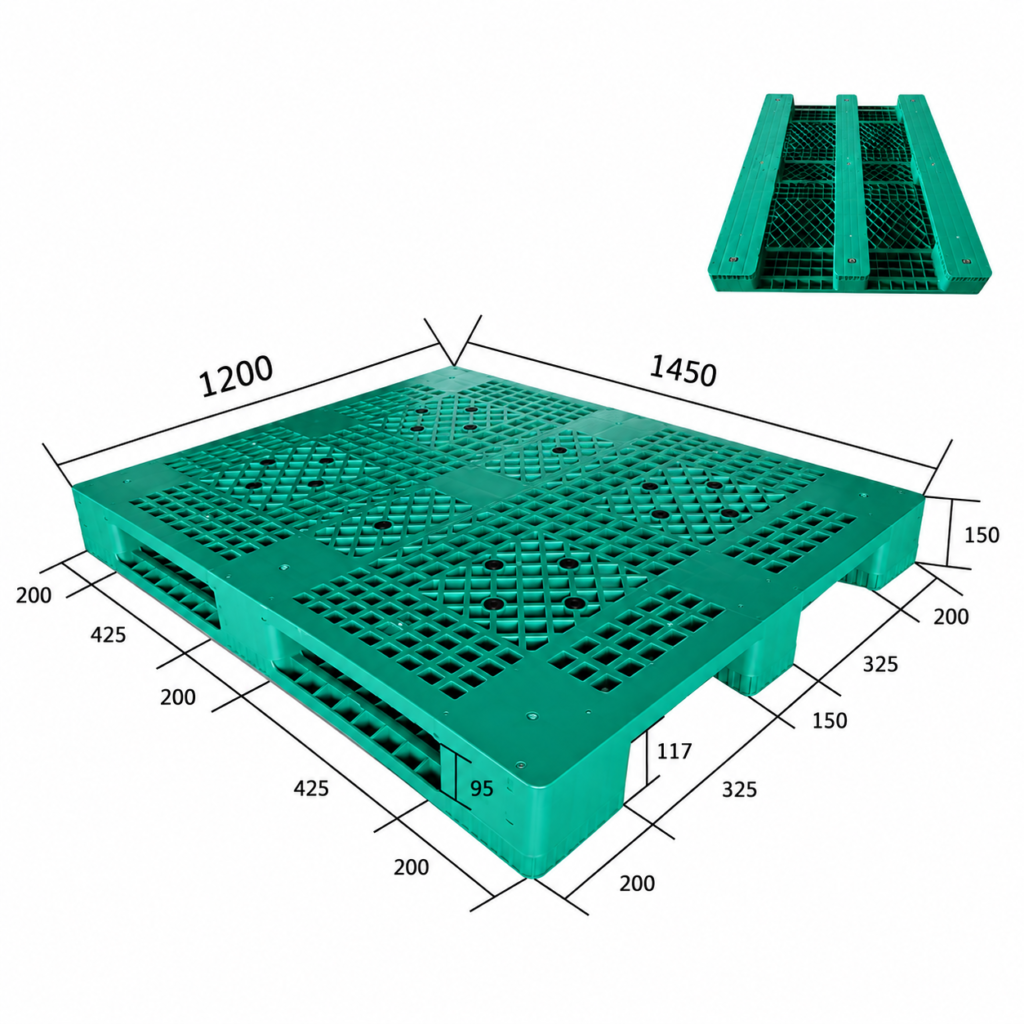
Technical Specifications
| Specification | Details |
|---|---|
| Product Model | Z14512WCA |
| Drawing Code | ENLWC14512-A |
| Footprint | 1450 × 1200 mm |
| Deck Area | 1.74 m² |
| Deck Type | Vented / Open Grid Deck |
| Base Structure | 3 Runners / 3 Skids |
| Construction | Assembled |
| Standard Color | Green |
| Plastic Body Weight | Approx. 23–24 kg |
| Steel Reinforcement | 10 steel tubes |
| Deck Reinforcement | 4 steel tubes |
| Base Reinforcement | 6 steel tubes |
| Reinforced Dynamic Load | 1,500 kg |
| Reinforced Static Load | 6,000 kg |
| Reinforced Rack Load | 1,000 kg |
Load note: Dynamic, static and rack loads describe three separate support conditions and must not be combined.
1. 1.74 m² Deck for Oversized Cargo
The 1450 × 1200 mm footprint provides 1.74 m² of loading area. This is 0.54 m², or 45%, more deck area than a conventional 1200 × 1000 mm pallet.
The additional length and width help support large cartons, industrial containers, bagged materials and components that could overhang a smaller pallet.
2. Green Color for Visual Warehouse Management
The green body makes this pallet easy to distinguish from standard blue, black or grey pallet fleets. You can use the color difference to identify a department, product category, production stage, controlled area or returnable pallet pool.
Clear color separation also helps operators locate and sort pallets inside manufacturing plants, loading areas and busy distribution centers.
3. Vented Grid Deck for Airflow and Drainage
The open-grid deck allows air and water to pass through the loading surface. This makes the pallet suitable for packaged goods that benefit from ventilation, drainage or easier visual inspection.
Compared with a completely flat deck, the grid structure also helps control plastic-body weight while maintaining a large 1.74 m² loading platform. Cargo contact points should still be large enough to span the grid openings.
4. Ten Steel Tubes Reinforce Both Structural Levels
The reinforced pallet contains 10 steel tubes: 4 inside the upper deck and 6 in the lower structure. This means 40% of the steel tubes reinforce the deck and 60% strengthen the base and three runners.
The distribution supports both the cargo-bearing surface and the lower load path that transfers weight to the floor, handling equipment or approved rack supports.
5. Assembled Three-Runner Structure
The upper grid deck and lower three-runner structure are produced as separate components and joined during assembly. This allows the deck and base to use different structural layouts while forming one complete load carrier.
The three continuous skids provide defined longitudinal support paths for floor stacking and compatible handling systems. Compared with a 9-leg pallet, the runners offer more continuous bottom contact under loaded conditions.
The reinforced configuration carries 1,500 kg dynamically, 6,000 kg statically and 1,000 kg in the stated rack application.
Typical Applications
- Oversized cartons and industrial containers
- Bagged materials and packaged raw materials
- Manufacturing work-in-progress
- Machinery and automotive components
- Ventilated warehouse storage
- Loaded floor and block stacking
- Approved beam-rack applications
- Factory-to-warehouse transfers
- Color-coded returnable pallet systems
Frequently Asked Questions
1. How much weight can this assembled pallet carry?
With all 10 steel tubes installed, the published capacities are 1,500 kg dynamic, 6,000 kg static and 1,000 kg rack load. Each figure applies to a different support condition.
2. How are the 10 steel tubes arranged?
Four steel tubes reinforce the upper grid deck, while six reinforce the lower structure and three runners. This places more reinforcement in the base that transfers the load to the supporting equipment.
3. What are the advantages of the grid deck?
The grid deck promotes airflow and drainage while reducing the amount of plastic required for the 1.74 m² loading surface. It is suitable for packaged goods with contact points large enough to bridge the openings.
4. What does assembled construction mean?
The upper deck and three-runner base are manufactured as separate components and joined during final assembly. It is different from a one-piece injection-molded pallet and from a welded pallet.
5. Can this pallet be used on warehouse racks?
It has a published reinforced rack load of 1,000 kg. Final use should match the rack type, beam span, support direction, pallet orientation, load distribution, temperature and storage duration.