
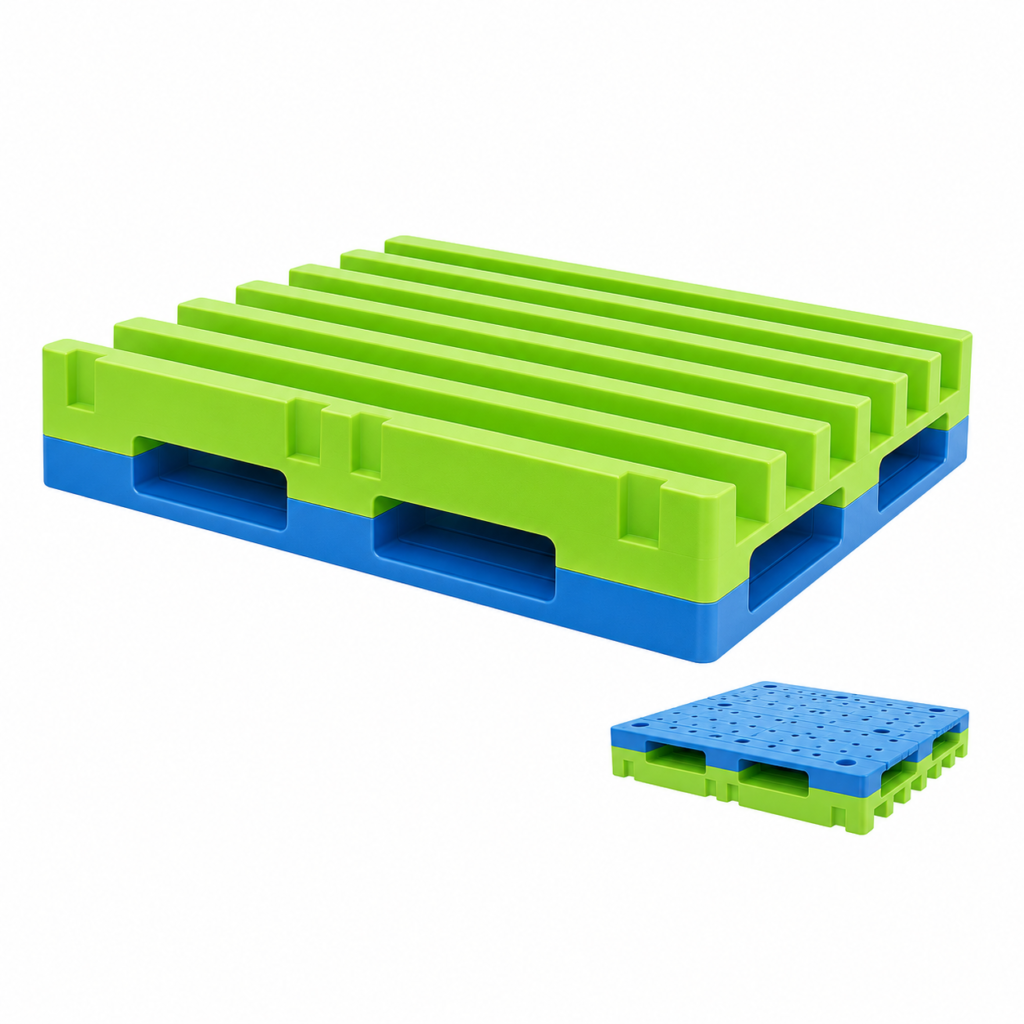
Product Specifications
| Specification | Details |
|---|---|
| Product type | Reversible / double-sided plastic pallet |
| Model | 1311 |
| Dimensions | 1300 × 1100 mm |
| Deck area | 1.43 m² per usable face |
| Deck type | Solid / flat deck |
| Special feature | Unloading-friendly deck design |
| Construction | One-piece |
| Standard reinforcement | Unreinforced |
| Optional reinforcement | 12 internal steel tubes |
| Standard dynamic load | 1,500 kg |
| Standard static load | 6,000 kg |
| Standard rack load | 1,000 kg |
| Reinforced dynamic load | 2,000 kg |
| Reinforced static load | 6,000 kg |
| Reinforced rack load | 1,000 kg |
| Shown colors | Green and blue |
Five Differences That Matter
1. Two 1.43 m² Usable Load Faces
The 1300 × 1100 mm footprint provides 1.43 m² of load area on each usable face. Its reversible construction gives you 2 load-bearing faces instead of 1.
Compared with a 1200 × 1000 mm pallet, its footprint is 0.23 m² larger, an increase of approximately 19.2%. This additional area helps support wider cartons, bags, drums and industrial packages with less overhang.
Unlike a conventional 3-runner, 9-leg or full-perimeter pallet, the lower face is not used only as a base—it can also become the upper load face.
2. One-Piece Body with Zero Assembly Interfaces
The complete double-sided body uses 1 integrated structure with 0 welded deck-to-base interfaces and 0 separately assembled load faces.
This distinguishes it from welded reversible pallets in which the upper and lower sections are manufactured separately and then joined together. The one-piece body also maintains the same overall structure when either face is used for loading.
3. Two-Sided Unloading-Friendly Design
Both load faces combine a solid support surface with an unloading-assist design. You receive the unloading-friendly feature on 2 usable sides, rather than maintaining one permanent upper surface.
The design is intended to make cargo removal easier than a conventional uninterrupted flat deck. It should be described as unloading-friendly, not as an automatic or self-unloading pallet.
4. Standard 1,500 / 6,000 / 1,000 kg Performance
The unreinforced pallet already supports three clearly separated operating conditions:
- 1,500 kg dynamic load for loaded forklift movement.
- 6,000 kg static load for floor-supported storage.
- 1,000 kg rack load for warehouse racking.
The static capacity is 4 times the dynamic capacity, while the published rack rating is 1,000 kg. These three ratings represent different operating conditions and should not be added together.
5. Twelve Steel Tubes Increase Dynamic Load by 33.3%
You can install 12 internal steel tubes when your operation requires greater capacity during loaded movement.
The reinforced version raises dynamic capacity:
- From 1,500 kg to 2,000 kg.
- An increase of 500 kg.
- A capacity improvement of 33.3%.
The published static capacity remains 6,000 kg, and the rack capacity remains 1,000 kg. The measurable benefit of the 12-tube option is therefore higher moving capacity, rather than an increase in every load rating.
Recommended Applications
Large Cartons and Industrial Packaging
The 1.43 m² solid surface gives larger cartons and industrial packages more continuous support than an open-grid deck. It also reduces the risk of smaller packages pressing into grid openings.
Bagged Materials
The flat load faces support sacks and flexible packaging without exposing the bottom layer to a ventilated grid pattern.
Drums and Rigid Containers
The continuous deck distributes contact under drums, buckets, boxes and reusable containers. The 6,000 kg static capacity supports heavy loads during floor storage.
Automotive and Industrial Components
Choose the standard version for moving loads up to 1,500 kg or the 12-tube version for dynamic loads up to 2,000 kg.
Closed-Loop Factory Logistics
The two usable faces and one-piece body suit routes in which the pallet repeatedly circulates between production, warehouse and distribution areas.
Warehouse Rack Storage
Both configurations have a published rack capacity of 1,000 kg. The 6,000 kg static rating must not be used as a rack-load rating.
Frequently Asked Questions
1. What does “unloading-assist design” mean?
It describes a deck surface designed to make cargo removal easier than a conventional uninterrupted flat surface. It does not mean that the pallet unloads goods automatically or contains a powered unloading mechanism.
2. What are the capacities without steel reinforcement?
The standard version carries 1,500 kg dynamically, 6,000 kg statically and 1,000 kg in warehouse racks. Each figure represents a separate operating condition.
3. What changes after adding 12 steel tubes?
The optional 12 steel tubes raise dynamic capacity from 1,500 to 2,000 kg. This adds 500 kg, or 33.3%, to the moving capacity. The static and rack ratings remain 6,000 and 1,000 kg.
4. Can both sides carry goods?
Yes. The reversible structure provides 2 usable solid load faces. Before turning the pallet over, clean the previous floor-contacting face if it will come into contact with sensitive packages.
5. Can the pallet be used in warehouse racks?
Yes. Both the standard and 12-tube configurations have a published 1,000 kg rack capacity. Dynamic, static and rack loads are separate ratings and cannot be substituted for one another.